

There he stands in what was once known as the Court of the Astronauts, his back to the Fountain of the Planets and facing the Unisphere. Rocket Thrower is one of a number of statues created for the Fair that had flight or space travel as a theme. The heroic-style sculpture depicts a giant throwing a rocket (in his right hand) through a network of stars (in his left). After the Fair opened in 1964, reviews of sculptor Donald De Lue’s sculpture were mixed. New York Times art reviewer John Canaday called it a “most lamentable monster, making Walt Disney look like Leonardo Da Vinci.” Time, however, treats massive public works with kindness. The Eiffel Tower received similar opprobrium when it was first built as well. DeLue is represented elsewhere in the park with a portrait of George Washington as a Freemason.
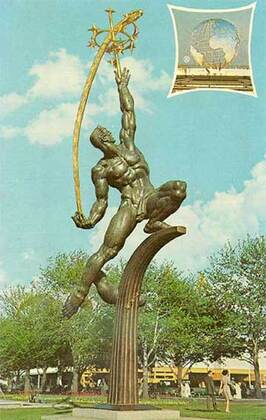
In this postcard view, Rocket Thrower appears in his original bronze finish, and gilded rocket and stars. I attended the Fair in person, but my memories have faded and are more in the abstract. The monorail, the Pieta, the feathered orange hats, the Belgian waffles, the oddly-shaped lampposts that looked like the Rubik’s cubes that followed them, nonstop plays of “It’s a Small World” and in 1964, Beatles, Beatles, Beatles on radios everywhere. When Donald Fagen had a hit with “I.G.Y.” (referencing the 1957-58 International Geophysical Year) in 1982, he wasn’t talking about the New York 1964-1965 World’s Fair in Flushing Meadows Corona Park in Queens, but with its elegiac references to now-forgotten or never-attained dreams of the future, he might as well have been.
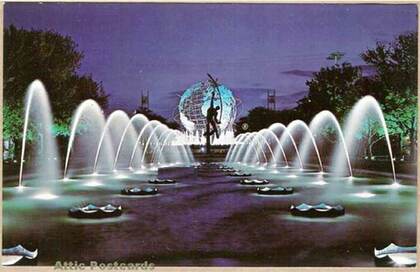
Postcard artists would sometimes take license when showing Fair scenes. The fountain beds, known officially as Fountains of the Fair, are still in place but haven’t worked in years. The position of Rocket Thrower is correct, but the twin towers of the New York State Pavilion are in the wrong spot, since they should appear to the left of the Unisphere from here.
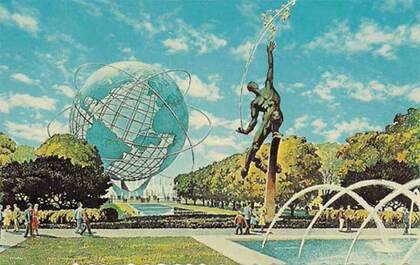
And at other times, a postcard artist would depict pure fantasy. The Unisphere doesn’t loom nearly as large at this distance from Rocket Thrower (though it’s still large) and the Thrower faces the Unisphere, not the way it’s shown here.
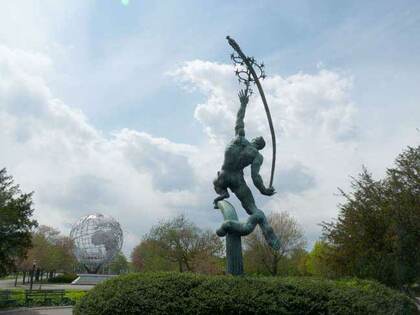
The World’s Fair was dismantled after the 1965 season, but a number of buildings and sculptures have been preserved from the Fair, such as Rocket Thrower, Hall of Science, Forms in Transit, and Freedom of the Human Spirit. The Hall of Science remains a popular attraction for kids of all ages, and the scale model of New York City contained in the old NY Pavilion is one of the city’s better-kept secrets.
The sculptures and statues, though, had been left on their own, and oxidation had its way, turning their bronze a ripe, light green. NYC Parks shored up Rocket Thrower in 2013, removing the green oxidation, repairing surface damage, and repainting the gold-leafed stars.
If you’d like to see Rocket Thrower, street coordinates are impossible, so this is an easy way to find it: From the #7 train, walk south on the boardwalk over Corona Yards and the Long Island Rail Road and descend a ramp to the Passarelle Plaza, which has a number of flagpoles and mosaic tablets surrounding it. Take the path to the left in the photo at top. Notice the yellow fire hydrants on the right as you walk the path. At the second one, turn right and walk straight ahead through the trees, skirting the playground on the left, and passing the Masonic Geoge Washington statue, also by DeLue, on the right. Rocket Thrower will soon be in view.
Sixty-one years after the Fair, I find a surreal quality to the remnants. From 1999-2019, I gave over 150 live, in-person tours for my website Forgotten New York, including five in Flushing Meadows, which were always popular. In 2014, for the Fair’s 50th anniversary, my Flushing Meadows tour was my best-attended, with 65 participants.
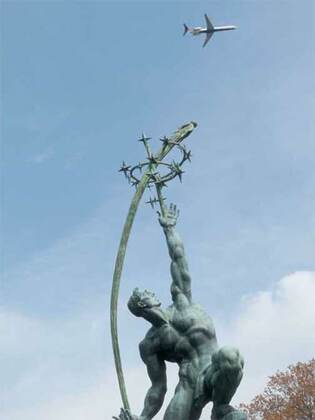
Rocket Thrower reaches for the stars and, in this case, a passing jet. I always thought he resembled Knicks standout Dave DeBusschere, though I doubt he was the inspiration, since in 1964 he was then playing for the Detroit Pistons.
—Kevin Walsh is the webmaster of the award-winning website Forgotten NY, and the author of the books Forgotten New York (HarperCollins, 2006) and also, with the Greater Astoria Historical Society, Forgotten Queens (Arcadia, 2013).