
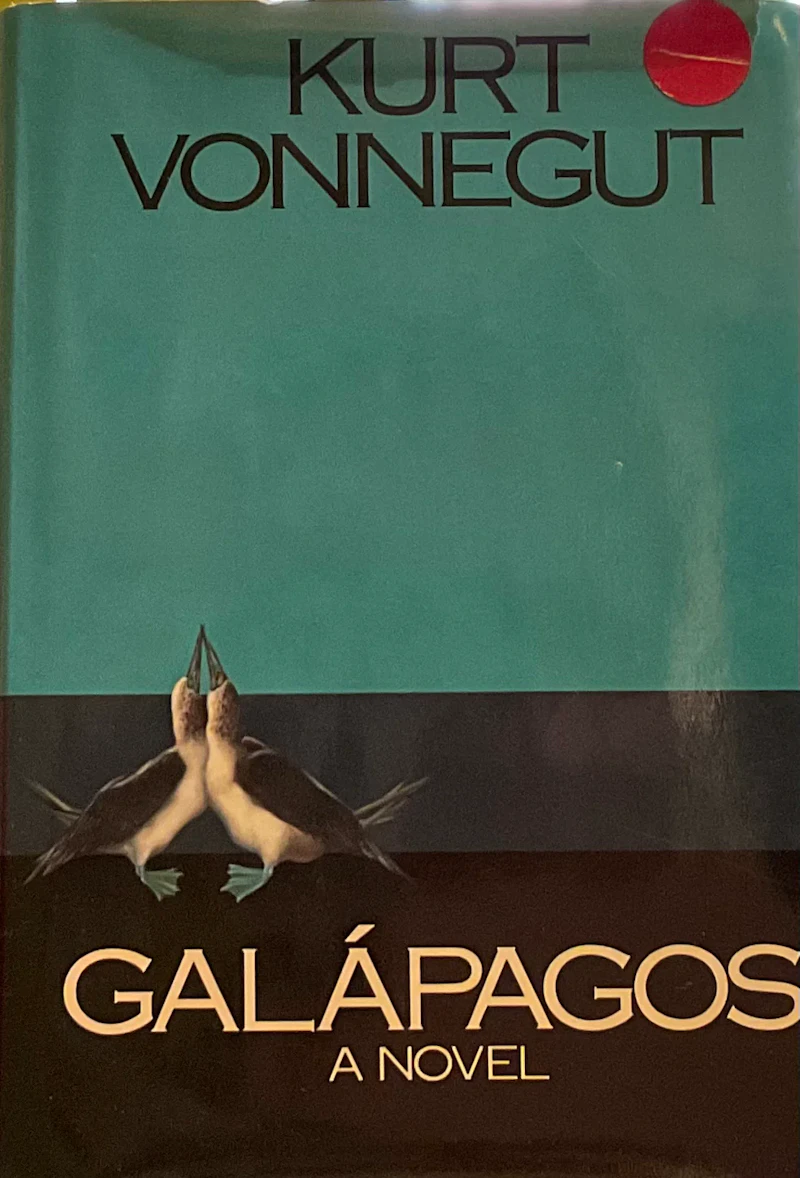
Galápagos, the 11th novel by Kurt Vonnegut, is a return to form. Specifically, a return to the literary form Vonnegut used in novels like Cat’s Cradle and Breakfast of Champions: a complex web of seemingly-random actions resolving into a series of heavily-foreshadowed events described by a wry narrator.
Published in 1985, Galápagos has war, an economic apocalypse, and a species-ending plague as background to its main story about a group of people in Ecuador bound for an unlikely cruise to the Galápagos Islands. Local consequences of apocalyptic global events get in the way. Some people die. Others, we know from early on in the story, don’t.
We know because our narrator speaks from a million years in the future, when human beings have evolved into small-brained white-furred semi-aquatic creatures who live on the Galápagos Islands and have an average lifespan of 30 years. The seemingly-omniscient narrator also gives us the backgrounds of various present-day characters and describes their mental states; part of the fascination of the book is figuring out who this narrator is, and how he knows what he knows.
The answer’s a pleasant surprise to longtime readers of Vonnegut’s fiction, and one of a series of references to his other works and the extended Kurt Vonnegut conceptual universe. There’s a character from Midland, Ohio (last seen destroyed by a neutron bomb in Deadeye Dick) and another from Ilium, New York (Slaughterhouse-Five). Ideas from earlier books are revisited; a computer that records and plays back the work of human craftsmen, for example, is something Vonnegut explored in his first novel, Player Piano.
Above all we see the familiar Vonnegutian structure, with a main story almost overwhelmed by heavy foreshadowing and digressions illustrating character. Plot is secondary, though well-crafted. Characters want things, and struggle to get them, and their actions bring them into some kind of meaningful conflict. But it’s also all beside the point, because in the long run human beings evolve into seals and there’s nothing anyone can do about it, for better or worse.
As before, Vonnegut breaks his chapters up into sections of a few paragraphs, emphasizing the mosaic nature of the book. As before, he plays about with typography, in this case inserting an asterisk before the name of any character who’ll soon die. But if he’s doing familiar things, there’s a new energy.
Having satirized elements of American politics and life in those books (Watergate in Jailbird and guns in Deadeye Dick), he digs deeper here. He challenges the social values of corporatism and technological triumphalism, as he did for decades. But beyond that, setting the book in and near the Galápagos Islands lets him rewrite Darwin and challenge the doctrine of survival of the fittest.
It’s not just that he dispenses with Social Darwinism (always based in a distortion of Darwin’s thought). And it’s not just that he returns to his old theme of what to do with the people who are useless in the eyes of society or nature. Vonnegut challenges the idea of what evolution is, and what “fittest” means.
A million years from now humans have become semi-intelligent seals. Is that evolution, or devolution? Most people would immediately say the second. The narrator argues for the first. It all depends on your values, and where you stand.
People who look fit may have genes that’ll bring on blindness, or madness, or early death. What’s bred in the bone is not always visible to the eye, though it comes out in the flesh. Flaws are inherent to humanity. And randomness plays a big role in who lives to reproduce; Vonnegut makes a point here that the precise constitution of the group of castaways who beget future humanity is defined by sheer blind chance. In this book “the sun was going down on a world where so many people believed, a million years ago, that only the fit survived.”
Hidden genetic flaws tie in with one of the book’s other major concerns: secrets and hidden things. Brains hide things, from themselves and from other people. The narrator goes on about the “big brains” that people had in our time, and the dangers those brains posed. Falsehood becomes a way of life; thus public relations. Is it really bad to evolve away from the ability to lie? Or indeed away from the ability to use words, that most equivocal kind of communication?
You might think a novelist would be wary of evolving away from language, but another theme of the book is the untrustworthiness of words. Characters use language to lie, they speak different languages, they use a machine to call up ironically inappropriate quotations from world literature. It all too often gets in the way of truth and communication, and language becomes a part of that mess of randomness that produce the future of a million years from now.
Fascinated by inevitability in earlier novels, Vonnegut here gives us a future shaped by small actions that have large effects. The narrator tells us again and again how nearly things turned out differently. Chaos theory was still a fairly abstract scientific idea in 1985, but the butterfly effect had been named in 1972, and in 1951 Ray Bradbury had published a science fiction story called “A Sound of Thunder” that toyed with the same ideas.
Vonnegut’s incorporating new ideas into his vision of inevitability, picking up on concepts that’ve become more important over the 40 years since the book was first published. There’s a new narrative vitality here, and a deepening of his themes. Vonnegut continues to change with Galápagos. It’s a return to his old form, but with a more profound approach to his ideas. Like humanity at large, Vonnegut evolves.