

Bayside, in northeast Queens, was first settled by the British around Alley Creek, the East River inlet now leading to Alley Pond Park, in the early-1700s. It was first named Bay Side in 1798 and by the time the one-word spelling appeared in the 1850s, it was a small but potent community, giving rise to governmental leaders and statesmen.
The neighborhood has always retained a small-town atmosphere centered around Bell Blvd. The street’s named for Abraham Bell, an Irish Quaker who was a partner in a shipping firm and owned a vast farm in the area, and has nothing at all to do with Alexander Graham Bell, the inventor who obtained the first patent for the telephone. The city, however, has added to the confusion by naming P.S. 205, as well as its playground at 75th Ave. and 217th St. (a couple of blocks from the boulevard), Bell Park and later, Telephone Park, in honor of the inventor.
Today, Bell Blvd.’s “business and entertainment” stretch runs from 35th Ave. south to Northern Blvd. History and commerce run together here: Queens’s first White Castle appeared at the northwest corner of Bell and Northern Blvd.’s in the 1930s, and has been there to the present day, albeit with a modern rebuild. A mix of culinary attractions and architecture awaits you during a stroll down this interesting thoroughfare.
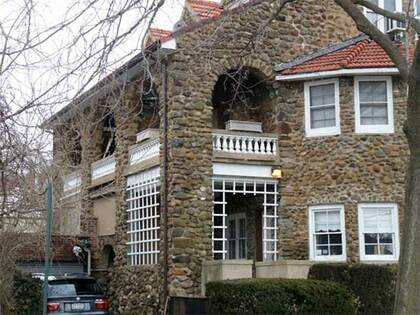
Queens isn’t short on cobblestone-fronted buildings—such as the Elmhurst Baptist Church at Whitney Ave. and Judge St., a building on Cherry Ave. in Waldheim, Flushing, and a partial cobblestone façade on a Pre-K center on 37th Ave. and 223rd St.—but this one, at 35-34 Bell Blvd., is the borough’s most notable. It was declared a NYC landmark in October 2004.
The house was built in 1906 and, according to local legend, it housed a speakeasy during Prohibition. Utahan actress Maude Adams (1872-1953), who had the title role in more than 1500 performances of Peter Pan, is thought to have lived in the house during her Broadway days.
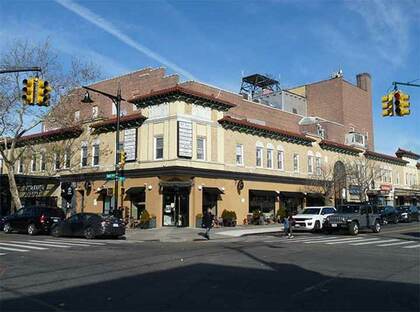
The former Bayside Theatre on the northeast corner of Bell Blvd. and 39th Ave. opened in 1927 as the Capitol Theatre, designed by prolific theater architect Thomas Lamb. It was closed during much of the Depression, but reopened in 1941 as the Skouras Bayside Theatre. The reopening was a gala affair that featured stars of stage, screen and radio, such as stage actors Patti Pickens and Rob Simmons, singer Bob Douglas, and the movies’ Erick Rhodes, who often served as the foil in Fred Astaire-Ginger Rogers pictures.
The theater closed in October 2001. The last features were Zoolander, Don’t Say a Word, Tortilla Soup and Rush Hour 2.
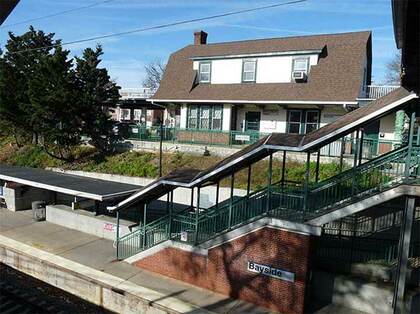
The present Bayside Long Island Rail Road station house is a gambrel-roofed structure dating to 1923. In those days, station agents and their families lived at their stations; the family quarters were on the second floor. When it was built, the Port Washington branch still ran on the surface, but it was placed in its present open cut here in 1927.
A railroad has run here since 1866, when the Flushing and North Side Railroad, operated by Elizur Hinsdale, ran east through Bayside to Great Neck (Port Washington wasn’t reached till 1896). It became a part of the LIRR, then owned by rubber magnate Conrad Poppenhusen, in 1876. On the Manhattan-bound side, Ed McGowin’s “Bayside Story” sculptures portray historical Bayside scenes. Notable is a raised boxing glove, honoring the still-standing home of late-19th-century heavyweight champion “Gentleman Jim” Corbett.
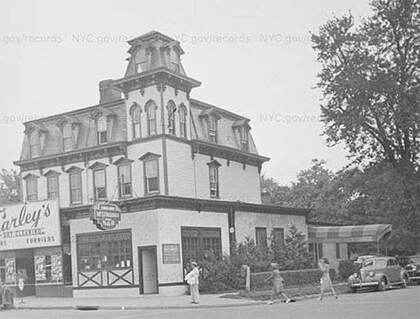
The one-story brick building at the NE corner of Bell Blvd. and 43rd Ave. is late-20th century Functional, but here used to stand the lively French Second Empire Straitton-Storm Cigar Factory, constructed in 1872 and was a factory though it didn’t look like one. Just to the east, a group of attached worker’s housing also stood; in the era, many manufacturers built “company towns” for their employees, as William Steinway (pianos) and Lalance-Grosjean (kitchenware) did for their workers in Astoria and Woodhaven. All trace of Bayside’s smoky past has vanished. The company produced White Owl cigars.
—Kevin Walsh is the webmaster of the award-winning website Forgotten NY, and the author of the books Forgotten New York (HarperCollins, 2006) and also, with the Greater Astoria Historical Society, Forgotten Queens (Arcadia, 2013)