
(This is the third in my three-part vintage Christmas series—part one and part two.)
I’ll admit to my passion and partiality to mid-century Christmas décor—but that’s not why I did this three part series. If you want to read about 1980s and 90s ribbons-and-Radko décor, you won’t find it here.
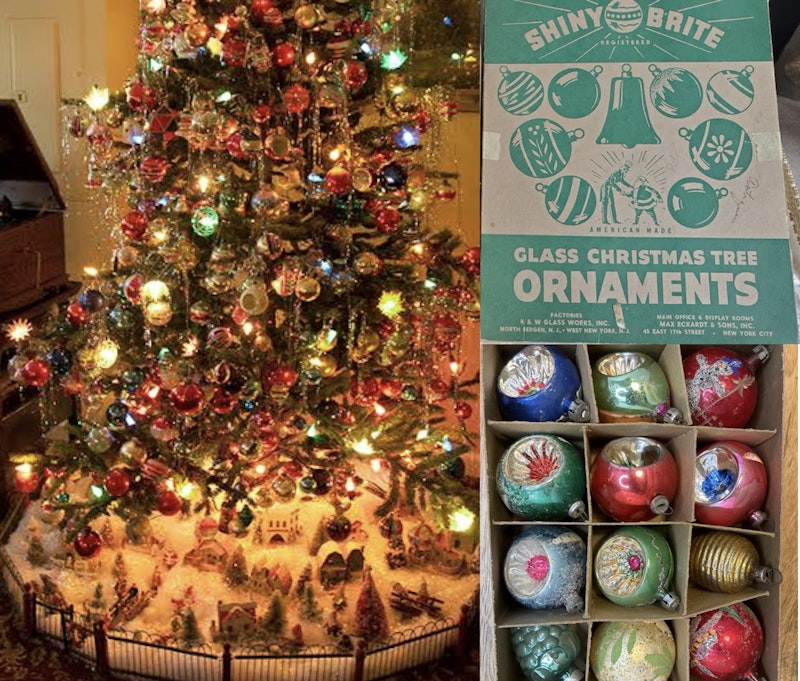
Once the delicate, handmade, pricey glass ornaments from Europe bedecked American trees, a new chapter of Christmas décor opened in the 1940s and 50s. The holiday spirit was mass-produced in the best way thanks to American company Shiny Brite, founded by German-American immigrant Max Eckardt, partnering with Corning Glass Works to turn light-bulb glass production lines into festive ornament-making factories. Corning was soon cranking out hundreds of thousands of clear glass balls daily, which were then silvered, lacquered, hand-painted, and shipped across the country.
By the 1950s, Shiny Brite ornaments came in a variety of shapes: bells, icicles, teardrops, pine cones, and “Japanese lanterns” and reflectors. Colors exploded too—bright red, green, shimmering gold, frosty silver, pink, blue, and striped or ombré finishes. To identify a vintage Shiny Brite, look at the cap: older ones had crimped metal tops stamped “SHINY BRITE—Made in U.S.A.”; WWII-era versions sometimes used cardboard caps due to metal shortages—which makes them extra collectible among holiday decor sleuths.
The mid-century Christmas aesthetic stretched beyond fragile bulbs. Enter ceramic figurines, handmade trees, and imported ornaments, especially from Japan—many from makers like Napco and Lefton. These pieces ranged from tiny Santa figurines to whimsical nativity sets and stylized holiday mugs and plates. Some may show up in thrift shops or estate sales now, worn but still carrying that mid-century charm.
Often, ceramics were more affordable, safer alternatives to delicate glass. For households with kids, pets, or a general lack of careful decorators, plastic blow molds or ceramic trees offered a way to get holiday cheer without shards. Blow-mold lawn Santas, plastic reindeer, small ceramic (or cardboard) villages, nativity sets, and holiday mugs became part of the broader mid-century holiday-scape. Even as plastics and ceramics rose, people still combined them with Shiny Brite ornaments, mixing fragility and fun.
By the late-1950s, some families got tired of mess, needles, emptying water stands, and falling pine needles. So when the Aluminum Christmas tree appeared (first manufactured in 1958), many took the bait. These trees, with their foil-branch “needles,” offered a clean, shiny, low-maintenance alternative that screamed modern. Often a rotating color wheel under the tree would cast shifting hues against the branches, creating a glowing, futuristic centerpiece.
Tinsel made a comeback too. Where once there might’ve been homemade popcorn strands, now trees dripped with metallic icicles. Tinsel shimmered, lights blinked, and ornaments gleamed, all designed to catch and reflect light. For lighting, many early adopters still used bubble lights—those mesmerizing liquid-filled tubes that bubbled when warmed. Under the glow of bubble lights, shiny ornaments and tinsel took on a storybook shimmer.
Mid-century holiday decor wasn’t only about trees. These decades were also when holiday entertaining, festive dinners, and themed parties took shape. Homes were decorated not just for the kids, but for gatherings. Dinner tables decked out in matching holiday china, ceramic Santa mugs, little ceramic reindeer or snowmen figurines, maybe even a blow-mold centerpiece.
Music was styled by crooners singing about snow, or big band versions of “Silver Bells” (released in 1951). Food included Jello molds shaped like Christmas trees, shiny aluminum trays filled with hors d’oeuvres, maybe deviled eggs and a tuna-salad ring. Anyone calling it tacky or gaudy could be considered boring.
“Ralph Lauren Christmas” be damned when so many people look back fondly on this era. Vintage Shiny Brite ornaments, aluminum trees, ceramic Santas, old blow molds—aren’t only collectible but bring a tidy sum at auction. Modern decorators who love the mid-century spirit deliberately mix a few original vintage pieces with safer modern reproduction equivalents to evoke that feeling without worrying about breakage or disposal.
There’s something honest and charming about a mid-century holiday mood. It’s not trying to be solemn or traditional. It’s dazzling and often messy, but it’s unapologetically joyous. There’s optimism: “We built homes, we came home from war, we got those babies seated around the table—we’re putting a shiny aluminum tree in the corner and decorating it in every color.”
It’s a style that says Christmas can be fun, loud, glittery, cozy—and still warm. Dig through attic boxes. Go to estate sales. Hunt flea markets. You might stumble on a faded Shiny Brite box, a ceramic Santa head, leftover blow mold, or an old box of tinsel. When your tree twinkles a bit brighter, know you’re participating in a slice of vintage American holiday history.