
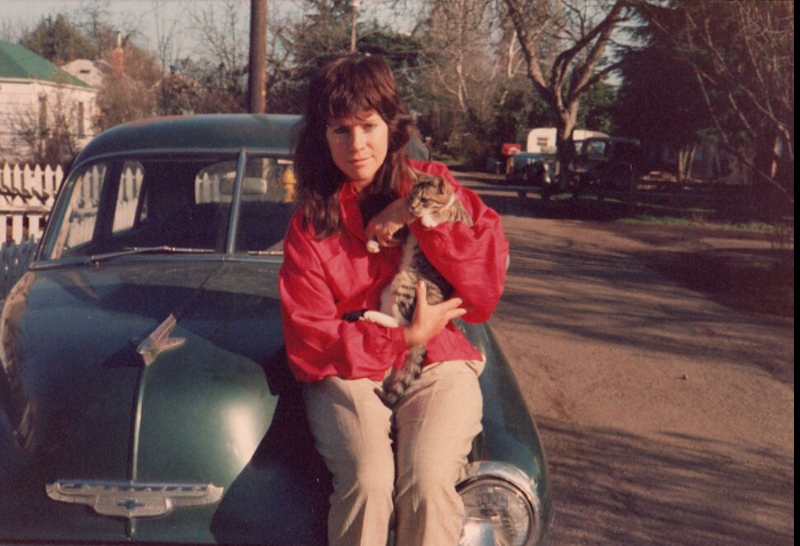
It’s impossible to read Jan Kerouac’s Baby Driver, just re-issued from New York Review Books, without her father’s literary reputation looming over her, which is too bad, because it’s a raw memoir from a person who had an interesting life of her own. Jan Kerouac reminds us a few times in the book of her lack of connection to her father, who basically refused to acknowledge her, except for child support payments. And that current of sadness runs throughout the book.
Kerouac splits her memoir into alternating time lines. She starts when she’s 15, on the road in Mexico, with later chapters back to Santa Fe, and then Mexico again and points south. The second chapter and subsequent timeline shifts to her childhood, mostly in New York City, up into Kerouac’s troubled teen years. This timeline split is interesting because the cut-off point, the childhood-to-young-adulthood switch happens shortly after she reads her father’s book On The Road while in juvie hall. Her reaction, at least looking back on it as an adult, is unintentionally heartbreaking:
I read it all in one night instead of ringing for a Seconal. And I was happy to know that my father’s thought patterns were so similar to mine. Also, now that I had a picture of what he’d been doing all this time, all over the country, it made more sense that he hadn’t had time to be fatherly.
This is Jan Kerouac bending over backwards to say kind things about her parents when there’s more than enough evidence for some justifiable rage. But shortly after this is when she takes off with a new boyfriend to Mexico and though she doesn’t specifically state it, nor may even herself realize it, reading her dad’s book was the permission to get out of New York and start living her own life. I like to think his book was a letter to her.
Reading On The Road might’ve been enough, but before she leaves, Jan Kerouac visits her father for their second and final meeting:
To which he replied, surprisingly, “Yeah, you go to Mexico an’ write a book. You can use my name.”
So he gives his blessing. Or, on his alcoholic downhill slide, maybe a curse. No denying her father was a deadbeat dad, painful to say, since he’s such a huge influence on me, both with writing and living life. But all of our heroes are flawed. The Buddha was a deadbeat dad too. I guess that’s love—loving them despite their flaws. More interesting to consider Jan Kerouac’s mother, Joan Haverty, whom she describes as having a “charming aura of chaos and disorder.” Surely it wasn’t easy to raise four children on her own, after marrying two seemingly-interesting-but-actually-loser husbands, and Jan Kerouac, the memoirist looking back years later, praises her.
But one huge decision seems awful—apparently back in the 1960s in New York City, one parent, with one call, could have four uniformed guards from Bellevue Mental Hospital come and carry off a troubled teen, to lock her away with other troubled teens, none of them with any serious mental problems. And locking up a bunch of angry teen girls together is never going to come to anything good. Here’s a glimpse at what her life was like:
There was also a crop of new girls that returned with us every week. One was a blond girl, so blond and fair that I was afraid for her. To make matters worse, when she opened her mouth to answer the inevitable, “Whaddyoo in foah?” she answered, “For runnin’ away,” a Southern drawl. When I heard that, I knew she was a goner. The poor girl couldn’t have picked a worse direction to run. All the black girls at Spofford had grown up listening to their parents and grandparents tell horror stories about their escapes from lynch mobs, and other raw deals suffered at the hands of Southern whites. But this generation up in New York had seldom, if ever, had a chance to see a real live “cracker.”
Now one had been dumped in their laps, made to order for revenge. I could see them almost drooling in anticipation as they closed in around her, shooting out steely questions to which there was not right answer. Then came threats, followed by insults, and finally the blows, sickening smacks and thuds, and her helpless screams. The rest of us, a weak minority, sat there gritting our teeth and swallowing our hearts. The burly matrons waited a long time to sound the alarm; this was a choice spectacle indeed.
On the other hand, Jan Kerouac was kind of out of control—dating 19-year-old guys when she was 13, and doing (later selling) all kinds of drugs, including heroin. If that sounds unbelievable, these teen year chapters of Baby Driver remind me of The Basketball Diaries by Jim Carroll, who was doing all the same crazy shit when he was 13, around the same time in New York. The only time Jan or her mom had peace is when they moved to Washington state, though even then her mom was a hoarder.
Jan Kerouac's adventures in South America in highlight how the “on the road” experience can be very different for men and women. Jack Kerouac and his friends, young American white dudes, could drive into town and drink, smoke pot and fuck prostitutes, and even park their car in the middle of the jungle to sleep, without fear. Jan, alone, has to be more careful, unless she comes under the protection of the one of many dubious men she hooks up with. But, she stays longer in places, connects with people from those countries, really live the life and not just experience a foreign country as a place to party.
Her choices with men (and women) are the hardest parts of the book. Almost always bad choices, especially since she’s sometimes using them for protection, transport, or a place to stay. Her worst decisions happen in Santa Fe when, out of poverty, almost “on a lark” she falls into prostitution. She doesn’t regret this, claims it as fun, and good money, and she met some interesting women. Hard for this reader to believe that, and not coincidently this period is the one where her minute sense of detail fails her.
When she’s looking back on her life, she concedes, “[I] just had to learn not to take advantage of people. Had to rely on myself.” A good lesson, though she qualifies that thought in the same paragraph, sounding a little like her father: “I might have been more responsible, less happy.”
