
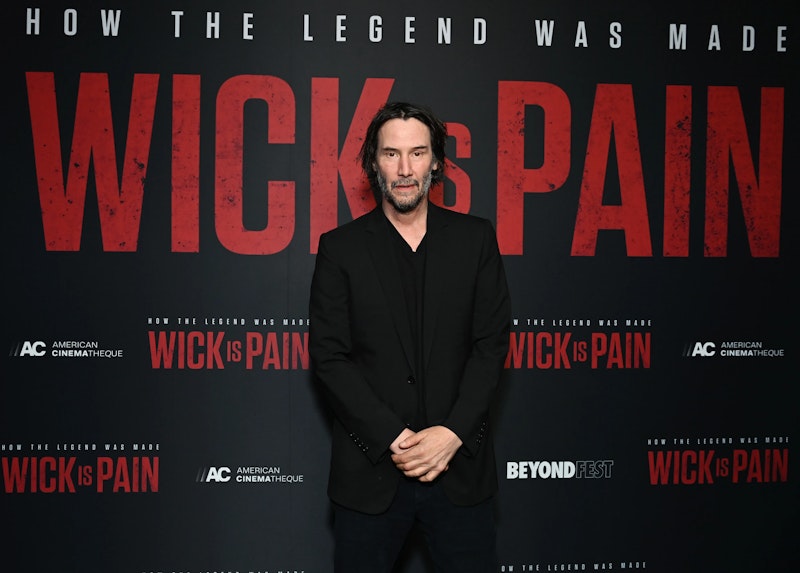
The purchasing of physical media has turned into a performative endeavor aimed at those with the disposable income to invest in their archives. Wick is Pain would’ve likely have been included in a four-pack Blu-Ray release of the John Wick franchise had the market been in the same place it was a decade prior, but it's now more logical to debut the 126-minute documentary as its own release. What’s fascinating about Wick is Pain is that it isn’t an extended marketing video on behalf of 87North, the production company behind John Wick and many other recent action films. It’s a damning portrayal of the erratic conception of the franchise.
The story behind the creation of John Wick has become a bit of a legend, especially when considering how radically it has influenced action films since its debut in 2014; in the same way that post-Die Hard films could be pitched as “Die Hard on a (blank),” there are many stars who currently go through extensive stunt training in hopes of having their own “John Wick moment.” Although the script for John Wick was a spec by screenwriter Derek Kolstad, it was developed and directed by former stuntmen Chad Stahelski and David Leitch, who sold their longtime collaborator Keanu Reeves on using it as a comeback vehicle. Stahelski had become one of the industry’s most reliable stuntmen, particularly after he doubled for Reeves in The Matrix trilogy. Leitch earned attention as a stunt coordinator, including star vehicles for Jason Statham and Sylvester Stallone.
The raw footage that was preserved from the making of the first John Wick is miraculously candid. Beyond the multiple instances in which financing was shut down and foreign investors threatened to drop the production, it was clear that Stahelski and Leitch were two veteran second-unit directors with little-to-no eye for story. Although Reeves seemed to be at ease during rigorous action set pieces (including the “Red Circle Shootout”), Stahelski and Leitch are flummoxed as to how to generate sympathy for their protagonist.
Wick is Pain never would’ve been released had the film not panned out; John Wick was saved from a potential direct-to-VOD release when word got out that it had done something unprecedented with its mix of East Asian fight choreography, contemporary action, and mythology of characters and secret societies. However, the documentary does point out how unclear the authorship of the franchise was, given that Leitch and Stahelski had a fallout after the first film was completed. Stahelski’s improvisatory, impressionistic approach to filmmaking marked a sharp contrast to Leitch’s aptitude for extensive storyboarding and rehearsal. Although the success of John Wick is largely attributed to Reeves, Wick is Pain is a suggestion that he perhaps didn’t get enough credit for being the synthesis between two discordant voices.
It’s when Wick is Pain is expanded beyond the initial wave of John Wick enthusiasm that it's established as a legitimate documentary, and not just bonus content. The split between Stahelski and Leitch led the two filmmakers down very different careers; Stahelski stuck around to direct three John Wick sequels, and Leitch took a shot at bigger endeavors like Fast & Furious Presents: Hobbs and Shaw, Atomic Blonde and Bullet Train. Even if Wick is Pain is evenly handled in its opinion of both directors, their respective track records are indicative of who came out on top; Stahelski was able to continuously innovate by expanding the scope and influences of each John Wick sequel, whereas Leitch was forced to apply his technical brilliance to middle-of-the-road Hollywood fare.
Wick is Pain doesn’t end with a sizzle reel of 87North’s next wave of releases because the company’s future is unclear. It’s no coincidence that, for Leitch, his best film to date (The Fall Guy) was considered a box office bomb, and his most successful was the unremarkable Deadpool 2. Stahelski may have pulled off a winner with John Wick: Chapter 4, but authorship of the series is so tied to Reeves that it's hard to imagine the franchise continuing in a meaningful way when the 61-year-old actor retires. Earlier this year, the spinoff From The World of John Wick: Ballerina (which Stahelski is rumored to have ghost-directed) exemplified the challenges of a John Wick expanded universe. Although its fight scenes were better than nearly any other Hollywood film this year, there was a Reeves-sized dearth of charisma at its core.
87North’s legacy may be the impact it had in the industry’s perception of stunt artists. Other stunt artists have made the leap to filmmaking, including Chris Hemsworth's former double, Sam Hargrave, who directed the Aussie star in the two Extraction films for Netflix. As was the case with Die Hard, many of the John Wick knock-offs are accomplished; Speed is a pretty great version of “Die Hard on a bus,” and similarly, several actors have followed Reeves’ trajectory in their own neo-noir revenge thrillers, including Jason Statham in The Beekeeper, Dev Patel in Monkey Man, and Liam Neeson in Cold Pursuit.
The closest thing 87North currently has to a John Wick replacement is the Nobody series, which was also written by Kolstad. The plot’s nearly identical to John Wick, with the distinction that Bob Odenkirk’s Hutch Mansell is a family man who has to balance parental responsibilities with covert black-op missions. This summer’s Nobody 2 made it clear that Odenkirk had managed to apply the off-kilter style of humor he developed with Mr. Show to a predictable “blood and bullets” exploitation that made for an entertaining 90 minutes. Should 87North find more stars like Reeves and Odenkirk, the company will be in good shape.