
The French hold on to whatever they can in the international contest for cultural supremacy. They have the largest library in the world (La Bibliothèque Nationale), the largest operatic stage (at first the old Opera Garnier, now Opera Bastille), the largest palace (Versailles), the largest museum (the Louvre), the largest number of sauces, wines, cheeses and most refined desserts. Plans are underway for Le Grand Paris which will be the largest, or at least one of the largest cities in the world. The boundaries of Paris will one day rival the size of London.
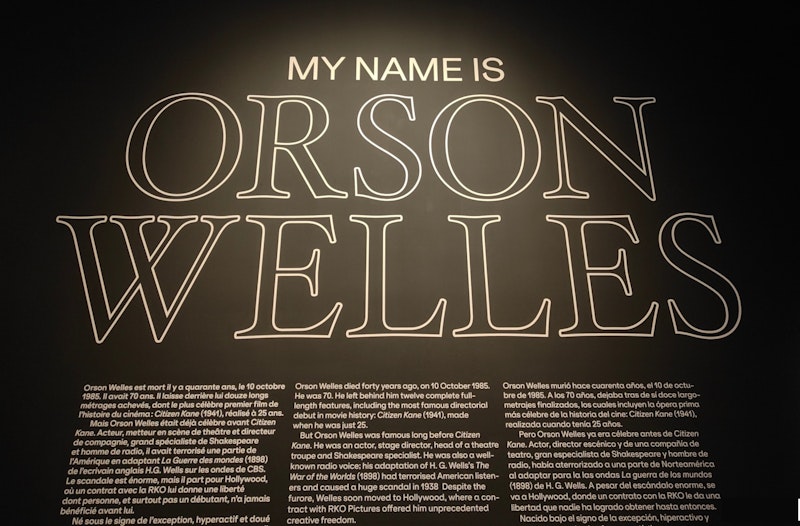
It shouldn’t come as a surprise that the Cinematheque Française, arguably the greatest (if not the largest, MOMA and the Library of Congress have more reels but these aren’t exclusively movies) film museum in the world, is currently hosting the largest exhibition ever on Orson Welles. Welles was an Honorary French Citizen, recipient of the Legion of Honor and longtime client at Maxim’s, one of the world’s most acclaimed restaurants.
The exhibition takes up the entire fifth floor of the museum and covers all his films and much of his theatrical and radio work. I was surprised that his forays into television weren’t represented, he’d tried several projects in the 1950s but none ever took off. I’ve seen many of them (all on YouTube), they’re enjoyable, though very radio-oriented, with lots of narration. His only TV mention were his Paul Masson wine commercials.
All the classic stories were there—the meteoric rise to fame in the 1930s, making the cover of Time when he was 23, his Voodoo Macbeth production in Harlem, The War of the Worlds broadcast, and then the films from Citizen Kane to The Other Side of the Wind. But something key was missing.
This recalled Rosebud from Citizen Kane. In the film, that word at once explains everything and nothing. Is it a reference to Kane’s childhood and lost innocence? Or was it an off-screen reference to the pet name given by William Randolph Hearst to a certain part of his girlfriend Marion Davies’ anatomy? Both theories still stand.
Walking through the exhibition, it was like the last scene in Kane where the reporter’s in the warehouse which holds all of Kane’s possessions, everything from priceless statues and crossword puzzles to a Burmese temple and unopened crates of Spanish ceilings; even the woodburning stove owned by his mother. And finally, we see his childhood sled Rosebud thrown cruelly into the incinerator. Has the mystery been solved?
Welles’ output was massive, he tried everything. He was always hustling, doing whatever he could to make money to finance his films, taking unequal film roles, doing commercials, etc. Passing through the rooms one becomes aware of the inexorable downfall of Welles’ career. He began at the so-called top, with a “right to final cut” contract with, as he referred to Hollywood production facilities, “the greatest toy train set a child ever had” and ended making films sometimes in his backyard (see his performance as Captain Ahab filmed in his living room). He kept dreaming of a comeback and his last project The Other Side of the Wind, was supposed to be it, but he died with the film held in a vault in Paris as investors, his daughter Beatrice and his girlfriend Oja Kodar argued over the rights. It was finally released in 2018 in a makeshift version assembled by Peter Bogdanovich.
Leaving, I asked myself: what did it all mean? What drove him on? But does one have the right to ask that question? Perhaps it can be allowed in Welles’ case, because he was such a public figure. Some people couldn’t bear the transition from Citizen Kane to his later self-financed productions. But he kept going. Searching for a clue, I looked up his last words. According to Oja Kodar, on the evening of his death Welles said, “I’d rather be here than anywhere else in the world.”
But there’s another version, perhaps a response to a famous quote from the 1970s: “They’ll love me when I’m dead.” That same day, he’d been on The Merv Griffin Show, once again hustling to make a buck. During their conversation he said, “We’re born alone, we live alone, we die alone. Only through our love and friendship can we create the illusion for the moment that we’re not alone.”