
In his new film, Send Help, director Sam Raimi begins by presenting what appears to be a standard office drama revolving around an employee passed over for a promotion. He waits about 20 minutes before throwing in the “kicker,” and it's a promising one.
Donovan, a blond Patrick Bateman type who’s a former frat brother of the new boss, gets the position his female co-worker was promised. A mousy—in the office scenes, anyway—Rachel McAdams (Mean Girls, The Notebook) plays the disgruntled employee, Linda Liddle. Dylan O’Brien is her arrogant, condescending boss, Bradley Preston (MTV series Teen Wolf and the Maze Runner film trilogy) whose father built the firm. Linda’s not slick like Donovan. She talks to Preston, unaware that there's a speck of tuna salad near her mouth. The nepo-boss, away from her, says she makes him sick.
After breaking the bad news to her, Preston gives Linda a bone by inviting her on a business trip to Asia. Just before the plane takes off, Raimi throws in a foreshadowing scene that appears he borrowed from Saturday Night Live’s 1990’s “Daily Affirmations with Stuart Smalley” skit. Looking into her car's rearview mirror, Linda repeats, “You are enough, just the way you are.”
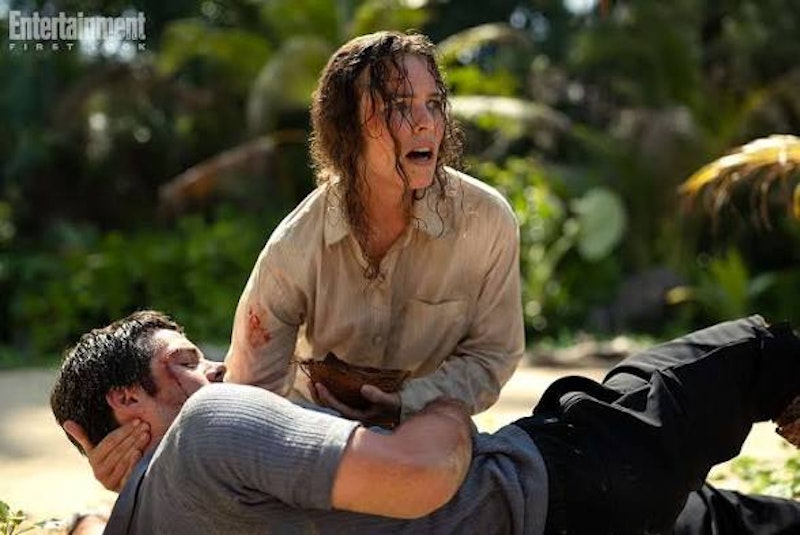
The private flight’s a boy’s club. The sniggering men find an audition video Linda made for the TV show Survivor and get a laugh at her expense. But the joke’s on them. The plane crashes (in a masterful piece of filmmaking by Raimi), leaving Preston and Liddle as the only survivors on a deserted Pacific island. The boss, used to depending on DoorDash for daily sustenance, finds himself in a subservient position as Linda sets about providing food, shelter, water and fire.
There are echoes of Swept Away in this unexpected scenario. In that polarizing 1974 Lina Wertmüller film, aristocratic, sexy Raffaella (Mariangela Melato) lords her status on a pleasure boat over bitter, communist deckhand Gennarino (Giancarlo Giannini). That dynamic gets reversed when the two of them are stranded on an uninhabited island. She needs his skills to survive, and Gennarino makes her pay for it. His abuse extends to raping Raffaella.
Linda starts off on the island as a caring person, taking care of Bradley, who hurt his leg in the crash. But when he gets snide with her, she takes off for a few days, leaving him helpless. She returns and kills a wild boar in a gruesome, blood-soaked scene. After the two of them enjoy their first meat of the “adventure,” they're back on good terms again. A drinking session fueled by Linda’s produces some bonding and sharing of secrets. But a fundamental problem remains. Linda’s happy on the island, while Bradley longs to return to civilization.
The director appears uninterested in depicting a realistic survival simulation. For her meals, Linda puts out colorful spreads of sashimi and fruit artfully laid out on tropical green leaves. She could be a food stylist preparing a shoot for a culinary magazine. And instead of taking on a gritty “survival” look, the once-frumpy, low-self-esteem office worker transforms into radiant, lovely island girl brimming with confidence. Her hair looks great.
Bradley makes a bad move, and Linda makes him pay for it in ways that appear outside her character. The story shifts away from psychological drama into horror. This is the new Linda now—or maybe the old, “real” Linda finally revealed—drained of sweetness.
The director goes too far with a scene in which Linda appears to punish Bradley with bodily mutilation. She didn't actually do it, but Raimi manipulates the audience, for about 10 seconds, into thinking she did.
Linda goes from turning the tables on someone who has it coming to him to breaking bad. It's a twist, but one twist too many. In this revised context, Bradley’s personality flaws come off as mere tics. Now he's the good guy without having to earn it. The viewer’s left with having an overgrown frat boy to root for.
Strong character development for the protagonists is essential in a two-character film, but Rachel McAdams gets the lion’s share of it, while Dylan O’Brien’s left to play a cardboard cutout. There's one scene where he opens up about his abusive mother and shows some emotion, but otherwise his job is to react to his co-star, who delivers a fine performance.
Beware of any film that’s called a “comic horror thriller,” as this one was. Just as that description suggests, Sam Raimi struggles with managing the tone here, unable to decide if he wants to be shocking, funny or sincere.
In Swept Away, the dynamic shift between domination and submission unfolds gradually. The emotional cruelty, humiliation, dependency and erotic power struggle build in increments that feel natural. On the other hand, the transitions in Send Help are forced. The film’s disturbing but not in a thoughtful way, turning it into a genre exercise rather than a subtle exploration of how class and gender differences play out when the law of the jungle is suddenly imposed.
Raimi tacks on a brief, post-action coda that's amusing and effective, but it’s too late. He's already squandered a promising setup. The set pieces he relies on don't get the job done. Unlike Swept Away, few viewers will be motivated to rewatch this film.