
In spite of the overbearing presence that online culture has upon what films get made and how they’re released, visualizing internet interactions is a challenge. It’s easy to look back at how antiquated films about the Internet look, now that years have passed since their perceived advancements were surpassed by real developments; although there’s an element of films like The Matrix or Strange Days that’s nostalgically retro, other 1990s titles like Hackers and Enemy of the State are now hilariously out-of-touch. Strangely enough, the most challenging aspect of the digital world to replicate is mundanity. There are ways to make technological processes compelling if they’re part of a Mission: Impossible sequel, but filmmakers have struggled to reflect the bored, dissociative scrolling that has dominated most people’s screentime.
The “screenlife” format, in which the film is composed solely of screen recordings from a smart device or laptop, went out of fashion in the same way that the “found footage” subgenre did. Beyond the impediment that these films needed to manufacture reasons why the characters would be recording at all times, they denied themselves to use cinematic techniques of lighting, blocking, and montaging, which differentiate a cinematic narrative from the vast sea of digital content made readily available. Red Rooms, the second feature from Canadian filmmaker Pascal Plante, is an inventive twist on the true crime genre with an acute understanding of the double consciousness of contemporary internet usage. The digital world’s so seductively filled with truth that it’s replaced reality for those who feel helpless to enact real change.
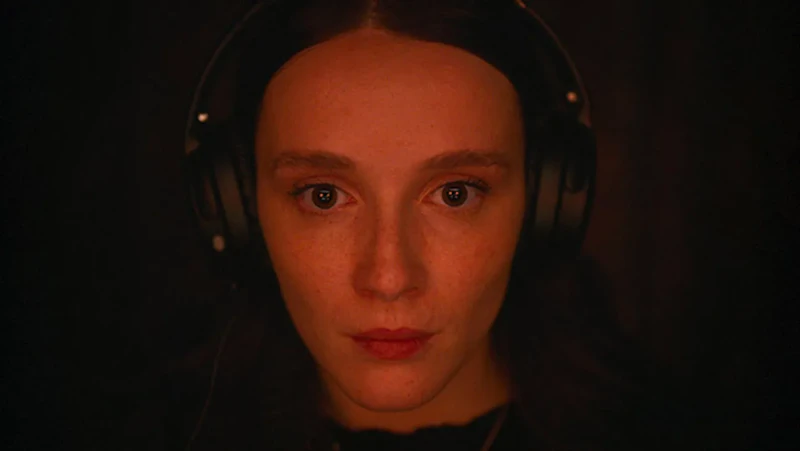
Red Rooms is about a high-profile murder case in Montreal, where the middle-aged man Ludovic Chevalier (Maxwell McCabe-Lokos) is accused of killing three teenage girls, whose deaths were broadcast on a dark web chat room. Although graphic footage of the snuff film is screened to the jury, Ludovic’s identity is not confirmed because the killer in the video was wearing a mask that obscured his face. Among those in attendance of the trial is the fashion model Kelly-Anne (Juliette Gariépy), who’s made herself independently wealthy through online gambling profits. Kelly-Anne’s use of an AI program to secure her life’s stability can be calculated, but she’s sought something tactile in a digital ecosystem where everything’s material. Convinced that Ludovic is guilty, Kelly-Anne’s plan is to follow the trial and develop a private investigation into the dark web community, known as a “red room.”
Obsession with true crime isn’t a byproduct of the internet. Each advancement in technology has augmented the degree to which people can interact with a criminal case, but society’s moved far past the point in which people were glued to their televisions during the O.J. Simpson trial. The digital plane is so uncharted that amateurs and authorities are on an equal playing field, even if they don’t share the same rigorous process. Law enforcement and legal officials are, in theory, supposed to avoid speculation for the sake of impartial justice. Comparatively, an independent hacker like Kelly-Anne’s quest is for truth, which itself isn’t enough when there’s no validation. This is the cyclical process that Red Rooms is so brilliant in orchestrating; knowledge obtained on the internet only has value if it’s shared, but it’s impossible to verify evidence in a climate where conspiracy theories have become mainstream.
Red Rooms isn’t the first film to show the way that conspiracies, QAnon, and the “post-truth” digital newscape have warped reality. David Robert Mitchell’s underseen neo-noir satire Under the Silver Lake offered a potent metaphor for the way that strand conspiracies have calcified existing anxieties and self-fulfilled fantasies; similarly, last year’s Eddington captured the ease at which insular belief systems fall apart when they’re taken out of chatrooms. The difference is that the majority of the action in Red Rooms is set before the events of the film, and the main character’s quest is to analyze, examine, and consume the kernels of sordid evidence that have been trapped in private servers. Plante is smart to offer few concrete motivations for why Kelly-Anne is so committed to this specific case; there are implications that connect her tenure as a model to the fetishization of teen girls’ suffering, but Red Rooms is also a reminder that obsessively charting a true crime case is an addiction.
That there’s a concrete goal to Kelly-Anne’s mission and a firm timespan in which she must succeed (since the evidence in a trial has a submission deadline) doesn’t mean that Red Rooms has any easy takeaways. Either outcome is horrifying; Ludovic’s conviction would confirm that the authorities are less equipped to deal with a sadistic psychopath than a fringe chatroom observer using consumer-grade technology, and his innocence would prove that the vicious killer has masked his own identity. There wouldn’t be true justice in Ludovic’s imprisonment or execution because he’s not the only person gratified by the crime; even if every single user who viewed the snuff film was tracked down and punished, the existence of a server to host this type of content has invited other fetishists to indulge in their own violent fantasies. The most disturbing revelation in Red Rooms is that the fear of consequences hasn’t discouraged potential criminals, but aroused them.
The film I was most reminded of watching Red Rooms is Joel Schumacher’s 8MM, a 1999 neo-noir thriller in which Nicolas Cage is a detective hired to determine whether a snuff murder tape is real. Schumacher’s film is clunky and filled with hardboiled mystery conventions, but it succeeds in questioning the degree of damage caused by dark sexual fantasies, regardless of whether or not they are “real.” 8MM was dismissed as exploitation at the time of its release, so the fact that Red Rooms has been more readily accepted as an arthouse gem would point to progress. The themes aren’t any less harrowing, but they’ve become harder to ignore.