
Netflix is often accused of disrupting the festival landscape by acquiring and releasing films with little effort put into their theatrical rollouts. Although it’s a shame that The Irishman and Train Dreams didn’t enjoy runs on the big screen, the platonic ideal of a Netflix acquisition title is a film like In the Hand of Dante, which surely no distributor would’ve touched. The latest film from Julian Schnabel is ambitious, but it's unfathomable to imagine that anyone would want to spend two-and-a-half hours in a convoluted headspace while watching In the Hand of Dante in theaters. That the film is readily available is itself a victory, even if it's buried deep within Netflix’s homepage, because it would otherwise be completely forgotten.
Schnabel’s defining quality as a filmmaker is his interest in art itself, with the caveat that he inserts himself into each narrative. His debut feature, Basquiat, was supposedly a biopic of the postmodernist Jean-Michel Basquiat, but was more focused on Schnabel’s personal recollections of the late artist than any historical facts. Most recently, Schnabel’s Vincent van Gogh biopic At Eternity’s Gate centered on the long-simmering theory that the influential painter was murdered, and served as an extended metaphor for the filmmaker’s own feelings about artistic persecution. Even when guided by history or established writing, Schnabel makes it clear that this is his version of events.
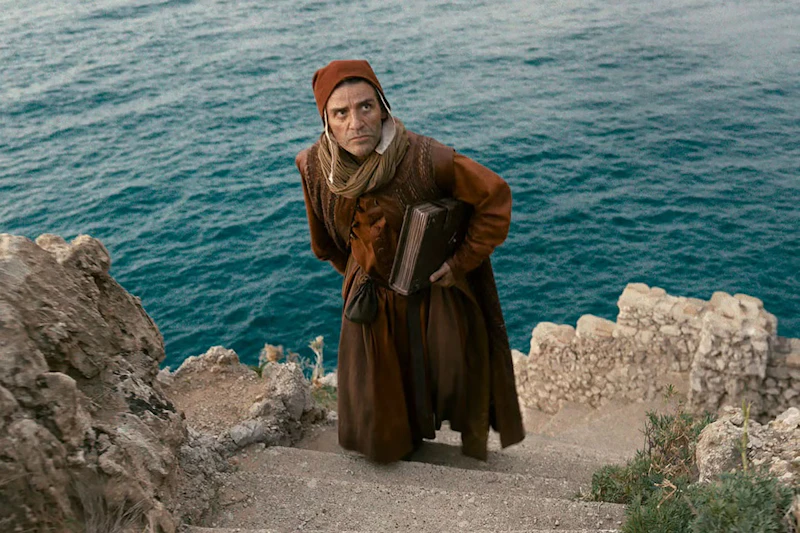
In the Hand of Dante is based on a 2002 novel by Nick Tosches that could already be considered a radical historical reinvention (at best) and a pretentious self-insert (at worst), so Schnabel was the ideal filmmaker to adapt it. The story is that of a fictionalized version of Tosches, played by Oscar Isaac, whose reputation as the world’s foremost expert on Dante Alighieri has attracted the attention of the mobster Joe Black (John Malkovich). Black has seemingly discovered the existence of Dante’s original manuscript, and has hired the assassin Louie (Gerard Butler) to help Tosches track it down. It’s an appropriately loony conspiracy mystery, but the weirdness is elevated to another level by Schnabel’s flashback sequences set in the 15th century. It’s here where Isaac has his second role as Dante himself, and most of the other cast members also have dual parts.
All of the present-day sequences are shot in black-and-white, which aid in the atmosphere of a moody neo-noir that’s suitably overcomplicated. The flashbacks are all in color, with the point being that Dante’s beautiful writing was a more honest, earnest expression of reality than the insidious commodification of the 21st century. An artist with crystallized ideas about divine justice would once be given the freedom to pursue his ideas to their greatest potential, whereas a modern figure, like the manufactured version of Tosches, has to do business with the criminal underworld to work within their field of expertise. Isaac’s performance is the only aspect of the film that’s legitimately great; he’s believable as a maverick Italian poet who doesn’t know he’s made history, and equally compelling as an eloquent modern author who has struggled to accept his irrelevance.
Otherwise, In the Hand of Dante is a collection of occasionally amusing scenes where Schnabel’s deliberate choices provoke some astonishment, even if it's often in the ironic sense. Schnabel’s never shown interest in subtlety, and he’s cast an ensemble filled with actors known for making drastic choices. Butler has become so established as a contemporary action star that it’s easy to forget that he was once a theater actor who played Shakespearean leaders, folklore heroes, and the Phantom of the Opera. His performance as Louie is entertaining because he’s the only character in the film who has no interest in art, and can provide the grounded perspective of someone who doesn’t hide his perverse indulgences. There’s a scene on a plane where Tosches and Louie discuss their respective professions that may not have intended to be funny, but yields laughs thanks to Butler’s “creative” line deliveries. Even stranger is Butler’s performance in the flashbacks as Pope Boniface VIII.
The film’s opening scene has a young Tosches (Ibrahim Elouahabi) confronted by his Uncle Carmine (Al Pacino) after getting into a squabble with another boy, and it must as well embody the strange statement that Schnabel’s trying to make; all art is shaped by tragedy, and the ends only justify the means if the art itself is profound enough to pass along wisdom for generations hence. It’s the closest thing to conflict that exists in In the Hand of Dante, given that Tosches is already grieving the loss of his child at the beginning of the story, and doesn’t have much to lose by getting involved in the underworld. Even if the flashbacks have the production value of dinner theater, they’re more dramatically effective because of the historical tragedies experienced by Dante and his wife Gemma Donati (Gal Gadot) upon their exile from Florence. Comparatively, Tosches is merely a mouthpiece for Schnabel to voice his thoughts on art and commerce.
The performances are otherwise hit-and-miss; Gadot can’t be bothered to show the mildest amount of emotion without straining, and Jason Momoa’s eloquent gangster Rosario is an idiosyncratic antagonist seemingly lifted from an Indiana Jones sequel. Malkovich and Pacino, while underutilized, are serviceable because they utilize their exaggerated line deliveries to make Schnabel’s dreck more memorable. Most unusual is an appearance by Martin Scorsese as Dante’s mentor, Isaiah, who’s only in the flashbacks. It’s not clear why Scorsese has been so keen on acting lately, because in the last year he’s also appeared in The Mandalorian & Grogu, The Studio, and Jonah Hill’s Apple TV comedy Outcome. Nonetheless, the moment where Isiash has realized his student has surpassed him is the only instance in In the Hand of Dante that’s moving.
As easy as it is to scoff at Schnabel’s indulgences, In the Hand of Dante has the opposite problem of most “bad films” of recent years. It’s not a film made by committee, and there’s no instance in which Schnabel’s vision is sacrificed for the sake of commercial appeal. That might not make it good, but it without a doubt has made it interesting.