
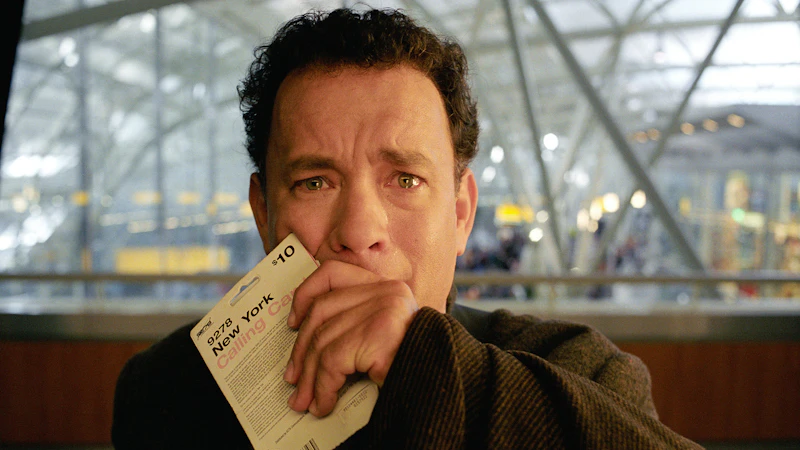
In 2002, three Steven Spielberg films were in wide release: Minority Report, Catch Me If You Can, and the 20th anniversary re-release of E.T.: The Extra-Terrestrial; these were all prepared before the 9/11 attacks, and after Spielberg was summoned to Washington, DC along with several other major filmmakers (David Fincher among them), he decided to make a movie, “that could make us laugh and cry and feel good about the world.” The Terminal, released in the summer of 2004 and starring Tom Hanks as a refugee from a fictional Eastern European country called Krakozhia, was his promised crowd-pleaser. Not exactly the kind of movie that the Pentagon wanted after 2001, but Spielberg would eventually produce two of the only major Hollywood films that addressed 9/11 in a meaningful way, War of the Worlds and Munich (both released in 2005). You have to wonder if that was a direct response to The Terminal, a commercial and critical success that felt dated and of another era as soon as it came out.
Continuing the trend he started with Forrest Gump, Hanks plays a functionally retarded man named Viktor Navorski; he’s not mentally disabled, just foreign, but the language and cultural barrier provide everything audiences had come to expect after a decade of I Am Sam, Gigli, and Radio. In the air, Krakozhia breaks out into civil war and the government’s dissolved; Navorski’s passport is invalid when he lands, and unable to return home or get a hotel in New York, he stays in the airport. Stanley Tucci plays an uptight commissioner eyeing a promotion, and he tries, tries, and tries again to get Navorski to either fly home or escape the airport. After Navorski befriends several of the airport cleaning staff, the commissioner threatens to fire or deport them. Lo and behold, the Indian janitor sacrifices his job for Navorski in a ridiculous scene played for pathos where he stops a plane on the runway with his mop. Navorski even mistranslates the desperate pleas of a man flying to Canada to give his father medicine, which the commissioner insists requires a specific license. Navorski says the man is bringing medicine for his goat, knowing that animal medication doesn’t require any forms.
The light comedy of bureaucratic technicalities is just one of many things that dates The Terminal to the 20th century: besides Hanks’ laughable accent, there’s Catherine Zeta-Jones, who plays a 39-year-old flight attendant who falls for Navorski. They never sleep together, nor do they kiss, but they have dinners together, and he restores her confidence after years of bad relationships and married men who won’t commit one way or the other. Navorski acts out scene after scene that could’ve been in a 1930s comedy, playing to a naive sentimentality that had already evaporated by the turn of the millennium. Looking at The Terminal now, it’s unbelievable that anyone thought this was a good idea; then again, I had the same reaction when I saw it opening weekend at the Ann Arundel Egyptian 24, an enormous movie theater inside an enormous mall—the perfect place to see The Terminal, which is really a feature-length ad for Burger King, Sbarro, and Hudson News. Like Super Size Me, which had come out only a month before, The Terminal made me crave fast food. No surprise that it was such a big success.
The Terminal didn’t feature the last retarded protagonist, but only four years before Tropic Thunder, it came close. Perhaps the last entry in the genre, before Robert Downey Jr. annihilated it in Ben Stiller’s film, was Reign Over Me, released in 2007 and starring Adam Sandler as a 9/11 widower who may be developing trauma-induced schizophrenia. If that movie ended the functionally retarded protagonist genre, it also ended Sandler’s earnest attempts at a dramatic career in acting, because unfortunately, once you play retarded in half a dozen comedies, you can’t play it straight. No one will buy it. You can’t even be solemn. Why else would The Day the Clown Cried remain buried for so long?
—Follow Nicky Otis Smith on Twitter: @NARCFILM