
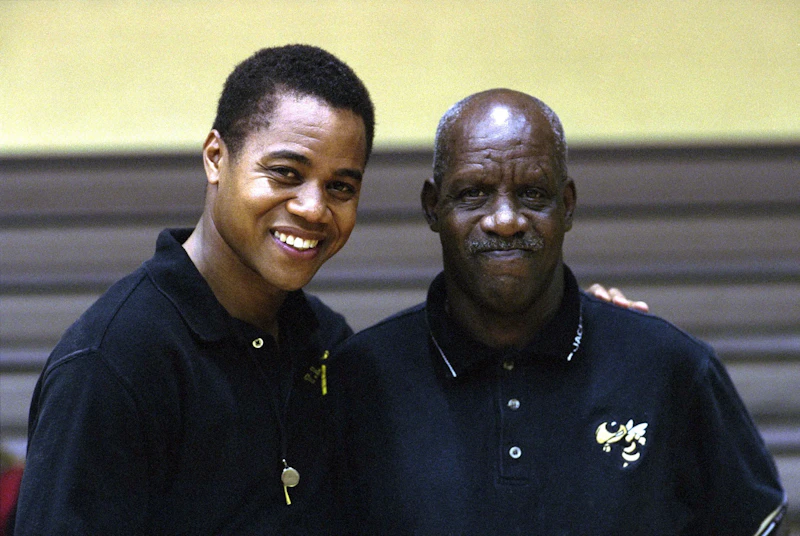
You don’t often see actors kill their careers overnight, but I knew it was lights out for Cuba Gooding Jr. the day I saw the trailer for Radio in the spring of 2003. That trailer had more impact than the movie itself, which I never saw; even in 2003, Gooding Jr.’s miscalculated performance as a mentally-disabled man was shocking. This was nine years after Forrest Gump, which I’ve never seen for the same reason I avoided Radio for so many years: how could this be real? “Movie star plays mentally disabled” was a thriving genre for nearly a decade after Tom Hanks sat on that bench, with films like Forrest Gump and I Am Sam making hundreds of millions of dollars and collecting dozens of awards and nominations. In the Union Square Virgin Megastore, around the corner from the theater where I saw the trailer for Radio, there was a massive floor-to-ceiling display for I Am Sam, a movie where Sean Penn speeds up Hanks’ deliberately “slow” delivery. But, crucially, he does not go “full retard,” a line from Tropic Thunder that’s the real enduring legacy of Radio.
Ben Stiller’s 2008 film famously featured Robert Downey Jr. as an Australian Method actor who dons blackface in order to play a black soldier in Vietnam (and, of course, win another Oscar). Stiller’s character, an action star desperate for dramatic credibility, derailed his career with Simple Jack, an obvious parody of Radio that’s barely hyperbolized. Like Gooding Jr., whose career never recovered from Radio, Stiller is surprised by the strong negative reaction to his work. Downey Jr. tells him what went wrong:
“Check it out. Dustin Hoffman, Rain Man, look retarded, act retarded, not retarded. Counted toothpicks, cheated cards. Autistic, sho'. Not retarded. You know Tom Hanks, Forrest Gump. Slow, yes. Retarded, maybe. Braces on his legs. But he charmed the pants off Nixon and he won a ping-pong competition. That ain't retarded. He was a goddamn war hero. You know any retarded war heroes? You went full retard, man. Never go full retard. You don't buy that? Ask Sean Penn, 2001, I Am Sam. Remember? Went full retard, went home empty-handed.”
He did, but crucially, he left the Oscars with his career intact. He even won another one last month, in absentia no less.
Unlike Hanks’ and Penn’s disabled protagonists, Gooding Jr.’s Radio is irrepressible, so slack-jawed and bug-eyed that any moment could be mistaken for cruel comedy. Radio is basically non-verbal, and Gooding Jr.’s performance is so exaggerated that he comes off looking and sounding like a scared, confused animal; in a positive review for The Chicago Sun-Times, Roger Ebert mused, “in a few scenes I think he wanted me to pet him.” Slightly more circumspect, Stephen Holden of The New York Times compared Gooding Jr.’s Radio to “an abused animal,” writing that, “Mr. Gooding conveys a mercurial blend of terror and childish glee that erupts across his face in lopsided, chipped-toothed grins.”
Radio takes place in 1976 South Carolina, with Ed Harris as the beloved football coach, Debra Winger as his barely-there wife, and a couple of obligatory villains in father and son Chris Mulkey and Riley Smith. Harris and his team befriend Radio after Smith leads a group of boys in tying Radio up and locking him in a shed. It’s the kind of thoughtless and cruel prank common among teenage boys, and, contra-expectations, Smith doesn’t become Radio’s nemesis, nor does Mulkey, who considers Radio a distraction but is distinctly in the minority when it comes to banning him from games or from going to school. Smith does play one more nasty prank on Radio, convincing him to run into the girls’ locker room, but he learns his lesson and gets to tell his dad that, “You’re the one getting in the way here.” The word “retarded” is spoken only once, by a bureaucrat from the school board convinced that Radio’s presence is a liability. Mulkey never says “retarded,” and when Harris and Alfre Woodard, the principal who’s on the fence regarding Radio, hear him say it, they wince (The New York Times didn’t get the memo, where Holden describes him as “mentally retarded;” Ebert went with “disabled”).
In a 2018 post on Great American Rivalry, Samantha Capley wrote, “It’s easy for the coach to take a liking to Radio so quickly. It’s easy for Coach Jones’ main assistant, Coach Honeycutt, to be on his side from the beginning. And it’s easy to never, ever make race an issue in the film. Which might be the greatest sin of Radio. This is a film about a black, mentally challenged young man in 1976 South Carolina. Throughout the film, his blackness is never the reason for his tokenism, or for the townspeople’s fears, or for parents’ disgust. Maybe the film doesn’t realize it’s taking place in 1976 because there are a myriad of time period mistakes found in the film. Or maybe the film wasn’t necessarily written for a black actor, and no one considered the consequences when they hired Cuba Gooding Jr. Or maybe everyone was just too lazy to bother changing this worthless script.”
This vitriolic response, as exaggerated as Gooding Jr.’s performance, was very common at the time and now—everyone remembered that trailer, and when Tropic Thunder came out, there was no need to get specific, to get mean. Gooding Jr. was already finished, reduced to straight-to-video junk and voiceover work. But Capley’s piece betrays something more disturbing and fairly common in retrospective reviews of Radio: a revulsion towards the severely disabled that makes the movie’s detractors far nastier than anyone who’s actually in the movie. Her quibble with the absence of racism is curious, as if a black man in 1976 South Carolina must be the victim of racism; in fact, Radio ultimately works because the love of the town is palpable, and you start to wonder if the bewildered reactions to the movie might just boil down to discomfort with the mentally disabled per se. Holden astutely points out: “Because Mr. Gooding doesn't underplay his character's distracting tics, his performance makes you feel the uneasiness that Radio's presence provokes in the more heartless residents of Anderson, a town that lives and breathes football.”
That uneasiness, disguised as defense against a “bad performance,” turned Radio into a joke months before it came out; audiences in 2003 were far more bigoted and openly disgusted by disability than anyone in the movie. Complicating the film even further, Radio’s based on a true story, and the real Radio shows up at the end, recreating shots from the movie we’ve just seen. We don’t spend enough time with him to get a sense of what he’s really like, so who knows if Gooding Jr. was off base? Surely the town of Anderson, which hosted a sold-out screening of the film the night before its October 2003 release, with the real Radio in attendance. “Nights like that are what make this all worth it,” says director Michael Tollin on the DVD commentary, recorded during the movie’s reasonably successful theatrical run, grossing $52 million against a $30 million budget.
Skimming Letterboxd reviews, Radio’s much more divisive than I imagined, with a solid two-thirds appalled, and one-third charmed and on board. When I finally watched Radio last week, I nearly turned it off 20 minutes in, so put off by Gooding Jr.’s kabuki take on the mentally disabled, but I’m glad I stuck with it. Besides the titular performance, Radio is played straight down the middle, a competent “inspirational drama” in every respect. Because Gooding Jr.’s take on the material is so extreme, it forces people to notice the schmaltzy music, the manipulative camera moves, and the familiar, if subtly subverted, narrative beats. But “Hallmark movies” are a dime a dozen, and while they’re not well-regarded, they’re not hated with the viciousness common in criticisms of Radio. Besides, if the people who know Radio were happy with the movie, who’s to say Gooding Jr. is miscalculating anything? It’s only a jarring performance because we so rarely see the mentally disabled in the movies; in other words, never go full retard lest people become uncomfortable. There’s nothing offensive about Radio, a movie that doesn’t hesitate in depicting disability or the genuine discomfort people feel around the disabled. What’s offensive is how quickly so many people dismissed it, turning into the very bigots they claimed to oppose.
—Follow Nicky Otis Smith on Twitter: @NARCFILM