
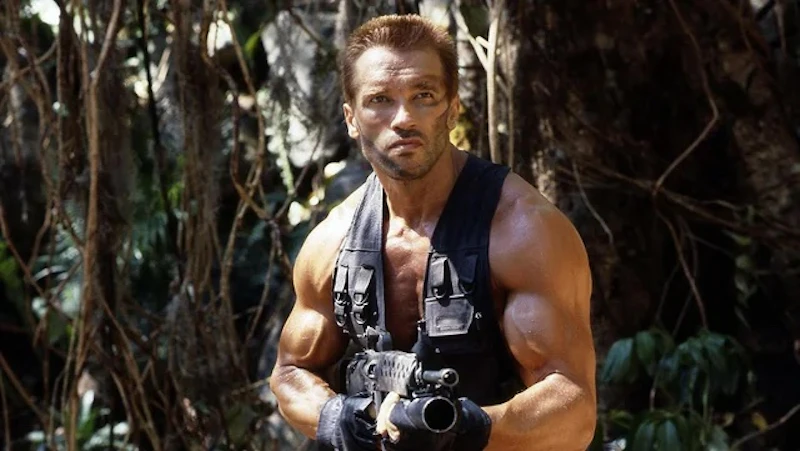
In 1987, a movie about muscle-bound commandos hunting an alien in a Central American jungle became one of the most philosophically interesting films of the decade. Predator wasn't supposed to last. It was supposed to make money, sell posters, and disappear. Nearly 40 years later, it's still a great watch.
Predator’s lasting power has little to do with nostalgia. Nostalgia is lazy and indiscriminate. It keeps Cocktail alive in people's hearts the same way it preserves Citizen Kane. But Predator endures because it earned it. The film does something structurally devious. It opens as a steroid-fueled, chest-thumping action movie—Arnold Schwarzenegger, Carl Weathers, biceps with their own gravitational fields—and then, slowly, turns that confidence into a liability. The hunters become the hunted. The firepower becomes irrelevant. By the end, the most powerful man in the jungle is covered in mud, setting primitive traps, and praying that he lives to do one more pushup.
That pivot’s the whole film. Strip away Stan Winston's extraordinary creature design and Alan Silvestri's percussion-heavy score, and what you have is a story about the arrogance of assumed dominance—and how quickly the jungle corrects it. Dutch doesn't defeat the Predator through superior technology. He wins by abandoning it entirely. A perverse kind of philosophy—the action hero triumphs by dismantling himself.
This is why the sequels failed. Predator 2 delivered Danny Glover and Los Angeles gang warfare. Predators offered a greatest-hits cast dropped onto an alien hunting ground. The Predator, Shane Black's 2018 entry, was frenetic and boring. Each installment confused violence for tension. They remembered the blood, but forgot to make you care about whose it was.
Horror operates on the unseen. Predator understood this instinctively. That shimmering heat-distortion outline in the foliage—barely visible— remains one of cinema's most unsettling images. The reason is simple: it respects what the audience's imagination can do. Modern blockbusters don't trust the audience. We got an entire film about young Dumbledore's gap year, a Joker sequel nobody requested that found time for musical numbers, and a Mufasa prequel that answered the question nobody was asking. Every emotional beat arrives pre-scored with swelling strings. The original Predator gave you a trembling outline in the jungle heat and said nothing. It didn't need to. In 2026, that ripple is still more frightening than anything Marvel has rendered at scale.
Now Schwarzenegger's name is circling a new installment, which produces a complicated cocktail of emotions. He's 78, which by any conventional measure disqualifies him from hauling himself through jungle warfare. But conventional measures never applied to Schwarzenegger. The man ran California while simultaneously maintaining a film career, a construction-worker physique, and a scandal count that would’ve retired most people permanently.
The interesting question isn't whether his return would work physically. It's whether Hollywood deserves to have him back. The franchise has spent decades strip-mining his legacy for brand recognition while producing work that would embarrass a direct-to-streaming algorithm. If he returns, he shouldn't be a cameo, a nod to the original that lets the new film coast on borrowed goodwill. He should be the film.
What makes this conversation worth having is what Predator still represents. A blockbuster made by people who understood the difference between impact and sensation. The film's central metaphor—man's certainty in his own supremacy, shattered inside 100 minutes—speaks directly to the current cultural moment. We’re living in the golden age of hubris. A president pushing us towards a third world war. Tech barons colonizing space. Algorithms replacing judgment. Studios replacing writers. Everyone, everywhere, convinced they are the apex predator. The jungle has opinions about this.