

I recently felt like taking a walk in southwest Manhattan. Desiring a peek at its newest attraction, Little Island, which was restricted at the height of the pandemic, I scuttled from the Meatpacking District and then down to Hudson River Park and would up in Tribeca in the City Hall area. What I look for is a little different from what tourists invading this area are seeking out, so I hope you’ll find something here that’s not in the guidebooks.
I’ve been in “The Meatpacking” often since beginning my website, forgotten-ny.com, in 1999. Then, there were more meat wholesalers around but it was beginning its transition into the tourist/shopping mecca it is today. Here’s a fascinating shot I found in the Facebook group New York’s Railroads, Subways & Trolleys Past & Present.
I’ve told this story before about my first encounter with the Meatpacking District. I was working nights at Photo-Lettering in 1983 (a long-defunct typesetting shop boasting the world’s biggest type library). I went into town early one frigid, cloudy December afternoon before work to check out a sci-fi bookstore on 8th Ave. at about Horatio, and something, I don’t know what, led me to the river. I discovered this slumbering metallic railroad behemoth, now High Line Park, then beginning its big sleep following the end of its freight service, and its revival now as an art playground. The neighborhood looked like the photo you see above.
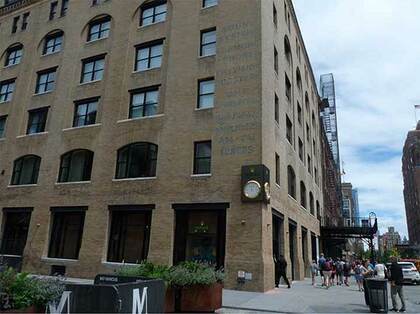
I kicked things off at #29-35 9th Avenue at W. 13th St., a stolid loft building developed in 1903 on land previously owned by the Astor family (along with most of what is now the Meatpacking District). The original tenant was Steinhardt Brothers liquor importers and dealers, but there have been many tenants, including glazed fruits and jellies packers, the Interborough Rapid Transit Co. (the subway’s IRT), electricity generators, binderies, meat packing (naturally). Perhaps the most noticeable former tenant is David Bogen Sound Systems, whose painted ad is still visible on the corner, although it’s fading fast now. Bogen was in the building from just 1954 to 1955.
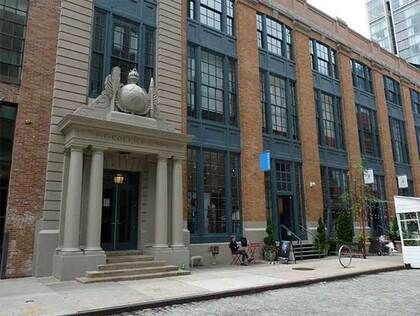
There were more businesses in what’s officially called Gansevoort Market (named for a cross street) than meat wholesalers. Peter F. Collier was a Catholic seminarian who, instead of joining the priesthood, became a salesman for a Catholic book company headed by a P.J. Kennedy, who turned him down on his idea to offer books on a subscription service. Collier went on to form his own company in 1875 and built it into the largest subscription publishing house in America. A magazine, Collier’s Weekly, appeared in 1888 (renamed from Once a Week in 1895) and published continuously until December 1956.
According to Preservation Ohio, “Collier’s was the main challenger to the dominance of the Saturday Evening Post as America’s favorite household magazine of the era. The name of the magazine was shortened in the first years of the 20th century when the word “weekly” was dropped from the masthead. In the age before electronic media Collier’s was a mix of news, features, tame humor and short stories—a format that is virtually non-existent today. The magazine was also recognized for its artwork and illustrations. Among the famous who contributed to Collier’s was Maxfield Parrish—recognized in the early 20th century as the most popular illustrator of the day. Circulation of the magazine declined steadily after 1950 as radio, television and the rise of a new generation of national news weeklies – including Time, Life and Newsweek—adapted to the changing national tastes.”
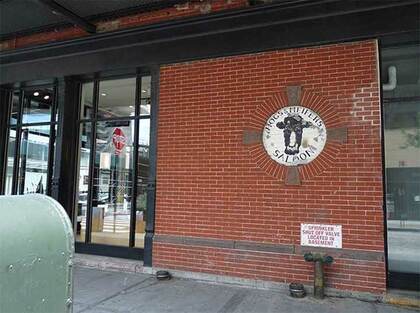
Only one small sign on the W. 13th St. side of 857 Washington St. marks the place where legendary bar Hogs & Heifers, serving both the Meatpacking and biker crowds between 1992 and 2015. A rent hike to $60,000 per month forced out the popular joint. The bartenders and female patrons, who were encouraged to remove their bras and donate them to the rafters, danced on the bar and drink orders were yelled through bullhorns. Sedate retailers now occupy the corner of the century-old brick building, itself once home to meat wholesalers.
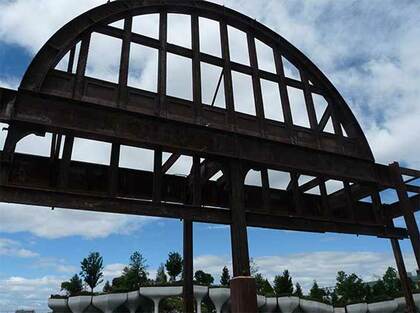
This gate, at the head of what was Pier 54, is the last remnant of a terminal building for White Star ocean liners. It’s now part of Hudson River Park. One of the spectacular ocean liners that used this gate in their heyday would’ve been the Titanic, though he great liner was due to arrive at nearby Pier 58—if fate hadn’t intervened. It was there that passengers from the doomed vessel debarked after they were picked up in the icy North Atlantic Ocean by the Carpathia, operated by Cunard.
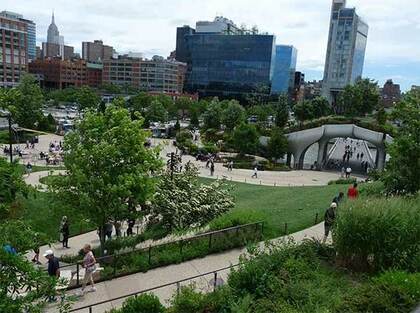
The reason I went to the Meatpacking District was that I wanted to get a peek at Little Island, a new park privately funded and built by media mogul Barry Diller and his wife, fashion designer Diane Von Furstenberg. The park’s constructed on 132 golf tee-shaped pylons sunk into the Hudson River bed. It features nature trails, hills, and a 700-seat amphitheater. The park’s design is by Thomas Heatherwick, who also designed “The Vessel,” the climbing structure in Hudson Yards further north.
My feeling about it is “meh.” The views are good, once you get to the summit of its artificially built hill, but you’re pretty much contained in a pack of people on a narrow trail until you get there. Of interest: I did get a look at Gansevoort Peninsula, a new park under construction at the old waterside Gansevoort Market.
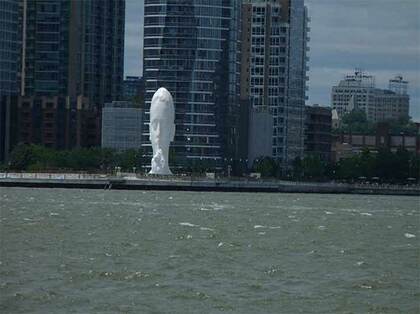
I headed down Hudson River Park for my first visit since late-2020. Across the river in Jersey City, south of Christopher Street, spotted a sculpture of a huge woman’s head and hand making a “shushing” sign. Newport Green Park is a relatively new waterside park created in 2012 along the waterfront. Open to the public, it was built as an amenity for a new apartment complex. The 80-foot-tall sculpture, “Water’s Soul,” was created by Spanish artist Jaume Plensa. His public art installations can be found in Spain, France, Japan, England, Korea, Germany and Canada. The sculptures are usually over-sized heads, torsos, or spheres.
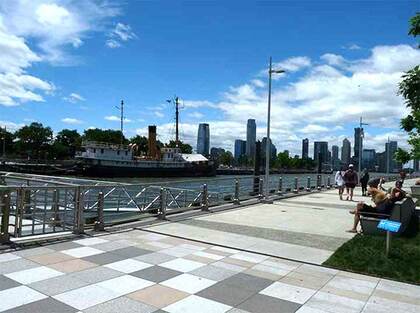
Pier 25, at N. Moore St., is the largest recreational pier at Hudson River Park and features an 18-hole miniature golf course, sand volleyball courts, a children’s playground with water features and climbing structures, a flexible turf field and a snack bar. There are also the steam powered lighthouse tender Lilac, restaurant ship Grand Banks, and fireboat McKean. When this was a working waterfront, Pier 25 was home to Eastern Steamship Co.
—Kevin Walsh is the webmaster of the award-winning website Forgotten NY, and the author of the books Forgotten New York (HarperCollins, 2006) and also, with the Greater Astoria Historical Society, Forgotten Queens (Arcadia, 2013)