
I read Jay McInerney’s slight new novel See You on the Other Side one afternoon last week and didn’t much care for it. It’s the fourth novel centering on Russell Calloway and his wife Corrine—this one’s set in the Covid panic year—and McInerney, now 71, gives a half-hearted effort to “capture the zeitgeist” of New York City. He fails. I’ve liked much of the second-tier writer’s work in the past—Bright Lights, Big City, Story of My Life and the initial Calloway novel, Brightness Falls. Never even skimmed one of his wine columns in The Wall Street Journal or whatever glossy mag would accept them. In his dotage, McInerney, married four times, likely is well-off and writes when he gets an itch. Not so different than a rock group like Journey playing nostalgia concerts.
After reading two scabrous reviews of See You on the Other Side—one in The New York Times, the other from The Guardian—I was puzzled that the critics were so vehement. The Times’ Dwight Garner started out: “Martin Amis had a theory about why novelists became celebrities in the 1980s and ‘90s. He thought it was because newspapers, unaware that the internet and forced starvation were just around the bend, had become fat with advertising and had space to fill.”
That’s not really accurate; big newspapers always had “space to fill,” hence the additional sections added on during that time period. The “literary brat pack” so often ballyhooed back then, consisted of McInerney, Tama Janowitz (barely remembered) and Bret Easton Ellis. (Ellis, whose novels never appealed to me—the “product placement” hurts my eyes—is the only one still relevant, with his magnificently honest podcast regularly stirring up cultural controversy.) That trio loved the attention, the four a.m. closing calls at bars before an after-hours party and “Page 6” mentions. It was “marketing” on the part of the writers and their publishers and agents. Anne Tyler, for example, a better novelist than all three of the “brat pack,” was at her peak and didn’t court attention. Same with Alice McDermott.
I lived in New York when the trio was most popular and, like “it” artists Julian Schnabel and David Salle, there were restaurants that I frequented downtown (Da Silvano, Barocco, and Arqua, for example) that approached “velvet rope” status for that crowd. A high school friend was a waiter at Barocco—his “day job,” naturally, subservient to an acting career that never materialized—and I really liked the Italian fare, and the “in” that my friend provided, procuring a choice table. One time, in early-1988, he whispered, “Rusty, in about an hour David Salle and Mary Boone are having a small party here, so stick around and maybe I can get you an introduction!” I couldn’t care less about the “glitzy” entourage appearing, so a friend and I finished dinner and went to the Raccoon Lodge for several nightcaps.
In The Guardian, Marcel Theroux blasts the new McInerney novel, saying it’s “perfunctory,” self-aggrandizing and filled with clichés. That’s correct. But I never believed Theroux’s claim that upon the success of Bright Lights, Big City McInerney was “earning” comparisons to F. Scott Fitzgerald. That was hyperbole in 1984 and still is today. He concludes: “Fitzgerald wrote with great precision and his vision of life was tragic, at odds with the dominant ethos of his time. McInerney’s prose is loose to the point of absurdity and he seems to fully embrace the materialism that surrounds him.” Do tell! I doubt, at least in moments of sober reflection, that McInerney ever considered himself an heir to Fitzgerald’s legacy. He’s a smart guy, was brilliant in self-publicizing (with the help of hangers-on) and, as I noted above, is a second-tier writer who made the most of his talent. Story Of His Life.
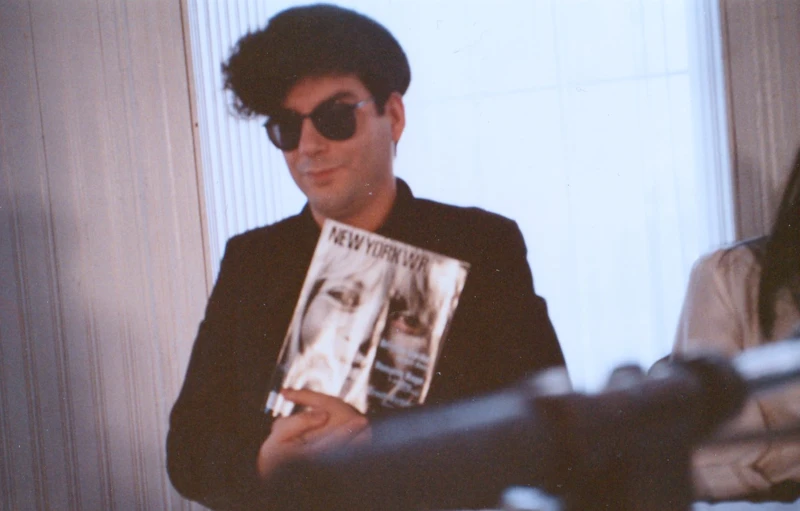
The accompanying photo is of Michael Musto, who wrote the “La Dolce Musto” column for The Village Voice. A couple of New York Press friends and I, goaded on by Beauregard Houston-Montgomery, went on a promotional cruise for some theater opening or new magazine launch and Musto was a fun companion, telling us, off-the-record, the names of those he included in his “Blind Items” in his Voice column.
Look at the clues to figure out the year: the first Hay Field of literature is held in the Welsh Marshes; Don DeLillo’s Libra, Alan Hollinghurst’s The Swimming Pool Library, Richard Russo’s The Risk Pool, Anne Tyler’s Breathing Lessons, James Merrill’s The Inner Room, and Michael Jackson’s Moonwalk are published; Peter Carrey wins The Booker Prize; Margaret Thatcher is the UK Prime Minister; Sandy Lyle wins The Masters (the first Brit to do so); The BBC film Tumbledown is broadcast; Hello! mag is launched in the UK; Jesse Plemons is born and Eva Novak dies; Philip Morris buys Kraft Foods; Andy Benes is the top MLB draft pick; and Frank Viola wins the A.L. Cy Young award.
—Follow Russ Smith on Twitter: @MUGGER2023