

Many say never look back, only look forward. I’ve never heeded that advice. I’m always replaying events, good and bad; I remember slights from decades ago. I never forget, but I forgive. From the beginnings of my website Forgotten New York, which led to over 150 live tours, two books, and numerous appearances in media, I was photographing things that still existed but New Yorkers hadn’t noticed them or didn’t care about them. One night I staggered into a hotel room in Calgary to find myself on the TV news speaking at a confab there about the reuse of alleyways (not sure if the king of CTV News, Lloyd Robertson, introduced the segment. I once authored an article “above the fold” in The New York Times.
When I began photographing for Forgotten NY I was an amateur and didn’t know how to get the best possible shot. I’m still a point-and-shoot photographer and haven’t realized the potential of my digital cameras and iPhone cameras. Nevertheless, my technique was good enough that I photographed everything in Forgotten New York The Book from 2006 (the HarperCollins production crew snazzed things up and gently retouched some material). But the passage of time has rendered these pictures an added effect of regret since many of them have disappeared in the 25 years since I first grabbed them.
Notice those vivid Kodachrome colors here; digital photos have a flatness to them, and while I retouch in Photoshop occasionally, I can’t get these kind of bright colors without laboring in the digital world longer than I want to. The corner of 23rd St. and 5th Ave. at Madison Square became a repository of the cast iron Twinlamp design, with one on the NW corner, one in the traffic island (both are still there) and this one, which was dispatched by a truck by 2008. Conversation on 5th Ave.: I wonder what those two guys were talking about all these years later. The Bell Atlantic “way faster” ad probably refers to cell phone connections; today’s speeds put 2000’s to shame. Bell Atlantic is now Verizon.
The building in the rear is the (200) 5th Ave. Building, which had longtime offices of toy companies. I worked in the Tiffany & Co. offices there from 2013-2014.
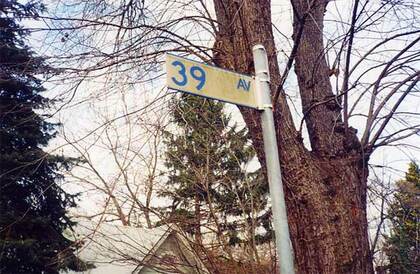
When I moved to Flushing from Brooklyn in 1993, there were still some remaining color-coded by borough NYC street signs around. These were introduced in 1964 and anyone knew what borough they were in by the color of the street signs. This wasn’t especially important except where boroughs had a land border such as Brooklyn/Queens and Manhattan (Marble Hill) and the Bronx. Manhattan and Staten Island were yellow with black letters; Brooklyn, black with white letters; Bronx, blue with white letters; and Queens, white with blue letters. By 2023, very few, if any, remain. I found these at 39th Ave. and Glenwood St. in Little Neck, and wound up moving there in 2007.
Before McDonald’s, Wendy’s and Big Boy, quick, cheap and tasty food was the province of the Automat. Horn and Hardart’s Automats provided lunches to generations of New York’s office workers. Arising at Art Deco’s height in the early to mid-1930s, Automat interiors greeted customers with sleek, functional graphics: row upon row of glass cabinets containing sandwiches, soups and slices of pie; the cabinets would unlock when a nickel was fed into a slot. Coffee would be dispensed by dolphin-headed founts, and there was a steam table dispensing hot food and more substantial fare. The food, while not of the quality of a sit-down restaurant, was nevertheless substantial; there was a large variety of choices, and at a nickel in the early days, the price was right. Horn and Hardart was renowned for using fresh food daily; no day-old leftovers were used at the Automat. At their height, Automats served 800,000 people per day.
Automats originated in Philadelphia in 1902 and debuted in NYC in 1912. As American palates changed after World War II, Automats gradually decreased in clientele, but it wasn’t until 1991 that New York’s last Automat, at 3rd Ave. and 42nd St., closed.
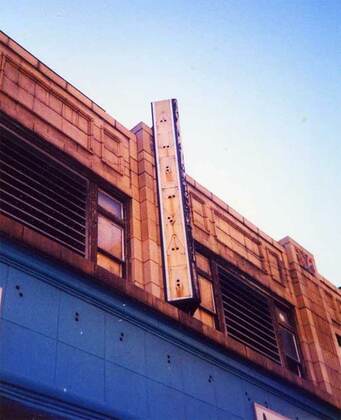
A couple of remnants of Automats remain around town. A former neon Automat sign could be found here on Willoughby St. between Pearl and Jay Sts.; I’d meant to include it in the Forgotten Book when I was furiously composing it from 2003-2005, but it vanished soon after I grabbed the shot in 1999. You can also find a painted ad on West 38th Street near 7th Ave. still bills an Automat that was nearby. In 2022, filmmaker Lisa Hurwitz put together a reminiscence of the Automat featuring Mel Brooks and other personalities who remember the Automat.
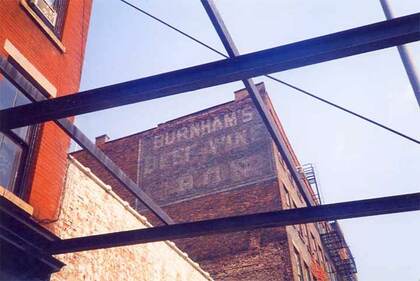
This ad for Burnham’s Beef Wine is still visible, though less so after 25 years, on Gansevoort St. in the Meatpacking District near Washington St.. When I took the photo, “the Meatpacking” was just beginning its transformation away from meat wholesaling to retail and tourism. However, the Meatpacking had a nightlife long before that as by night there were gay and lesbian clubs in the area. A great French-American restaurant below the sign, Florent, had its feet in all of the Meatpacking worlds as it served the clubgoers, meat merchants and tourists and all felt welcome. A rent increase took it out in 2008.
When I first saw this painted sign I naturally assumed it said, “Burnham’s BEET Wine.” The T is an F. “Beef Wine” was a patent medicine popular in the 1900s, comprised of port wine fortified with beef extract and iron, not unlike the tonic “Hadacol” that was so popular in the Deep South in the 1940s which was Iron and a Vitamin B complex in a 12 percent alcohol base.
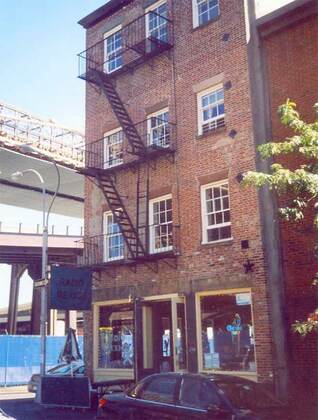
259 Front St., on the corner of Dover, is one of the oldest houses in the South Street Seaport area. It was constructed in 1808 for flour merchant David Lydig. Lydig owned a fleet of schooners that would carry flour from his upstate mills to a dock, or slip, on Dover Str. He had the foresight to sell his flour empire and take a profit when he learned the Erie Canal was under construction. The rest of this block is occupied by a huge Con Ed transformer station built in 1975. Lydig has an avenue named for him in Morris Park, Bronx.
In 1999 the ground floor business was a bar/restaurant called Radio Mexico and later Mexican Radio, named, no doubt, for the 1982 hit record by Stan Ridgeway and Wall of Voodoo; it since moved to Cleveland Place in NoLita. By 2014 there was a bar called Cowgirl Sea Horse on the ground floor here. One block west on Water St., the Bridge Cafe had been in business as a bar in one form or another since the 1700s, but it has been closed since Hurricane Sandy in October 2012. In 1971, this corner was featured in the cop classic The French Connection.
What moved me to take this photo was also the unusually-configured Donald Deskey lamppost on the corner: it’s bent and configured unusually, and still had an original fire alarm indicator lamp. It’s since been replaced by a retro Bishop Crook. Note the star-shaped appendage on the lower right. It’s the end of a metal tie rod used to support brick buildings before iron and steel frameworks began to be employed. In the Seaport they were fashioned to look like starfish.
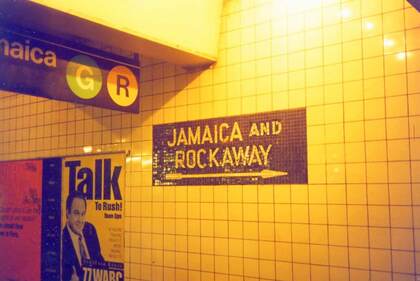
Plenty of history here in 1999. Until 2010 the G train ran to Continental/71st Ave. on the Queens Boulevard line. The late conservative talk show host Rush Limbaugh held forth for three hours, 12-3 p.m., on WABC; his show later moved to WOR.
When the Queens Blvd. line was opened from 1933-1936, the Independent Subway had every intention of expanding further, crossing Jamaica Bay en route to the Rockaways. However, World War II stopped NYC subway expansion. The IND eventually did reach the Rockaways, but via the Fulton Street IND (A train) as the city purchased the burned-down LIRR Jamaica Bay trestle, rebuilt it, and ran subway service across beginning in 1956. This sign at 65th St. was placed in anticipation of Rockaway service on the Queens Boulevard line that never materialized; a branch would’ve run south through Elmhurst, Maspeth, Glendale and Woodhaven. Those areas have never received rail service in the modern era and by now many of its residents say they can do without it, opposing the planned light-rail Interborough Express line that would connect Bay Ridge and Jackson Heights.
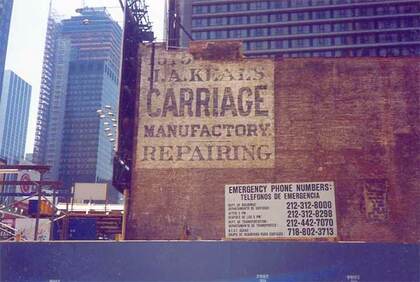
Keal’s Carriage Manufactory (“factory,” basically) helped get the ball rolling for Forgotten New York when this ancient painted sign was exposed briefly when a corner building at Broadway and W. 47th St. (Duffy Square) was torn down in 1998. The Times Square area, before it was an entertainment mecca, was home to the horse and carriage trade; Keal’s, likely from the 1878-1885 period, was one of them. A new building quickly went up and the sign may still be there, underneath.
—Kevin Walsh is the webmaster of the award-winning website Forgotten NY, and the author of the books Forgotten New York (HarperCollins, 2006) and also, with the Greater Astoria Historical Society, Forgotten Queens (Arcadia, 2013)