
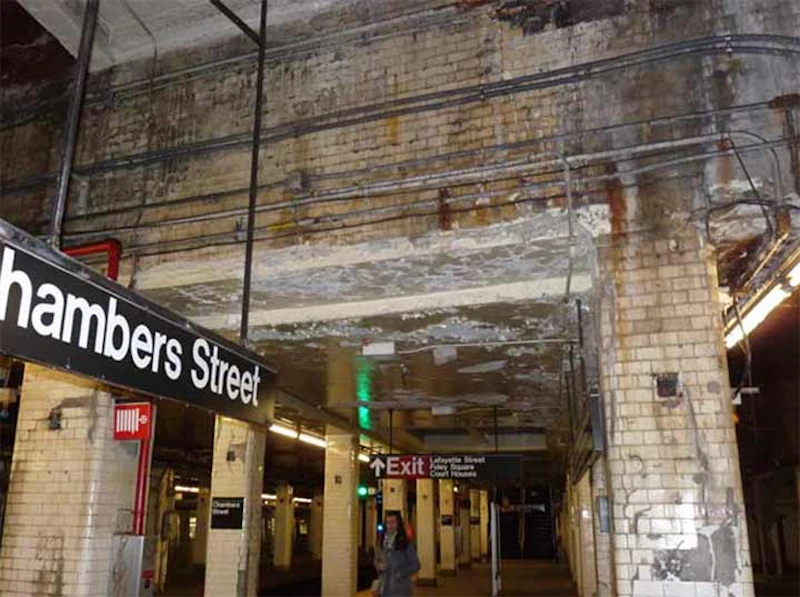
The MTA is finally poised to overhaul the BMT Chambers street station located beneath the Municipal Building across Centre and Chambers Sts. from City Hall. The station opened in 1913 and serves J, Z trains running across the Williamsburg Bridge, and once served as a terminal for trains arriving from the Manhattan Bridge before the track configuration was changed in the 1960s.
I first visited the Chambers Street BMT station to obtain photos for my website Forgotten New York in 2003. I used the station on the exhilarating day I appeared on Brian Lehrer’s WNYC radio show, then produced in the NYC Municipal Building, on October 23, 2006 (I was told I’d sold 50 Forgotten New York books during their pledge drive that day, and my amazon.com rank temporarily bulleted into the top 500) and to treat myself, I got a J train out of the Chambers St. station and went straight to Bushwick (where else?)
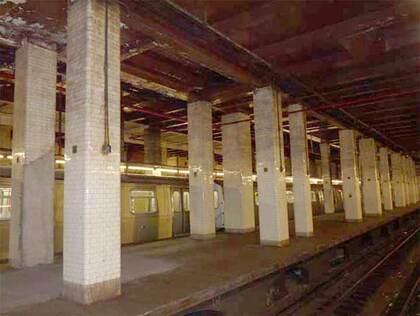
The Chambers St. station consists of two center platforms, a surviving wall platform (on the east side) and a destroyed wall platform on the west side. Uptown trains use the eastern center platform and the western track that used to face the destroyed wall platform: now there’s a bare-bones, 1960s-era tile wall with station ID. That downtown wall platform was eliminated when the adjacent IRT Lexington line Brooklyn Bridge station platform was extended.
Note the tiled columns. The BMT Chambers station sits directly beneath the Municipal Building, and in such an occurrence throughout the system, the iron station columns are generally buttressed with extra concrete that is covered with tilework.
When the Chambers St. station opened in March 1913, the side platforms were used for exiting the station exclusively, and the station served as the southern terminal. In 1915, the station also began to serve as the terminal for trains coming off the southern tracks on the Manhattan Bridge. Originally, tracks were supposed to connect with el lines running on the Brooklyn Bridge, but that connection was never made. In 1931, two extra stations were added south of Chambers; Fulton and Broad; and the tunnel was extended to connect with the BMT Montague Tunnel, currently unused in revenue service.
From 1913 to 1917, the station also served as the southern terminal for some Long Island Rail Road trains. The LIRR would use BMT tracks on the Williamsburg Bridge, the Brooklyn Broadway el on Broadway and Fulton St., and use a flyover at Chestnut St. (now the site of the west end of Conduit Blvd.) to LIRR tracks on Atlantic Ave., long before they were placed in a tunnel under the avenue in 1940. The LIRR would then use the Rockaway line, still under its control, and cross Jamaica Bay to the Rockaway peninsula.
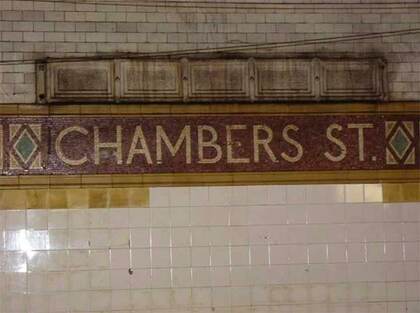
The station identification signs, along with those on Canal St. and Bowery, are unusual for the BMT in that they employ sanserif lettering on the mosaics. The diamonds, though, are standard items on BMT decor.
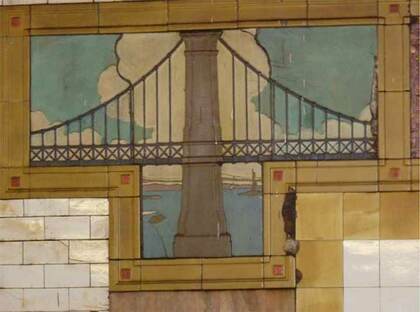
Because the line was originally going to connect to tracks on the Brooklyn Bridge, large T-shaped terra cotta plaques depicting the bridge were installed on the two exit platforms. The plaques depict the East River looking south, with a steamship on the left and Statue of Liberty on the right. The Brooklyn Bridge’s crosswise cables weren’t part of the design, whether for a lack of money or because of difficulty depicting them.
Large plaques such as this were made by original subway station designers Heins and LaFarge, but by this time Squire Vickers had assumed the mantle and would keep it until 1940. He executed large terra cotta plaques here, but they were more simplified than the ones by H&F. On Vickers’ later BMT and IRT stations, he designed smaller mosaic plaques as station identifiers, and with the Machine Age IND, dispensed with them entirely.
For a few years now, these plaques and the exit platforms have been hidden from view by a barrier. I presume the MTA will find a way to display these beautiful artifacts again during the upcoming station rebuild.
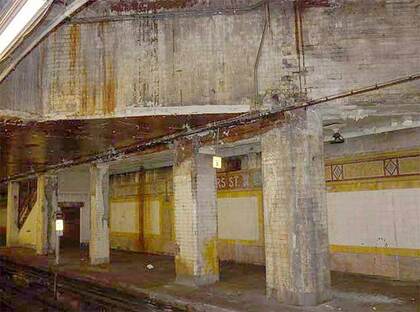
The side exit platform at Chambers hasn’t been used since 1931, when the line was extended south, and appears it hasn’t been maintained since that time; as stated, it was finally hidden behind a barrier. You might give the Transit Authority, later the MTA, a pass for not maintaining the side platform at all, since no one uses it (a similar situation exists at Hoyt-Schermerhorn in Brooklyn, where a platform servicing trains that used to arrive from the Court Street Shuttle has been closed down; and a center platform at the IND Columbus Circle station has been converted into a walkway—train doors don’t open onto it.
Puzzling, though, in an era when many stations, especially in Manhattan, have been given the TLC treatment with the restoration of station mosaics on the BMT Broadway and other improvements, is why the mold off the tiling at Chambers St. hasn’t been cleaned. That should be changing soon.
—Kevin Walsh is the webmaster of the award-winning website Forgotten NY, and the author of the books Forgotten New York (HarperCollins, 2006) and also, with the Greater Astoria Historical Society, Forgotten Queens (Arcadia, 2013)