
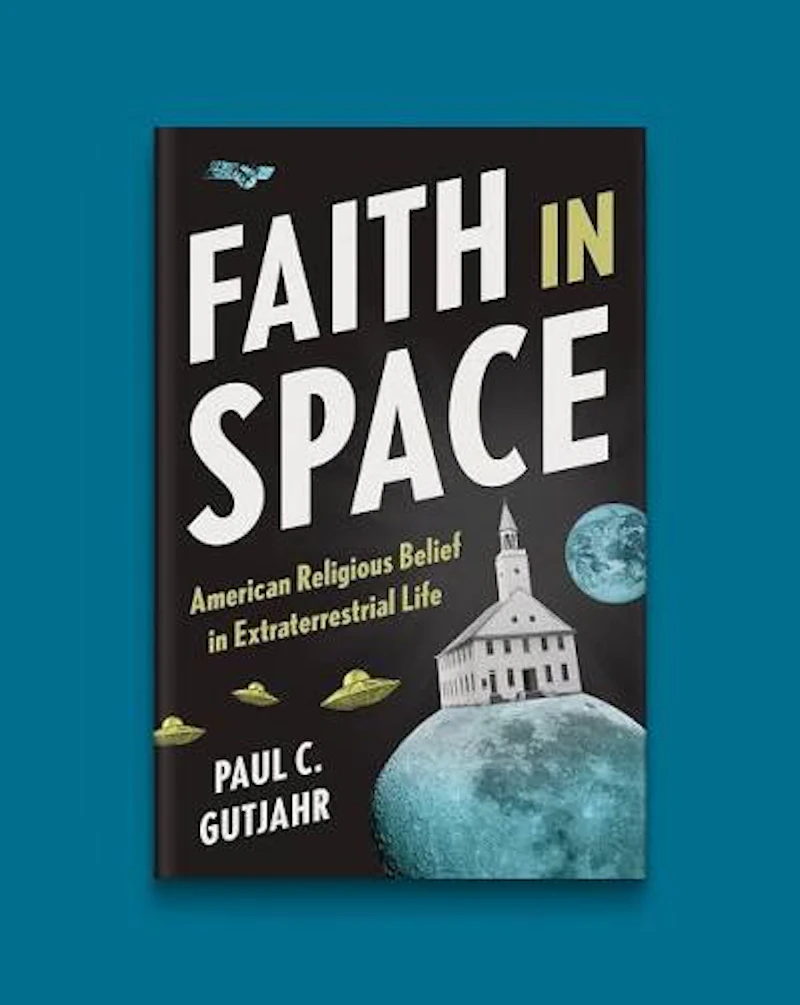
As I was reading On Time: The Physics That Makes the Universe Tick, by Jim Al-Khalili, which inspired thoughts about fatalism’s relevance to both science and horror, I noticed another Princeton University Press offering, Faith in Space: American Religious Belief in Extraterrestrial Life, by Paul C. Gutjahr. This book’s focus seemed counterintuitive, as my assumption was that religiosity and interest in extraterrestrials do not tend to combine; and that any evidence of aliens might be a blow to believers’ faith, perhaps something to be denied or countered that the purported entities are, as JD Vance has suggested, “demons.”
Yet much religious thought, particularly in the US, is “already convinced of the existence of life on other planets,” Gutjahr shows, discussing belief systems including Mormonism, Seventh-Day Adventism, Spiritualism, Theosophy, Scientology, the Nation of Islam, and “UFO religions” like Ashtar Command. Some of these were outgrowths of Protestantism, Gutjahr notes, and others adapted to “America’s largely Protestant hegemonic religious culture as they encountered a range of Christian critiques.” Accordingly: “The story of American extraterrestrial religious belief is but another lens to view the endlessly generative and ubiquitous cultural presence of Protestantism in the United States.”
Pluralism, defined as a belief in a multitude of inhabited worlds, has deep roots in Western thought, with the ancient philosopher Democritus an early exponent. Some of America’s founders held similar views. Thomas Paine, a Deist, believed Earth wasn’t unique in holding life; Gutjahr writes that “Paine made an absurdity of traditional Christian belief, as he questioned whether God in his ‘boundless creation, had an Eve, an apple, a serpent, and a redeemer’” for each planet. Theologian Thomas Chalmers too believed in numerous inhabited worlds but drew an opposite conclusion, arguing these showed God’s greatness in placing “a close and a careful attention on a countless diversity of objects.”
Gutjahr, a professor of English at Indiana University, notes that extraterrestrial beliefs sometimes developed over time within belief systems that didn’t initially feature or emphasize them: “Joseph Smith Jr. introduced his Book of Mormon in 1830, but it was only years later in his other revelations and sacred scriptures that he fleshed out his belief in life on other worlds. L. Ron Hubbard had begun with his new mental health science of Dianetics in 1950, but it was not until the late 1960s that he offered the followers of his Church of Scientology a mythic, extraterrestrial framework to help explain his belief in reincarnation, exorcism, and the immortal nature of every individual’s soul.”
Other religious traditions took belief in extraterrestrial life as a starting point. This was true of the UFO-focused sects that arose as belief in alien visitations and reports of flying saucers spread from the late-1940s on. George W. Van Tassel, a former flight inspector and engineer, used land leased from the federal government in California to run a small airport and, over time, develop a community of UFO believers. In 1952, he published his first book, I Rode in a Flying Saucer, and reported he was in touch with an alien named Ashtar, who commanded a fleet of spaceships protecting Earth and nearby space.
Van Tassel’s community soon took on a religious identity, as the Ministry of Universal Wisdom. However, a follower named Robert Short (aka Bill Rose) developed his own backchannel to Ashtar and set up a rival group called Ashtar Command. Both factions, Gutjahr notes, “built many of their core messages around how the presence of extraterrestrials in biblical times provided unrivaled insight into the sacred texts held dear by those in a wide range of Judeo-Christian traditions.” Van Tassel’s 1956 book Into This World and Out Again was advertised as “verified by the Holy Bible.” In more recent decades, the Ashtar movement has taken on more of a New Age, spiritual quality.
Gutjahr has a surer touch in discussing religion than science. “In scientific fields, there has been growing interest by astronomers, astrophysicists, astrobiologists, and the public in the existence and specific identification of ‘exoplanets,’” he writes. “Exoplanets are planets in the universe that orbit stars much like our own Sun.” That’s incorrect; exoplanets are any planets outside our solar system, regardless of what type of star they orbit (or whether they orbit a star at all). Moreover, astrobiology isn’t limited to stars like our sun (type G), as some other types’ conditions, such as greater stability, may have advantages for fostering life.
Faith in Space casts light on an under-recognized nexus of American thought, between the alien and the divine. Gutjahr opens by contrasting his approach with a future-oriented NASA colloquium geared toward assessing how religious groups hypothetically would respond to alien contact. He convincingly demonstrates there’s a long history to draw upon in analyzing such scenarios, and that beliefs in aliens have shaped American religion.