
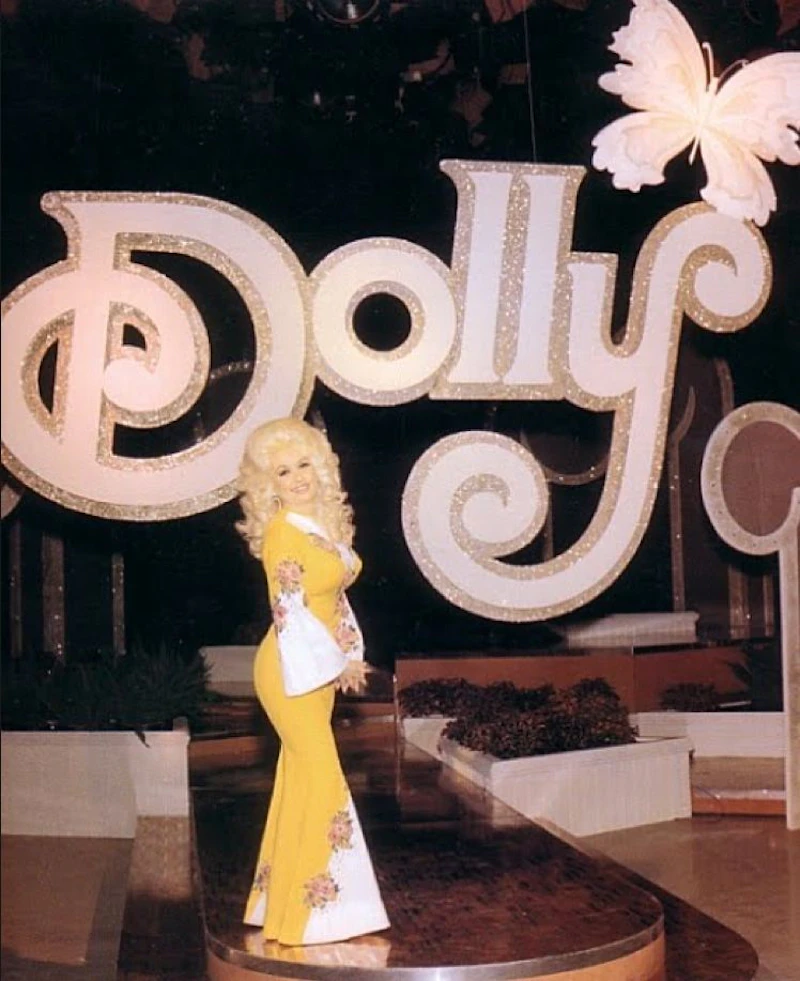
In 1987 I was going through a painful breakup. Combined with a weed addiction and depression, I was having a tough summer. My friend Julien, a television producer, threw me a lifeline. He’d been hired for a new show called Dolly starring Dolly Parton. He offered me a production assistant gig. I leapt at the opportunity. The long hours would be a welcome distraction from my breakup blues. He gave me the address of a home in the Hollywood Hills and instructed me to arrive at one p.m. the following day.
“Make sure to bring your video equipment,” he said.
“Whose house,” I asked.
“Dolly’s.”
“Really?”
“Keep the address to yourself.”
I should’ve been nervous since Dolly was one of the biggest stars in the world. But she wasn’t on my radar. I’d always dismissed her as a big-busted country act with ridiculous wigs and tacky gowns. My main exposure to her was the movie 9 to 5 directed by the guy who wrote Harold and Maude, one of my favorites.
I went for a haircut and swore off the weed. The next day I drove my Toyota Corolla into the Hollywood Hills past the massive tennis courts and swimming pools. I turned onto Thrasher Avenue and parked in front of a peach-colored house at the end of a cul-de-sac. I gathered my video equipment and announced myself at the security intercom. The gates opened and I walked through a courtyard filled with palm trees and banana plants.
A tall man with perfect hair and coiffed eyebrows greeted me at the door. He wore an elegant Italian suit with a gold Jewish Chai necklace, his chest hair spilling over a perfectly ironed pink shirt. I didn’t know it at the time but the man was Sandy Gallin, Dolly’s manager and the show’s executive producer. Gallin was one of the most powerful men in Hollywood. He perused me up and down then uttered a condescending “Oh.”
I followed him through the foyer into a large living room with polished wood floors and high ceilings. The couches, chairs and tables were moved aside and a boom box sat in the corner. Gallin instructed me to position my camera near the piano over a spot designated by gaffer tape.
“Your job is to record Dolly as she practices her dance moves,” he said. “I don’t want you conversing with her. I don’t even want you looking at her.”
“How can I videotape her if I’m not looking at her?”
“Look through the lens but the rest of the time keep your head down. She is a star. You are a prop. Understand?”
“Yes sir,” I said.
I locked the camera on a tripod and inserted a VHS tape into the recorder. I dusted the lens, tested the microphone and battery and did a quick white balance for color accuracy. I perused the backyard. There was an infinity swimming pool with sprawling views from downtown to Catalina.
I heard approaching footsteps. My nerves awakened. A moment later, Dolly entered. She flashed a bright smile with perfect white teeth and crimson lipstick. Her hair was in a bun and she wore a dark leotard and tennis shoes. She was a lot shorter and skinnier than I expected though she was as buxom as advertised.
Dolly asked my name. I put my finger in the air as if to say, “hold on a moment.” I scrawled my name on a piece of paper and flashed it to her.
“Did Sandy tell you not to talk?”
I nodded up and down like a trained seal.
“Good Lord. What’s your name, sweetie.”
“Loren.”
“Nice to meet you, Loren. I’m Dolly.”
She stuck out her hand and we shook. Gallin glared at me from behind the piano.
“You want anything to drink,” she asked.
“I’m okay, thanks.”
“There’s a 1:00 meeting at the studio,” Gallin said.
“We have plenty of time,” Dolly replied.
I was beginning to love her. Gallin instructed me to frame the shot wide and avoid panning and tilting. “Keep everything in focus,” he said. “This goes to the choreographer.”
Dolly stretched and then said she was ready. Gallin turned on the boom box. A country-disco ditty filled the room. The music was the kind of dreck you hear in supermarkets or dental office waiting rooms.
I hit record and gave Dolly the thumbs up sign. She wriggled back and forth in place, high stepping while flapping her arms like a bird. The music changed to an up-tempo number. Dolly moved a few steps left and right as if she was in an aerobics class. She appeared uncomfortable. This made me love her more since I didn’t like dancing either.
Gallin munched on Almond Roca and kept checking his watch. Whenever Dolly looked his way, he smiled. After about 10 minutes, she turned off the boom box.
“Cut the camera,” she said. I stopped recording. She stared at me.
“What’s wrong, sweetie? You look like your dog died.”
I was confused, unsure if she was talking to me. Gallin grimaced, clearly annoyed.
“Did I do something wrong,” I asked.
“Something’s wrong, alright. It’s all over your face. You can tell Dolly, it’s alright.”
She stepped forward and put her hand on my arm. Her eyes were kind. “Girlfriend trouble,” she asked.
“Is it obvious?”
Before I knew what was happening, I spilled everything. I told her about the incessant fighting and how I didn’t know how to make my girlfriend happy. I shared how much I loved her and didn’t want to live without her.
“We’re on a tight schedule,” Gallin interrupted.
“Can’t you see this boy’s in pain? Get me the phone, Sandy.”
Gallin streamed laser beams of rage. He left the room and returned with a pink phone.
“Call your girlfriend,” Dolly said.
“Now?”
“Tell her Dolly wants the two of you to give it another try. Love is precious and before you walk away you need to do everything you can to keep love alive.”
Her smile gave me confidence. I dialed my girlfriend’s number. After several rings, she picked up.
“Hey,” I said. “You’re not going to believe this but I’m standing next to Dolly Parton in her living room. She asked me to call you.”
I heard a laugh on the other end of the line.
“I’m serious. She’s right here.”
Dolly flashed an encouraging smile.
“She said we have to get back together. She said love is precious and we can’t let it die.”
Dolly gave me a thumbs up and exited the room. Gallin was pissed. “What the hell,” he said with gritted teeth. I shrugged apologetically.
“Give me that videotape,” he said. “And tell whoever hired you I don’t want to see you again.”
I hung up the phone, gathered my equipment and drove straight to my girlfriend’s apartment. We reunited for a few weeks until things fell apart again. The Dolly energy force wasn’t enough to keep us together.
Formal pre-production on Dolly began in July. I didn’t tell Julien about the incident at Dolly’s home so he wouldn’t fire me. I’d do my best to stay out of Gallin’s way. Fortunately, he and Dolly weren’t expected in the offices until August after the initial scripts were completed.
The offices were located at ABC Prospect Studios in a dodgy part of Silverlake. Four years earlier, would-be robbers shot a local newscaster named Jerry Dunphy as he entered the studio in a Rolls Royce. Since then, studio security was on high alert and production assistants were asked to park off the lot.
I worked directly under Julien. We’d known each other since high school and were close friends. He was calm and relaxed while I was high-strung. My duties included answering phones, copying scripts, picking up lunch orders and running errands to ABC corporate in Century City.
The other production assistant was Tom, a 20ish, long-haired country boy from Kentucky. He was a Dolly fanatic who knew everything about her history. Somehow he’d finagled a meeting with Julien and was hired. When I told Tom about my experience at Dolly’s home, he became apoplectic.
“You lucky SOB. I’d kill to spend time with Dolly. Did you touch her?”
“We shook hands,” I said.
“What’d they look like in person,” he asked. He held his hands above his chest to mimic breasts.
“They were big, I guess. I didn’t stare.”
“Damn son, you ain’t got the good sense God promised a billy goat. You know how lucky you are? I mean I’ve parked outside her house a few times, but to go inside? You been living in high cotton.”
“She’s just a human being like you and me.”
“Shush yourself,” he said. “Dolly wrote music when she was five. She was on television when she was 10. She debuted at the Grand Ole Opry when she was 13. You know what she sang? ‘You Gotta Be My Baby’ by George Jones.”
“Not familiar,” I said.
“She’s not like you and me. She’s a legend.”
I grew accustomed to these diatribes. Back in Kentucky, Tom led his own Dolly fan club. Working on her show was the high point of his life. He begged Julien to let him make the next delivery to her house arguing I had no respect for her reputation. This concerned Julien.
“Should I be worried,” he asked me.
“What do you mean?”
“I’m starting to think I hired Mark David Chapman to work on a Beatles special.”
“He’s harmless, I think. Though he did say something about parking outside her house.”
“Keep an eye on him. If he does something inappropriate, I want to know.”
The first few weeks of pre-production were long and boring. Los Angeles was in the midst of a heat wave and the office air conditioning system was on the fritz. The first order of business was to hire writers for the show. Dolly wanted to resurrect the variety shows of the 1970s like Carol Burnett and Sonny and Cher. The producers wanted an edgier vibe. A compromise was reached with several writers inspired by Hee-Haw and a few like those from Saturday Night Live.
I provided water and snacks at the first writer’s meeting. I wanted to be a writer myself and was excited to learn how these things worked. The meeting was presided over by director Don Mischer while Sandy Gallin attended remotely via speakerphone. The writers included Fanny Flagg (Fried Green Tomatoes), Phil Hahn (Rowan & Martin’s Laugh-In), Tom Tenowich (Mork and Mindy), Rhea Kohan (writer of the novel Save Me a Seat), Roger Miller (country music legend), Al Rogers (singer from the Rocky Mountain Boys) and Bruce Kirschbaum (later wrote for Seinfeld).
The creative arguments began immediately. Phil Hahn laid out a formula for a successful variety show: Dolly welcomes audience, song, comedy sketch, musical duet with guest, comedy sketch, guest music performance, audience interaction then final musical number. Tom Tenowich wanted to include pre-taped sketches. Fanny Flagg emphasized Dolly’s comedic chops and the need to write good jokes. Bruce Kirschbaum reminded everyone that 1970s variety shows died because they were too corny and Dolly needed an edge. Sandy Gallin then spoke over the intercom about the importance of maintaining Dolly’s image. This meant no overt sexuality, no vulgarity, no politics and no cynicism. “Dolly makes people happy,” he said. “Our job is to support her positive image.”
Gallin thought it would be cute to start each show with Dolly in a bathtub covered in soap bubbles speaking directly to camera. Fanny Flagg asked if this “might be too titillating.” Bruce Kirschbaum said, “How about if people start coming out of the bath water like a scuba diver, a plumber, a soldier, a celebrity like Rip Taylor.” Gallin responded with ferocity. “You can’t have men in the tub with Dolly. This implies she’s promiscuous.” (Kirschbaum later told me he thought he’d be fired.)
The solution was to have Dolly in the tub apologizing for being in a tub. The first written bathtub speech went as follows:
“I don’t know what to make of me taking a bath on television. My daddy don’t like it at all. When he first saw this he said, ‘What the hell you doing on television in a bubble bath?’ Then my momma said, ‘Oh you leave her alone, that’s cute, she ain’t as big as a bar of soap anymore.’ And I bet the rest of you out there are wondering if this is my real hair. Yes it is. Now I’m going to get out of this tub right now and put on a wig before I wreck my image. I’ll see you out front.”
The monologue was awful and forecast future problems. Gallin wanted to tantalize the audience while making sure no one was offended. Dolly went along with her manager’s wishes while the writers struggled to understand the appropriate tone. One writer joked after the meeting, “It’s like Dolly is saying let me show you my tits. Hey, what are you looking at my tits for?”
The initial scripts were completed by mid-August. It was time for Dolly and Gallin to make their first appearance at the studio. Don Mischer gathered staff and crew and instructed everyone to be on their best behavior. It was our job to make Dolly comfortable.
Julien sent Tom and I to the downtown flower mart to purchase 12 dozen roses. We woke at four a.m. and grabbed a studio production van. I was going on two hours sleep and was exhausted. Tom was exhilarated. This was the day he’d finally meet Dolly and he couldn’t hide his excitement. He wore cowboy boots, a white cowboy hat and a purple suede jacket embellished with beads and rhinestones.
“What’s with the duds,” I asked.
“It’s Nashville style. I want Dolly to feel at home.”
“You look like a psychotic rodeo clown.”
“I’m dressed like Porter Wagoner.”
“Who?”
“He’s country royalty, man. He gave Dolly her start.”
We spent $300 on flowers and returned to the studio. Julien admonished Tom for his country garb and told him to change into something normal. Tom argued his wardrobe was “normal to someone like Dolly.” After Julien threatened to fire him, Tom donned jeans and a t-shirt. We put flowers inside Dolly’s dressing room, assembled a fruit basket and filled her refrigerator with drinks. Tom kept staring at the dressing room bed, his eyes wide and creepy. I sensed if I wasn’t there he would’ve plopped down for a nap.
Dolly and Gallin were scheduled to arrive mid-morning. Truth be told, I was as excited as Tom. It would be the first time I saw Dolly since meeting her at her home. I wanted to rekindle our personal connection and thank her for her kindness. Around 11, a black Lincoln Town Car entered the lot.
“They’re here,” someone yelled.
The staff gathered in the foyer outside the writing room. Everyone smiled and giggled as if about to meet a visiting dignitary. Julien asked Tom and me to linger in the copy room concerned Tom might do something weird. We heard the sound of cheers and applause as Dolly and Gallin sauntered through the offices. She wore jeans, tennis shoes and a frilly blouse. Her high-pitched laugh was audible above the fray.
She greeted everyone with smiles and hugs. Gallin stepped into the scrum and said a short prayer. I couldn’t hear all the words but he started with, “Our Father who art in Heaven,” then said something about “bless this production,” “keep darkness at bay” and “show us the way with joy, love and laughter.” His gold necklace swung back and forth like an amulet. He wanted the crew to view him as a spiritual advisor, but I’d already seen his true colors. His religion was money and power.
Mischer gave Dolly and Gallin an office tour. As they approached the copy room, Tom nervously drummed his foot while I rehearsed things to say to Dolly. Their voices grew louder until they were standing in our doorway.
“These are the PA’s who’ll be helping on the show,” Mischer said.
Dolly smiled and said, “Nice to meet you.”
I waved back. “Hi Dolly, it’s so good to see you again.”
“Thank you,” she said as if she’d never met me before. I was disappointed. Then I realized she was setting boundaries, establishing a professional distance between herself and the staff. Gallin averted his eyes not wanting our low-level stink to infect his being. Had he recognized me, I’d knew I’d be out of a job.
Once they left, Tom fell to the floor and rocked back and forth in a fetal position. He muttered, “Oh my God, Oh my God.” Julien gave Tom the afternoon off but not before a short lecture. “Control yourself. If you can’t act like a professional, I’ll have to let you go.”
I walked Tom to his car, a battered 1970s station wagon. The back seat was packed with clothes and discarded food boxes. The rear area held pillows and a folded comforter. I realized Tom was living out of his vehicle. That explained his subtle odor.
“You okay, man?”
“Yeah, yeah,” he said.
“Get yourself together,” I said. “I need you.”
I didn’t tell Julien about Tom’s living arrangement. He might be a homeless Dolly stalker, but otherwise he was a good guy.
The next few weeks of pre-production were intense. We worked 16-hour days as the writers struggled to develop a coherent show. I became a Bruce Kirschbaum acolyte, sitting outside his office as he wrote sketches he knew would be rejected. Tom bonded with Roger Miller, known for the song “King of the Road.”
To kill time, Tom and I debated the merits of country music versus rock ‘n’ roll. Tom argued that country guitarists were superior since “it was harder to pluck than to strum.” He said, “Roy Clark and Glen Campbell would destroy Eric Clapton and Jimmy Paige in a finger-picking contest.” I countered, “It’s not about speed but creativity. Every country song is about trucks, guns or farm equipment. Rock ‘n’ roll is inventive and majestic.”
“Has a rock song ever made you cry,” Tom asked.
I couldn’t think of one.
“Let me play you a George Jones song. If you don’t cry, I’ll buy you lunch.”
He retrieved his Sony Walkman and cued up the song “He Stopped Loving Her Today.” I expected a cornball ode to lost love, but the depth of the lyrics surprised me. The opening words intoned, “He said I’ll love you till I die. She told him you’ll forget in time.” It depicts the breakdown of a man after a woman leaves him, something I could relate to. It ends with a twist as the woman returns to see the man one last time… on the day of his funeral. This is why he “stopped loving her today.” By song’s end, I teared up. Tom smiled.
“That’s country, man. Three chords and the Truth.”
By mid-August, the writers and Gallin established a show formula. They kept the “Dolly in the Tub” opening sequence followed by Dolly singing in front of a live studio audience. “Dolly’s Date” had her flirting with famous stars like Burt Reynolds and Bruce Willis. There were musical duets with Emmylou Harris and Linda Ronstadt while bands like Alabama and the Oak Ridge Boys played their own music. The “Vanity Fair” segment had Dolly interview celebrities like Oprah Winfrey and Whoopi Goldberg. “My Tennessee Home” gave Dolly a chance to sing country classics. The show ended with an audience Q & A (akin to Carol Burnett) followed by Dolly singing, “I Will always Love You.”
As show publicity spread, stars clamored to be included. Country icons like Willie Nelson, Kenny Rogers and Merle Haggard appeared as did Smokey Robinson and Jerry Lee Lewis. The producers invited celebrities such as Hulk Hogan, Pee-wee Herman, Kermit the Frog and Joe Piscopo.
Since this was the Reagan era, Dolly agreed to participate in a “Just Say No” anti-drug spot. This led to a memorable incident with rock star Terence Trent D’Arby, who recorded a promo before Show #5. D’Arby exited his dressing room in a billowing cloud of weed then dutifully recorded his “Just Say No” promo.
By mid-September, it was time to tape the first episode. While Dolly rehearsed, Gallin attended the daily script conferences. He required two things for each meeting. A tin of Almond Roca and a bucket of ice chips that he chewed incessantly. I stood behind him during meetings wearing a backwards baseball cap and eye mascara (my attempt at camouflage). Miraculously, he didn’t recognize me.
The shows were taped on Friday night. After a five p.m. dress rehearsal, a live studio audience was invited inside. Stars came in droves for the premiere. They included Lily Tomlin, Shirley MacLaine, Cher and Lionel Richie. Tom was excited to meet Mac Davis, the writer of his favorite Elvis song “In the Ghetto.”
At seven, formal taping began. The audience erupted as Dolly’s pre-taped bubble bath sequence played on a large video screen. “If sitting in a bubble bath is not enough to get your attention,” she said, “what can I tell you? It’s alright with me because I’ve been in hot water before. I want you to know I’m going to bust my bubbles to try to please you.”
The words were awkward and corny but the audience ate it up. After the opening credits, Dolly appeared live with a band. She wore a white sequined gown and sang “Bubbling Over.” Her aerobics-style dancing was just as I remembered from her home. Director Don Mischer appeared from the booth and spoke privately with Dolly. They taped the song a second time. Then a third. And a fourth and a fifth.
This is how the show was recorded, in fits and starts. There were elaborate wardrobe changes between skits. The “Dolly’s Date” segment debuted with Dudley Moore. Tom and I called the segment “Dolly’s Boobs” due to her revealing bustier top. The jokes were hackneyed and painful. (“Partin’ from Parton is such sweet sorrow.”) On the first take, the audience dutifully laughed. By take 12, we heard groans. The segment wasn’t completed until 10.
The rest of the evening was interminable. Much of the audience left by midnight and wrap wasn’t called until 4:30 a.m. Having started work at 7:30 the previous morning, Tom and I were drained. Julien told us that Dolly wanted her dressing room flowers to be delivered to Children’s Hospital. We were too exhausted. We gathered the flowers as instructed but tossed them into a studio dumpster just as Dolly’s limousine drove past. She rolled down the window and scowled at us in disgust. Just like that, my bond with Dolly was destroyed. I was too tired to care though Tom was crushed. He dove in the dumpster and buried himself in the flowers.
Around the third week of production, there was a mini-crisis. Rumors spread that Dolly and Gallin were each making $2 million per episode. At the same time, the office staff hadn’t been paid in weeks. We were told it had something to do with a misunderstanding between payroll companies. In my case, I was working 80+ hour weeks and not getting paid. The staff threatened to quit while Tom had no money to repair his station wagon. He approached me with an idea.
“You know what I saw in Dolly’s dressing room this morning?”
“What were you doing in her dressing room?”
He leaned forward and whispered. “I sneak in there every morning to use her commode. Knowing her butt cheeks were on that seat makes me hotter than blue blazes.”
“How’d you get in there?”
“I made a copy of the key. Anyway, here’s my idea. We kidnap her wig, write a ransom note demanding we get paid our back salaries plus interest and then return the wig when it’s over.”
“Won’t they recognize our writing?”
“Not if we cut the words out of a magazine and glue ’em to paper like you see in the movies. What they’re doing to us is wrong. We’ll be heroes.”
“What if we get caught?”
“We won’t get caught.”
I dismissed the idea but by week four without pay, I was furious like everyone else. I shared the wig-napping plan with my roommates. They thought it was hilarious. The next day I told Tom, “Let’s do it.”
We met early at the studio on a Monday. The offices were empty so we had free reign. We traversed the hallway noting the absence of security cameras. Tom unlocked the dressing room door and we entered. Dolly’s bouffant blonde wig with curly locks rested on a mannequin head in front of her makeup mirror. Tom stuffed the wig into a Ralphs supermarket bag and we hurried off the lot in Tom’s station wagon. The car smelled awful with half-filled piss bottles on the floorboard. We drove to Griffith park, the car sputtering. We sat on a bench and came up with a ransom message, short and sweet:
“Pay your workers or you will never see the wig again.”
Tom brought scissors and a stack of magazines. We cut out disparate words and glued them on a sheet of yellow paper. Tom explained that yellow was Dolly’s favorite color. We tossed the cut-up magazines into a park trash can then drove back to the studio. We placed the ransom letter on Julien’s desk and then went for breakfast at the Pantry coffee shop downtown. When we returned, the office was abuzz. Julien summoned me to his office. He closed the door behind him.
“You know anything about this,” he asked. He held up the ransom letter.
“What is it?”
“Someone stole Dolly’s wig.”
I laughed.
“It’s not funny,” he said. “That wig is worth $40,000. Gallin wants to call the FBI.”
The smile vanished from my face.
“If you’re involved I don’t want to know anything. Just get that wig back.”
I panicked. Tom was emboldened.
“Great,” he said. “I knew we’d get their attention.”
“It’s not great. We could go to jail.”
“Act like you been to town before. As long as they get that hair piece back, they won’t do nothing. They don’t want bad publicity.”
Later that day, Tom called studio security from a gas station pay phone. Using a horrendous accent, he told a guard that the wig was in a garbage bag behind the commissary dumpster. The wig was retrieved and returned to Dolly’s stylist.
I was tense for the next few days, expecting the police to walk through the door. It never happened. As Tom predicted, Gallin didn’t want negative press. Coincidentally or not, everyone was paid their back salary (plus a bonus) the following day. I was able to cover my bills while Tom repaired his car.
Dolly premiered on September 27th, 1987. Forty million viewers tuned in placing the show in the top five Nielsen ratings. The producers were ecstatic. The writers were more cynical. They read savage reviews like Howard Rosenberg’s from The Los Angeles Times who wrote, “it stunk all the way to the Smokies.”
Ratings declined with each episode. By the middle of season one, new writers were hired. The show worsened. The low point came during Episode 12 when Dolly and an off-key Mary Hart (from Entertainment Tonight) sang “Footloose” while dancing like drunken chickens. Dolly was game but the moment she stepped off stage, her smile vanished. She was angry at being made to look like a fool.
Dolly took over decision-making. She axed the splashy musical numbers in favor of a more folksy Hee-Haw approach. She turned to her country music peers for help. New guests included Glen Campbell, Barbara Mandrell and Randy Travis. It was too late. The show was in free fall.
By the end of season one, I was burnt out. I gave formal notice to Julien and bid goodbye to Tom. ABC cancelled the show in May, 1988 after two seasons. I was invited to the wrap party at El Chavo Restaurant in Silverlake. I reconnected with Julien and told him about my experience at Dolly’s home and my part in the failed wig-napping. I also reconnected with Tom. He was ebullient. He took me outside and showed me his brand new Chevy Pickup. The cab was spotless and empty.
“Where’s your stuff,” I asked.
“I got an apartment in Silverlake. I’m sleeping on a real bed again.”
We laughed and toasted over a beer. He said he was hired for a Country Western special taping the following week. I asked if he ever had a private moment with Dolly.
“Almost,” he said. “I saw her sitting alone on set one day. I was fixin’ to tell her how much she meant to me when suddenly someone farted. I looked around and the only two people in the vicinity were me and her. I knew I didn’t fart. That’s when I realized Dolly was just a regular old person like you and me.”
The Dolly Show achieved two accomplishments. It drove a nail into the coffin of variety shows, a bane of television entertainment. And it helped rehabilitate the life of one of Dolly’s biggest fans.


