
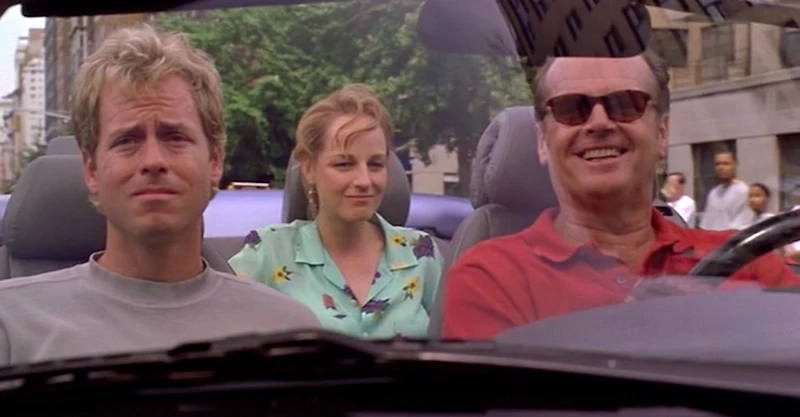
Playing at The Senator Theatre here in Baltimore this Sunday at 10 a.m. and Monday at four p.m., As Good as it Gets is one of the great romances and perhaps the best American movie of the 1990s. James L. Brooks’ fourth film followed his biggest bomb, the aborted Hollywood satire I’ll Do Anything; originally conceived and cut as a musical with contributions by Prince and Twyla Tharp, I’ll Do Anything was undone by the very thing it tried to satirize: test screenings. According to Albert Brooks (no relation), J. L. Brooks, an infamous perfectionist known for making dozens of takes, was coming undone when his debut Terms of Endearment tested with an average score of 98. “Out of what?” A. Brooks asked. “A hundred,” said J. L. Brooks, still sweating, about to curl up into a ball.
That 98 wasn’t a fluke: Terms of Endearment went on to win Best Picture, Best Director, and Best Actress (Shirley MacLaine) at the 1984 Oscars. It wasn’t a coronation: Philip Kaufman’s epic adaptation of Tom Wolfe’s The Right Stuff was tipped to sweep awards season that year, but when Kaufman’s film bombed, a new winner needed to be found, and they picked Terms, the first of Brooks’ five masterpieces. Keep in mind he’s only directed seven feature films; like Stanley Kubrick and Quentin Tarantino, Brooks doesn’t make movies for the sake of it. He may be a workaholic, but as the executive producer and grand domo of The Simpsons, he has plenty to keep him occupied. He spent the 15 years in between How Do You Know and last year’s Ella McCay overseeing the show and making sure it ran smoothly into its apparently endless future.
But has he contributed anything to the show on the level of “You are Lisa Simpson” recently? No. Still, at 86, he’s less out of touch than 79-year-old Steven Spielberg, whose Disclosure Day ends in a laughable climax that would’ve made sense 25 years ago when the pop monoculture was still intact; Ella McCay, on the other hand, gets to the heart of the matter in a single line of voice over from narrator Julie Kavner, who explains that the movie takes place in, “2008. The middle of the Great Recession. But you know, in a way, a better time. We all still liked each other.” The “partisan hackery” that Jon Stewart claimed was “hurting America” on shows like CNN’s Crossfire has been replaced by various echo chambers with zero intercourse. Although they form the core of Broadcast News, Brooks’ second film and second masterpiece, the disagreements between William Hurt and Holly Hunter over ethical journalism are comically small now: both liberals, she believes he’s too manipulative and too concerned with ratings, but of course they end up together in the end.
If any of Brooks’ characters could thrive in 2026, Jack Nicholson’s Melvin Udall might feel most at home. As Good as it Gets begins with a series of provocations that seriously challenge the audience’s sympathy: a successful romance novelist, Melvin is also a misanthrope with severe OCD. As the opening credits flash on and off, Melvin picks up his neighbor’s dog and throws him down the garbage chute; his neighbor, Greg Kinnear’s Simon Bishop, is a gay painter managed by Cuba Gooding Jr.’s Frank Sachs (described by the director as a convenient bisexual, a careerist who nonetheless cares for Simon). The janitor brings Simon his dog, “covered in diaper shit,” and both Simon and Frank confront Melvin.
Melvin answers the door and Frank pulls him into the hallway. “SHUT UP! You think you can intimidate the whole world with your attitude, but you don’t intimidate me. I grew up in Hell, homeboy. My grandmother had more attitude.” Melvin jumps up and down and screams. “HELP!!! POLICE!!! ASSAULT AND BATTERY! AND YOU’RE BLACK!” He’s just getting started: when Simon knocks on his door, breaking his precious concentration, he lets loose: “Never, never, interrupt me, okay? Not if there's a fire, not even if you hear the sound of a thud from my home and one week later there's a smell coming from there that can only be a decaying human body and you have to hold a hanky to your face because the stench is so thick that you think you're going to faint. Even then, don't come knocking. Or, if it's election night, and you're excited and you wanna celebrate because some fudgepacker that you date has been elected the first queer president of the United States and he's going to have you down to Camp David, and you want someone to share the moment with. Even then, don't knock. Not on this door. Not for ANY reason. Do you get me, sweetheart?” Simon backs away, chastened: “It's not a... subtle point that you're making.”
No good news on the horizon for Simon: a hustler-cum-nude-model played by Skeet Ulrich helps his friends rob Simon’s place, and Simon’s brutalized in the process. When Frank and friend Yeardley Smith come to visit him in the hospital, they cry at the sight of his mangled face. Estranged from his homophobic parents and financially drained, Simon eventually moves into a spare bedroom in Melvin’s apartment, an invitation from the latter after Simon’s dog and a certain waitress begin to change his mind about a few things.
Helen Hunt plays Carol Connelly, the only waitress who Melvin will allow to wait on him at the café where he eats breakfast every day. She has to put up his shit more than anyone else, dealing with complaints as various as “There are Jews at my table” and “all this… small talk… is so… EXHAUSTING!” Melvin’s banned from the café for life after calling another waitress “Elephant Girl” and causing a scene (writer/director Shane Black is superb in a cameo as the café’s manager, one of several director cameos in the film), but with her last name, he’s able to track her down to Brooklyn. Carol has a young son with severe asthma, and Melvin asks his publisher to help him. Harold Ramis plays the hero doc, making a house call and reassuring Carol and her mother (Shirley Knight) that “your son is going to feel a lot better from now on.” Melvin’s footing the bill.
She goes to his house in the middle of the night and reminds him, in no uncertain terms, that “I WILL NEVER SLEEP WITH YOU!” Melvin takes it alright, already aware that he’s the problem in nearly situation; soon him, Carol, and Simon are headed down to Baltimore to see if Simon can reconcile with his parents. Carol and Melvin are there for support, but when they insist Simon go out to dinner with them, he demurs, exhausted. Melvin and Carol go out for crab cakes, and after inadvertently insulting her yet again, Carol gets up to go. She only stays when Melvin agrees to pay her a compliment. His wind-up is extraordinary: he tells Carol that his therapist (director Lawrence Kasdan) subscribed him pills for his OCD, but he hates pills, “hate them. You understand? I am using the word hate. And yesterday, I started taking them.” Carol looks like she’s been pinched on the butt. “I don’t see how that’s a compliment.” Melvin pauses, looks at her, and delivers one of the most romantic lines in all cinema: “You make me want to be a better man.”
Not five minutes later, Carol moves over and kisses Melvin, but he offends her again, and they’re on the outs again. Back at the hotel, Simon sketches Carol in the bath, finally at peace with the fact that his parents will never be in his life. He’ll figure out his finances. He has new friends. He’s smiling and life is great for a bit.
Back in New York, Melvin tries to fix things with Carol, and finally gets out to her place in Brooklyn. Carol admits that, “When you first walked in, I thought you were handsome. Then you opened your mouth.” They go out for a walk at four a.m., waiting for a bakery to open. Melvin tiptoes around cracks in the sidewalk, and with less than five minutes to go, Carol still has her doubts: “Whatever this is… is not going to work.” Melvin, smooth, grabs her and kisses her, decides it wasn’t enough, and then they embrace as Hans Zimmer’s score swells. The bakery’s open, and Carol and Melvin are ready to look on the bright side of life.
Brooks’ genius is in taking the most trite and broad emotions and revivifying them without any subversion. Watching his movies feels like walking through a Thomas Kinkade painting, syrup sitting alongside the fire described by Joan Didion in 2001. His movies are in the Classic Hollywood tradition, with grand gestures and emotions, albeit rooted in contemporary America (Ella McCay is his only period piece). The magnificence of As Good as it Gets is in its expansion of Hollywood clichés into the present, reaffirming their value beyond the works of Capra, Chaplin, Ford, and Hawks. His characters are real and unlike anyone else in the movies; the emotional effect of his films is largely a product of what happens when you allow real people to live in a movie fantasy.
In an era when the word “empathy” is abused and misunderstood, As Good as it Gets is practically radioactive; those who talk constantly about “empathy” and understanding others give up on Melvin pretty quickly. They don’t know what they’re talking about: Brooks’ triumph is in so quickly establishing Melvin as an arrogant and bigoted prick, one who nonetheless deserves to be loved as much as anyone else. As Jonathan Rosenbaum wrote in his rave 1997 review (later retracted in 2004 when his colleagues complained), “a triumph for all involved.”
—Follow Nicky Otis Smith on Twitter: @NARCFILM
