
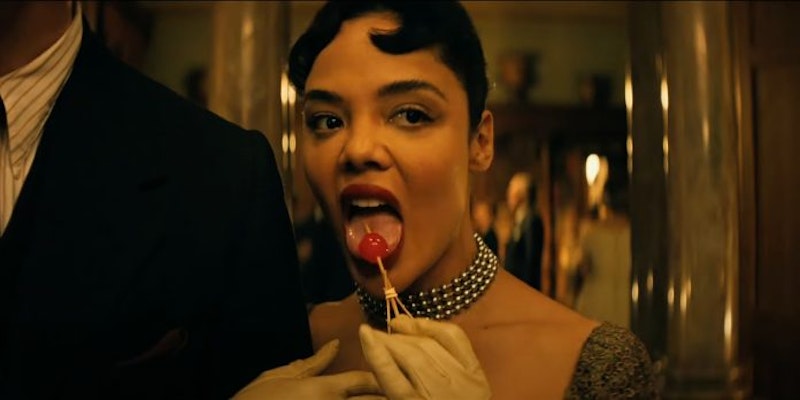
Nia DaCosta’s Hedda is based on the 1891 Ibsen play Hedda Gabler, but it’s neither outdated nor stagey. DaCosta uses her command of filmic resources to create a claustrophobic story of thwarted ambition and stifled love which is relevant in the current era of dwindling possibilities and escalating bigotry.
DaCosta—the writer as well as the director—sets the film in the 1950s. Hedda, played by a glamorously decadent Tessa Thompson, is an illegitimate Black bisexual woman who recently married aspiring and insecure academic George Tesman (Tom Bateman). George bought Hedda an enormous house on the strength of his hopes for a new position and fellowship. But at the 11th hour he learns the fellowship may go to brilliant alcoholic lesbian sexologist Eileen Lovborg (Nina Hoss). Unbeknownst to George, Hedda and Eileen had been lovers. Eileen shows up to the Tesman’s elaborate house party with her co-author and lover Thea (Imogen Poots) and their irreplaceable manuscript; Hedda responds by launching a manipulative scheme maybe to get Eileen back, maybe to elevate George’s career, maybe to just burn everything down in the hopes that she might be briefly aroused from her state of overwhelming ennui.
The movie takes every advantage of the interior setting; the camera lingers on furnishings and passageways, sliding suggestively into corridors and along contours. Crucial scenes and moments—like the first phone conversation between Hedda and Eileen—are filmed in such a way that you can’t see the actor’s faces. The climactic dramatic shooting (outdoors) is arranged so that you can’t see who’s pulling the trigger or who’s hit.
The point isn’t to create suspense so much as to visualize psychological opacity. The house is full of secrets—guns hidden in drawers, stolen kisses in alcoves and hedge mazes, stolen manuscripts in the bushes. But the biggest mysteries are those behind the eyes of the protagonist, whose consciousness seems inaccessible even to herself. In the opening sequence, Hedda stalks through the house in a striking red dress snapping at the servants and exasperatedly removing flowers from each opulent room. We never learn why she finds flowers so offensive; all we know is that she’s on a mission, filled with spite, to remove beauty from her house and from her life.
Though Hedda’s motives are locked away, DaCosta offers some hints and context. Hedda’s bored and frustrated—there’s a wonderful scene where she’s standing listening to a couple of academics drone on and you see her eyes flit here and there; one of the other partiers looks at her and says, with some delight, that she’s about to wreak havoc, which is what she does. Her unhappiness isn’t precisely connected to career ambitions (does she even want to write a book?) and isn’t precisely connected to romantic disappointment (does she love Eileen?) Nor is she driven by material motives; she asked George to buy her the house, but insists it was just a whim, and given her impulsive destructiveness, that rings true.
Hedda doesn’t know what she wants; she just knows that she wants. DaCosta is very attentive to soundscapes, and there are moments in the film—after Hedda’s been on the receiving end of an insult, as she starts to plan chaos—when the ambient sounds of the party fade away and narrow down to a disturbing vibration or hiss as the camera closes in on Hedda’s features. It’s the empty buzz of emptiness—something that Hedda can’t have, the self that isn’t there.
Hedda’s often cruel and capricious, and the other characters mostly believe that that’s a failure of her own character. There’s evidence for that—she bullied Thea relentlessly when they were children. But there’s also evidence that her wants are so stifled by the stigma attached to women, to illegitimate women, to illegitimate Black women, and to illegitimate Black queer women that she can’t even identify which of her own desires have been strangled in the crib. When Elaine suggests that Hedda should follow her into academia, Hedda points out, with acid disdain, that there are very few positions for women in the university—and none at all for Black women.
Early in the film, Hedda fires a pistol from the roof at Judge Brack (Nicholas Pinnock) her husband’s friend and benefactor, who’s below approaching the house. Initially this seems like caprice. But over the course of the film it’s clear Brack’s been sexually harassing her—which means those shots from the roof were less an irresponsible game, and more a desperate bid for freedom. Rewatching that moment, Thompson’s expression of boredom after she fires are ambiguous; maybe self-loathing, maybe resignation.
Hedda’s obsessed with guns because people keep hurting her, and she wants revenge. But you can’t kill structures of oppression anymore than you can kill a house. You can knock down a chandelier and listen with pleasure to the crash. Or you can make a film filled with the elegant, angry, inescapable sound of lives being crammed into a space that, despite the high ceilings, is too small for them.