
Looks like I missed Edgar Wright’s remake of The Running Man, already out of most theaters and dropping precipitously at the box office (I don’t care about the money, just who’s seeing what and when; I had no idea Zootopia was popular enough to dethrone Wicked in its second weekend. And I think about this.) The Running Man was already a hit in 1987 starring Arnold Schwarzenegger, directed by Paul Michael Glaser from one of Stephen King’s Richard Bachman novels. It’s a good premise: in a dystopian future similar to Death Race 2000, the most popular program on television is trained assassins (“stalkers”) hunting down the accused and the convicted (“runners”). You take the world of John Carpenter’s They Live, push it up 100 years, and you get something like The Running Man. You can see it in most of Paul Verhoeven’s work, just on the tip of the horizon. Hey, I’d buy that for a dollar.
Wright may be an uncool auteur, but he’s an auteur nonetheless, and in a healthier movie industry, he’d adapt contemporary bestsellers, or books that haven’t been made into movies yet; remakes aren’t necessarily folly, but what’s the point if you just change it a little? Gus Van Sant’s shot-for-shot color remake of Psycho is fascinating, but once you start monkeying with the original, it’s pointless unless you do something completely different (His Girl Friday is the classic example, but even there, all they did was make one of the male characters a woman; it still made a big difference). I’m not going to look it up, but I’d bet $20 that Marathon Man, a slightly classier movie with a similar title from 1976, is also in development right now, waiting to be remade. Why?
Because people don’t read paperbacks anymore. Until Hollywood starts adapting “romantasy,” the popular bestseller turned into a major motion picture is a thing of the past. That’s why I’m interested in the Colleen Hoover adaptations It Ends With Us and Regretting You, however wonky and ham-handed they are—those movies reflect our time more closely than Weapons, One Battle After Another, Sinners, or Materialists. Hoover’s books are enormously popular, and no one was betting on her; whatever’s in them speaks to millions of people. If contemporary readers are concerned with spousal abuse and grim fatalism, readers and moviegoers of the 1970s were paranoid and considerably more educated than most today.
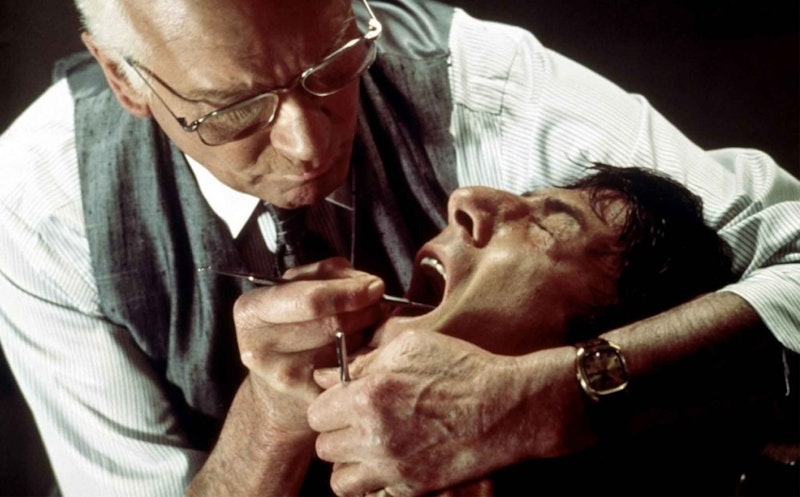
John Schlesinger’s Marathon Man, from a screenplay by William Goldman based on his novel, is a widely-known title, but the movie isn’t seen as much as something like The Parallax View, Three Days of the Condor, or All the President’s Men. The dentist torture scene is still talked about, but the rest of the plot is lost outside the lexicon. Dustin Hoffman and Roy Scheider play brothers (a brilliant choice), the former a grad student, the latter an assassin and footman for “The Division,” a typically opaque government cutout familiar to audiences of the time from both recent movies and recent events. Scheider, along with colleague William Devane, are looking for Laurence Olivier, a Nazi scientist in hiding trying to secure some precious stones. Who cares: Hoffman will reach Olivier’s dentist chair, and even if you know that, the movie can still work if it does a good job getting you there.
Scheider is thrilling here, equally icy and endearing whenever he’s around his brother; Devane is also a fantastic choice to play one of these secret organization guys. There are stacks and stacks of paperbacks like Marathon Man from the last 50 years that haven’t been turned into movies; they’re probably not that good, which means they’ll make good movies. Why not adapt something like The Voice of Armageddon by David Lippincott? It’s only been made as a movie once—in France. Marathon Man wasn’t a standard thriller, it had prestige in front of and behind the camera, but it didn’t require a lot of imagination: Goldman was on a hot streak, it was a popular book, you get a few good actors, what could go wrong? Not much, usually, but now Hollywood is atrophying its own audiences by insisting that they want remakes of remakes and sequels to kids movies and adaptations of Broadway musicals I had no idea were so popular… it’s not the audience wants these things, but eventually they’ll forget that anything else is possible, and they’ll either stop going, stop watching, or accept less for more money, because expending any effort at all is “a big ask” right now. Still, it’s hard to blame the drowning. Millions don’t know what junk they’re missing.
—Follow Nicky Otis Smith on Twitter: @NickyOtisSmith