
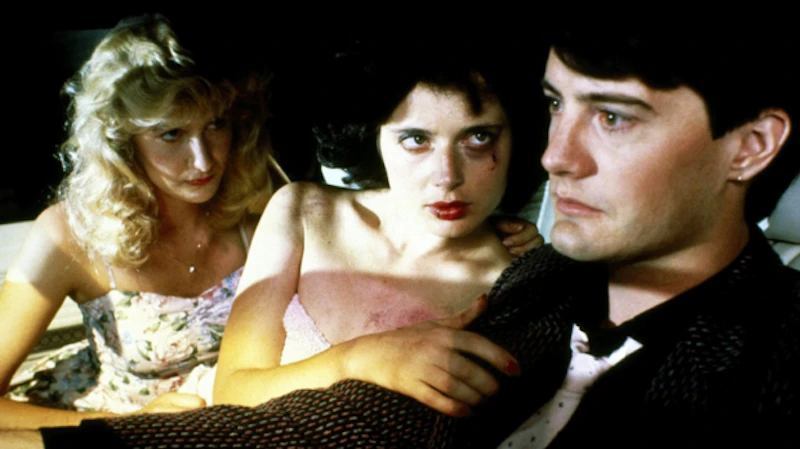
Forty years ago, David Lynch released Blue Velvet to a reception of such vocal disagreement that the argument itself became part of the film's legend. Pauline Kael championed it. Roger Ebert gave it one star and produced what remains one of the more puzzling reviews of his otherwise distinguished career. The film didn’t slot neatly into any available critical vocabulary, which was the point.
Lynch opens with deliberate seduction. Sunshine. Red roses. A white fence. A fireman waving from a passing truck. It’s America as a greeting card. Then a man watering his lawn clutches his chest and falls, and the camera begins its slow descent until it finds the beetles churning in the dark beneath. It’s one of cinema's great prologues: a declaration of intent delivered entirely without words.
Film editor Duwayne Dunham, a Lynch veteran who cut Blue Velvet and shaped the original Twin Peaks, was floored by the script long before a single frame was shot. “When David first sent me the script, I read it and dreaded having to answer him,” he says. “I was so moved and almost terrified by it.” When Lynch eventually called to ask what he thought, Dunham chose candor over diplomacy. “I hesitated,” he remembers, “and then said: ‘I don’t know, David. This really isn’t my cup of tea.’” Lynch was taken aback. “What do you mean it’s not your cup of tea?” Dunham’s answer was disarmingly honest: “Well, I’m more of a Disney kind of guy, and this script is pretty dark.” Lynch proceeded to explain why he’d written it the way he had, and asked Dunham to trust him. In the end, the decision made itself. “Blue Velvet and David Lynch,” Dunham says, “was an offer I couldn’t refuse.”
The Danish film scholar Anne Jerslev suggests that "audiences were mostly not prepared for a cinematic view of small-town America which was not idyllic and orderly." Lynch, she argues, "insists on the way the world is never what it appears to be—there is always strangeness hidden underneath the everyday."
That strangeness found its purest, most terrifying expression in Frank Booth. Dennis Hopper’s Frank remains one of cinema’s most disturbing figures because he’s not inexplicable, but horribly, recognizably human. Lust dressed as rage; rage dressed as power; power deployed with the arbitrariness of a man who has never once been told no. Hopper plays him with the commitment of a man who has nothing left to lose, and it’s that quality that makes Frank impossible to dismiss. For Dunham, the editorial approach to Frank required no great deliberation. "Frank Booth was who he was. Evil." Everything else followed from that.
The deeper question the film asks, however, is a different one. Not what kind of monster Frank is, but what kind of man Jeffrey Beaumont might be. Kyle MacLachlan's Jeffrey finds a severed ear in a field and, rather than leaving it where it lies as any sensible adult would, brings it home, then smuggles himself into Dorothy Vallens' apartment concealed inside a wardrobe. He witnesses Frank's assault on Dorothy. He stays and watches. The film doesn’t excuse this. It doesn’t condemn it either. It simply holds your gaze to it, and lets the discomfort accumulate.
This ambiguity nearly derailed the film. Dunham recalls that the debate between himself and Lynch "centered on one scene"—Dorothy alone after Frank leaves, stumbling to the bathroom, running her fingers through blood, repeating a phrase. As originally written, that phrase was: hit me, hurt me. "My position was," Dunham explains, "if Jeffrey hears this, having witnessed the rape, and comes back—this makes him a bit of a creep who wants some of the action." The character risked becoming irredeemable; the film risked becoming complicit in exactly the prurience it was attempting to anatomize.
Then, late one night in the editing room, Lynch suddenly shouted that he had the answer. The change, when it came, was surgical: two words replaced with two different words. Hit me, hurt me became help me. Dorothy shifted, in an instant, from apparent provocateur to unambiguous victim. Jeffrey, returning to the bathroom, became someone reaching toward rescue rather than angling toward violence.
What keeps Blue Velvet so stubbornly alive is that Lynch offers no guidance and no comfort, only the unsettling suggestion that you already know more than you wish you did. The notion that white picket fences conceal dark interiors has been franchised into tedium, deployed in a thousand thrillers and prestige dramas ever since. Lynch rarely receives the credit he deserves for having invented the template while simultaneously transcending it. As the critic Dennis Lim, author of David Lynch: The Man from Another Place, observes, "good and evil, innocence and depravity, are not fixed coordinates" in Blue Velvet. And that, he argues, is "precisely what makes the film so unnerving," pushing it beyond what he calls the "by-now clichéd critique of conformity."
The debt owed to Blue Velvet by the decades of television drama that followed it is enormous and largely unpaid. Twin Peaks is the obvious heir. But the lineage runs further. Twin Peaks begat The Sopranos, The Sopranos begat True Detective. Every prestige drama steeped in lingering dread and unresolved tension owes something to a piece of flesh lying in a suburban field in Lumberton, North Carolina.
No one is better placed to map the distance between those two works than Dunham. Both Blue Velvet and Twin Peaks, he argues, “raised the possibility that you don’t really know who or what may be lurking next door.” But the two works arrive at that same unsettling destination by very different routes. “Blue Velvet came out punching,” Dunham says. “The camera dives beneath the surface, past the grass and into all kinds of creepy bugs, telegraphing things to come.” Twin Peaks, by contrast, sets itself up as a more honest and peaceful kind of place—“even though,” Dunham notes, “the series starts with a young woman dead on the beach, wrapped in plastic.” The seduction is gentler, the cruelty slower to announce itself. Lynch learned from his own film how to withhold.
Jerslev puts a finer point on it. Lynch's gift, she notes, lies in creating "a universe a bit off, and characters a bit off too"—in the dialogue that arrives just slightly out of time, in the detectives who never grasp what’s happening around them. That grammar became a language. Screenwriters still speak it.
Ebert wasn’t wrong to be disturbed by Blue Velvet; he was wrong about what that disturbance meant. The film, by design, refuses to let you watch from a safe distance. Jeffrey in the closet is you in the cinema seat: watching something you perhaps shouldn’t, unable to look away, and left wondering, in the silence afterwards, what that says about you. Forty years on, in an era of sanitized streaming and algorithmic comfort, most cinema asks very little of its audience. Blue Velvet still asks everything.