
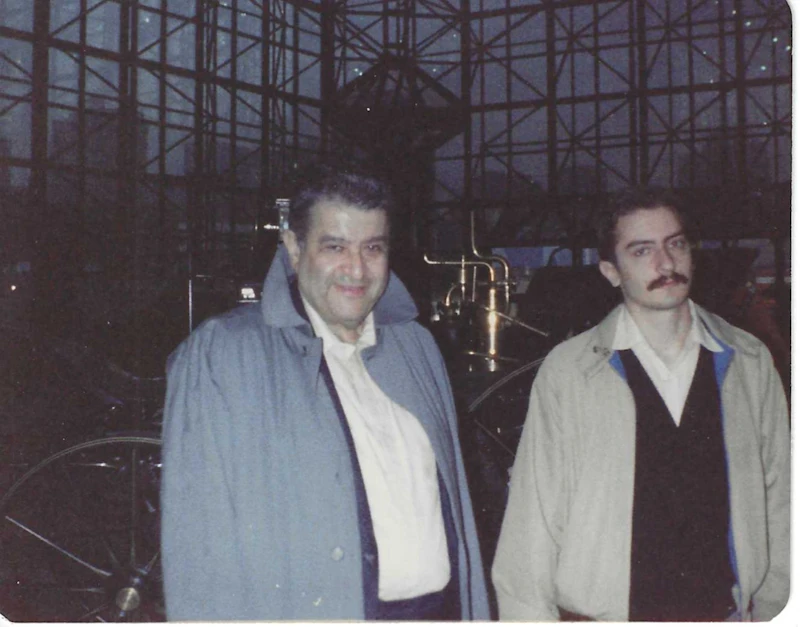
Sometime in the 1980s, I was with my father in the lobby of a hotel in Caracas, Venezuela, where an elderly gentleman was sitting and reading a newspaper. My father went up to him and introduced himself and me, and the man said he was pleased to meet us. This was all in English. Then my father said to the man that this was to show, for my benefit, that he, my father, could recognize one of his “own people,” which I realized meant Jews, wherever he might meet one. The man’s response might’ve been a polite “Oh,” perhaps with a touch of puzzlement, and a moment later my father and I were off to whatever was next.
I thought of that odd encounter when I came across a Matthew Yglesias post from last year that mentions a passage from Agatha Christie’s 1928 novel The Mystery of the Blue Train, in which Inspector Hercule Poirot “is talking to a Greek gem merchant and says, ‘I believe that I am right in saying, Monsieur, that your race does not forget.’ ‘A Greek?’ the merchant asks. ‘It was not as a Greek I meant,’ Poirot replies, and the merchant clarifies, ‘You are right, Mr. Poirot… I am a Jew. And, as you say, our race does not forget.’” Yglesias finds that passage “jarring,” in conveying a stereotyped view of Jews prior to the Holocaust. Christie, for her part, later revised her early works to downplay possible anti-Semitic inferences.
Yglesias notes that Jews having long memories isn’t a particularly familiar stereotype (“Poirot is saying that he’d expect a Jewish person to remember something that happened to him personally ten years ago, not remarking on long-standing cultural traditions”) but might play into positive views of Jews as successful, or negatives ones of them as greedy. I’m 83 percent Ashkenazi Jew, according to AncestryDNA, by which measure, though Episcopalian, I’m more Jewish than many Jews I know.
The DNA analysis keeps getting updated; at one point I was less than one percent Native-American, which disappeared as mysteriously as it came. The current results break the Ashkenazi part into 63 percent Central and Southeastern Europe; 20 percent Eastern Europe and Russia. Then there’s my non-Jewish ancestry, given as 14 percent Southern Germanic Europe, two percent Northeastern Poland, and one percent Slovakia. This is plausible, in that my maternal grandmother, who was Lutheran, came from Plauen, which is to the south in Germany and near the Czech border. She was the only of my grandparents who wasn’t Jewish, though my maternal grandfather, whom she married, seems to have had little attachment to Judaism, happily raising his four kids as nominally Christian.
My parents agreed my brother and I would be Lutheran, though this wasn’t taken seriously enough to involve church services; it’s only as an adult that I was baptized and received into the Episcopal Church, which aligned with my wife’s family’s religion and wasn’t much of a leap from Lutheranism anyway, as the Evangelical Lutheran Church in America and the Episcopal Church are now in “full communion,” open to each other’s clergy and laity, and harmonized on key aspects of belief and practice.
My father wasn’t religious, and his brother, Uncle Bob, was expressly a non-believer. Still, both readily identified, and were perceived, as Jewish. Seders were held at Bob’s house for years. The Kaddish was sung at funerals. Working at my father’s import-export firm, where the principals were all Jewish, or meeting some of my uncle’s colleagues or patients who were émigrés from Central Europe, or in early friendships in Queens, I grew up sufficiently steeped in late-20th-century Jewish-American culture that I didn’t always recognize it.
That may be why that brief conversation in Caracas struck me as curious, where I’d remember it decades later. I knew what my father meant by his “people,” but was enough of an outsider that I’d little clue how my father had assessed the man’s background. I wasn’t focused on the religion or ethnicity of people I met, and it was a surprise later to learn how important such affiliations can be in social and political relations. In any case, I was a lot less inclined than my father to strike up conversations with people I didn’t know, which bode ill for his hopes I’d follow in his footsteps as an import-export rainmaker.