
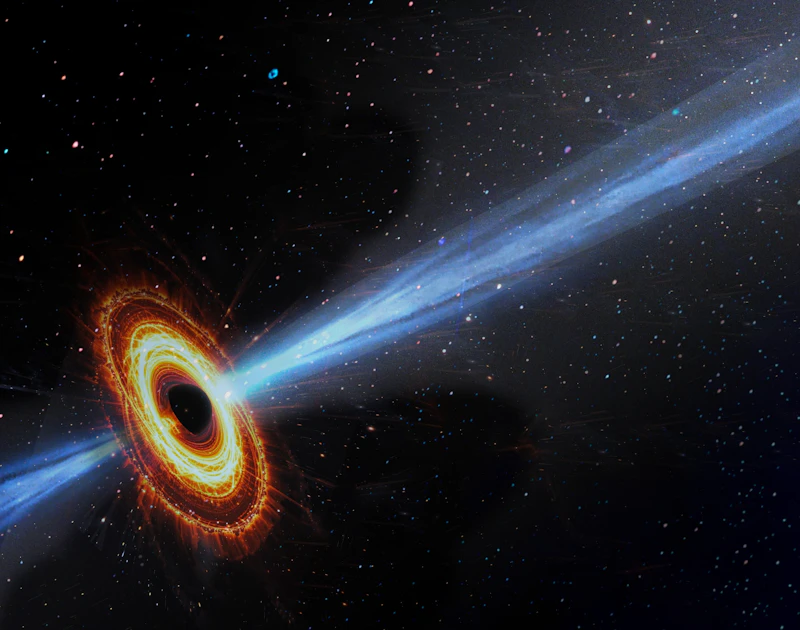
M87* (the asterisk is pronounced “star”) is the supermassive black hole at the center of galaxy M87, some 55 million light-years from Earth. It was the first of two black holes that’ve been imaged; the other is Sagittarius A* (Sgr A*), the Milky Way’s own central black hole. Recently, theoretical physicist Alex Lupsasca, of Vanderbilt University, gave a presentation at the Simons Foundation, in Manhattan, that opened with a remarkable video zooming in on M87, then entering the galaxy and ending with a blurry image of M87*. This was real imagery, he explained, not a simulation. It had required a network of telescopes spanning the Earth, called the Event Horizon Telescope (EHT), to produce these images.
Lupsasca then shifted to a simulated image, an extrapolation from the known data. Now one saw the black hole as a well-defined circle of darkness at the end of a tunnel, the walls of which were glowing gas. A bright circle near the darkness was a “photon ring,” light that’s orbiting the black hole, whipping around it amid distorted spacetime. Getting real images of such a scene, he explained, was the goal of a proposed project called the Black Hole Explorer (BHEX), which would expand EHT’s capabilities through an Earth-orbiting satellite. If approved as a NASA project, BHEX could be in orbit in 2032. Its projected cost is $190 million, putting it within the scope of what NASA calls a Small Explorer Mission (SMEX).
Closer examination of black holes and their photon rings is a complementary approach to the burgeoning field of gravitational-wave astronomy, which measures distortions of spacetime from violent cosmic events, particularly collisions of black holes. Moreover, a key motivation for pushing the envelope of knowledge about black holes, Lupsasca explained, is not just that “they’re cool” but that they’re a promising avenue into quantum gravity, a century-old conundrum of making two foundational theories of modern physics—quantum mechanics (focused on the very small, such as particles) and general relativity (dealing with the very large, such as stars and galaxies)—compatible with each other.
Quantum mechanics provides details of three of nature’s four fundamental forces: electromagnetism (visible light, radio waves, and so on), the strong nuclear force (which holds the nuclei of atoms together and can release massive energy), and the weak nuclear force (responsible for radioactivity). General relativity focuses on the fourth—and weakest—force, gravity, which becomes dominant only when dealing with the most massive objects. (At the lecture, Lupsasca jumped at the podium, demonstrating that the electromagnetic bonds in his legs could briefly overcome the gravitational field of Earth.)
Besides his academic post, Lupsasca took a position at OpenAI last year, to explore how AI programs such as ChatGPT can help make headway on quantum gravity and other physics problems, a prospect of which he’d once been skeptical. He and colleagues recently posted a preprint paper describing how GPT-5.2 Pro and other models enabled an unexpected finding about the helicity, or spinning motion, of gluons, particles that carry the strong force. This caused a stir in physics circles for AI’s prominent role in the research.
The audience at the Simons lecture, including both scientists and laypeople, asked Lupsasca about some exotic possibilities that may stem from BHEX. Could the satellite detect a wormhole, a theorized tunnel through spacetime? Nobody knows, because it’s not yet confirmed that wormholes exist. Could a black hole serve as an energy source? In theory, yes; but the practical obstacles may be insurmountable, including a lack of black holes in Earth’s vicinity and that no one knows how to create one. And yet, Lupsasca noted, theorists like him shouldn’t underestimate what experimentalists may someday achieve.