

College Point, a middle-to-upper class neighborhood in northern Queens, is isolated as only a few roads connect it to its more populous neighbor to the south, Flushing. The Whitestone Expressway and the current wasteland (but maybe soon to be developed) former Flushing Airport grounds cut it off; to travel south on local routes, it’s easier to go east to Whitestone, then south.
College Point was built on the manufacture of rubber. Conrad Poppenhusen (1818-1883) arrived here from Germany in 1854 and converted College Point into a company town. Poppenhusen opened a large rubber factory employing hundreds of immigrant workers and native College Pointers; he produced rubber products, combs, dental and medical goods and hardware; he also built the Flushing and North Side Railroad, now a part of the LIRR Port Washington line, and later owned the LIRR between 1876 and 1879. Poppenhusen built water and sewage systems, a library, and the Poppenhusen Institute, which included the first free kindergarten in the United States (see below). He’s recalled by the Institute, an avenue, and an 1884 bust by Henry Baehrer at Poppenhusen Triangle at College Pl. and 12th Ave., seen above.
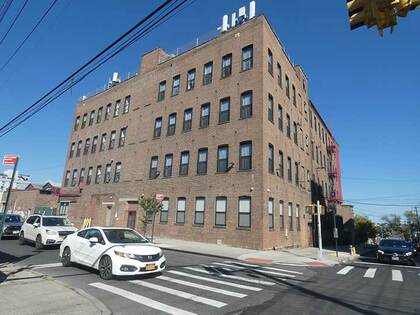
Meanwhile, Isaak B. Kleinert founded a rubber company in College Point in 1869, and constructed this stolid four-story brick factory at 20th Ave. and 127th St. in 1889. A second building arrived in the complex in the early-20th century, across 20th Ave. The Kleinert company is credited with inventing or pioneering the manufacture of the shower cap, shower curtain, dress shields (underarm garment pads), and waterproof baby pants. Kleinert also made bathing caps, beach bags, rubber-lined swim accessories, corsets, and bras. The company’s still in business, selling dryness and incontinence garments available by mail order, though its factory moved to Alabama many years ago. This factory building was a lamp wholesaler but is home now to several small business offices.
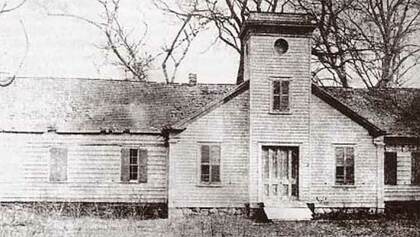
Photo courtesy “College Point” by Victor Lederer, Arcadia Publishing
College Point was originally settled by the Native-American Matinecocks. The Indians sold much of it to New Netherland Governor William Kieft in 1645. William Lawrence was the first British settler (College Point Boulevard’s name until 1969, Lawrence St., honored the Lawrence family) and by 1838, Augustus Muhlenberg, rector of St. George’s Church on Main Street in Flushing, had founded St. Paul’s College in the area. The college foundered within a decade, but the place names College Point and College Place recall it.
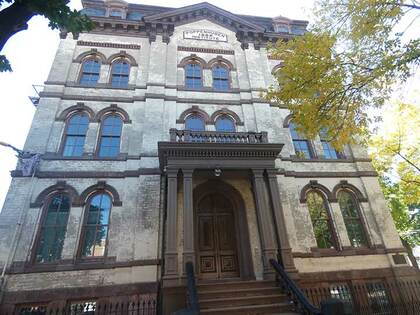
Conrad Poppenhusen’s philanthropy and good will was responsible for College Point’s early development. The Poppenhusen Institute, built in 1868 at what is now 14th Rd. and 114th St., featured the nation’s first free kindergarten, as well as a justice of the peace, the first home of the College Point Savings Bank, German singing societies, the first library in the area, a court room, the Sheriff's Office with two jail cells, and a grand ballroom.
Today the Institute is used as a community center and features karate and piano lessons, summer band concerts, and fire department museum and Native-American exhibits, while the ballroom is rented for wedding receptions. It’s open by appointment and whenever the Institute schedules a musical or historical program.
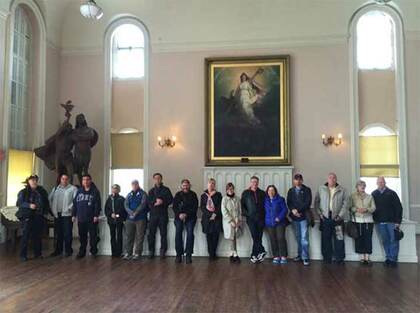
Two Forgotten New York tours I’ve conducted took place in College Point, and I obtained this photo of our group in the Institute’s upstairs ballroom, where two major works of art are exhibited: Friedrich Spangenberg’s painting, “The Triumph of the American Union,” and a plaster cast of local sculptor Hermon McNeil’s “Coming of the White Man” depicting two Native-Americans observing the Lewis and Clark expedition in the early-19th century.
According to the Institute, “Renowned sculptor Hermon Atkins MacNeil has an important place in the history of College Point and in the annals of the Poppenhusen Institute. MacNeil was born in Massachusetts in 1866 and received his early training at Boston’s Normal Art School. He went on to study in Paris and Rome and held teaching positions at Cornell University, the Art Institute of Chicago, and the Pratt Institute. His early work included assisting with sculptures on various buildings on the 1893 World’s Columbian Exposition in Chicago. It was during his time in Chicago that MacNeil developed his interest in depicting Native American subjects, which remained a major theme throughout his career.
When he moved to College Point in 1900, MacNeil had already won attention and several awards for his work but a series of important commissions soon established him as a major American sculptor. Some of his important works are The Sun Vow (Metropolitan Museum of Art), Coming of the White Man (Portland, Oregon), the McKinley Memorial (Columbus, Ohio), the Soldiers and Sailors Monument (Albany, NY), the Marquette Memorial (Chicago), the Pony Express Rider (St Joseph, Missouri) the figure Washington as Commander-in-Chief of the Army for the Washington Square Arch (NYC), and the pedimental group for the east wing of the United States Supreme Court Building, Washington, D. C. He also designed the U.S. Liberty Quarter that was minted from 1916 to 1932.”
MacNeil had his home and studio at 121-01 5th Ave. in College Point, where he remained until his death in 1947. He sometimes used local residents as models for his designs, and in 1966 Mayor John Lindsay renamed College Point’s Chisolm Park in honor of MacNeil. McNeil donated to the Institute a plaster cast of his bronze sculpture “Coming of the White Man.” The bronze was completed in 1904 for a city park in Portland, Oregon.
Meanwhile, German immigrant Friederich Spangenberg’s “The Triumph of the American Union,” executed in 1867, celebrates the end of the Civil War and depicts Lady Liberty hovering over the commanding generals of the Union and Confederate armies, General Ulysses S. Grant and General Robert E. Lee. Liberty is veiled with the American flag, holding aloft the victor’s laurel wreath and sword, facing down. She’s accompanied by an American eagle.
The institute acquired the work in 1870 and hung in the main hall until 1980, when the building was intended to be sold as well as the artworks. The painting was boxed up and disappeared for four years. It was located in 1984 and its then-owner donated it back to the Institute. Spangenberg was born in Gottingen, Germany, in 1843, and died while ascending Mt. Vesuvius, June 8, 1874.
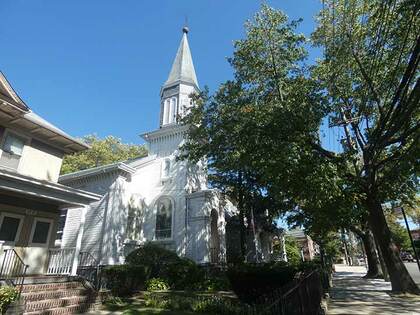
The doyenne of 14th Ave. is the wedding-cake white First Reformed Church at 14th Ave. and 119th. It was built in 1873 with the chapel about a decade later. Poppenhusen donated much of the necessary funding. The building’s what is known by architectural cognoscenti as Eastlakian Gothic (after an early proponent named Charles Eastlake), with Italianate touches. Also known as “Stick Style” after the thin timbers used in the ornamentation. In 1992, the church considered using vinyl siding to cover the walls, but decided against it from an aesthetic viewpoint. The church had to rebuild after a devastating fire on June 6, 2008.
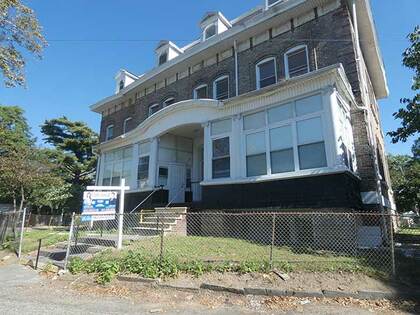
The traffic circle at 13th Ave. and 123rd St. is occupied by just one building: the red-bricked, dormer-windowed Grand View Hotel, built in 1853 as Herman Schleicher’s mansion. Schleicher supported the South in the Civil War, and ran guns to the Confederates. It later became the Grand View Hotel (its elevation permitted views of the East River and Flushing Bay) and later became divided into apartments.
The building predates the College Point street grid, so instead of moving the building, a traffic circle was laid out around it. The same thing happened with the Boker Mansion, which stood in the middle of 120th St. north of 14th Ave.: it was in a bad position when cross streets were cut through early in the 20th century, and unlike other houses in this circumstance, it was never moved. The mansion became a hotel, the College Point Clubhouse, and was divided into apartments, all the time falling into decrepitude. At length, it was razed in 2004, 120th St. built through, and new houses built in its place. The Grand View looks to be in similar danger; a For Sale sign has appeared at the entrance.
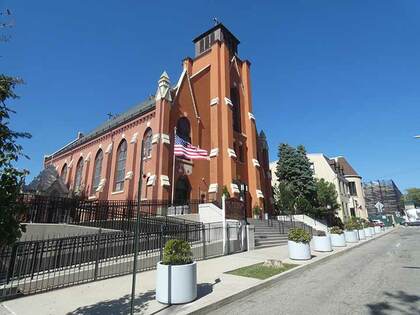
Father Joseph Huber, Austrian by birth, came to College Point in 1856 to found the town’s first Catholic parish. He oversaw the original church’s construction, dedicated to St. Fidelis of Sigmarigen, Germany, a Franciscan Capuchin monk who was martyred in 1577. So many German and Irish Catholics moved to College Point throughout the second half of the 19th century that the church became inadequate, and on September 3, 1894, the cornerstone for the second St. Fidelis was laid.
—Kevin Walsh is the webmaster of the award-winning website Forgotten NY, and the author of the books Forgotten New York (HarperCollins, 2006) and also, with the Greater Astoria Historical Society, Forgotten Queens (Arcadia, 2013).