
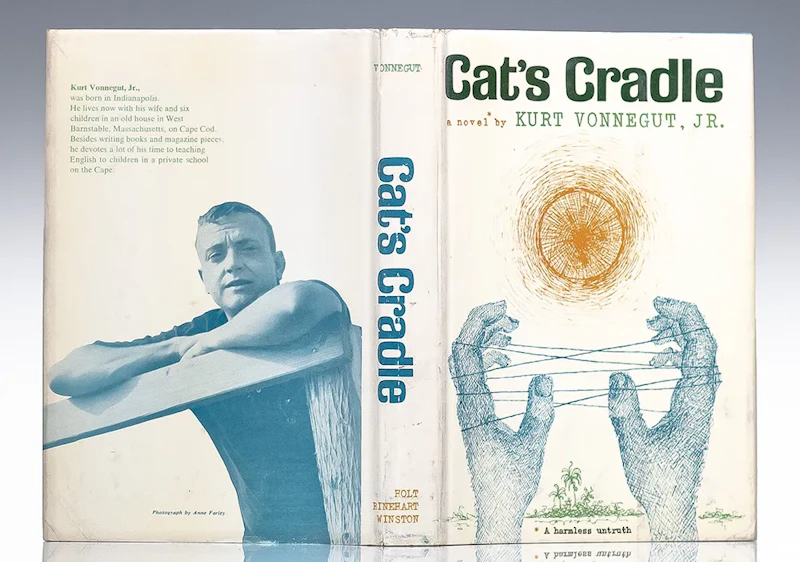
Kurt Vonnegut’s explosive development as a writer continued with his fourth novel, 1963’s Cat’s Cradle. Among the story’s ingredients are an invented religion, a science-fictional doomsday device, cold war paranoia, empathic humanism, and coal-black despair. And, fitting together, this illuminates character and creates a vision of the world.
Specifically, the early-1960s. The novel’s about the end of that world, though the plot takes a while to get there. It’s the tale of a writer named Jonah, who in the first chapter sets out to write a book about what the creators of the atom bomb were doing the day the bomb was dropped on Hiroshima. That leads him to investigate the life of dead physicist Felix Hoenikker, and to learn about an idea Hoenikker had for something called ice-nine.
Ice-nine is a form of water that freezes at room temperature and changes normal water to ice-nine when mixed. Capable of bringing about the extinction of life on Earth, it was created by Hoenikker out of an interest in the pure science behind ice-nine’s chemistry. But when Jonah’s book idea falls through and he pursues another story in the fictional Caribbean island of San Lorenzo, threads of the novel dovetail and ice-nine comes to the forefront.
The ending’s inevitable. If a new technology that can do nothing but destroy the world is introduced in the first act of a story, the final act’s going to revolve around its use or lack of same. Yet Cat’s Cradle never feels predetermined, in part because it’s consistently quick, funny, and terse, with sharp prose.
That’s helped by the structure. Vonnegut builds the book out of short chapters, often a page or less in length. A scene can include many chapters, each with its own internal build and logic. Vonnegut talked about the structure as a mosaic, with each chapter as a tessera that builds the overall book. The effect, especially early on, is of a sprawling richness that bit by bit reveals a network of connections.
That’s appropriate for a book called Cat’s Cradle; as the image is of a single piece of string turned into a complex pattern of loops, so the first-person narration is a strand of event that loops around to link themes and plot points. The image is also reflected in the fictional religion called Bokononism, many of whose beliefs are about the way people and things are connected without their knowing. We get glimpses of Bokononist beliefs because Jonah, as he tells us early on, is led to convert by the events of the novel. And that also should be a hint about how the story will go, because Bokononism is a heady mix of the absurd, the cynical and the humanistic.
Some Bokononist ideas have gone beyond the book, such as the concept of the kerass, a group of people often without any obvious connection who are nevertheless intertwined with each other’s destinies. That again speaks to the book’s theme of the unexpected interrelations of things. Chaos theory was only just emerging in 1963, while the Gaia hypothesis and the Big Blue Marble photo of the Earth from space were years away; Vonnegut was ahead of science here, intuiting truths about how the universe was put together.
The idea of the interrelatedness of everything would lend itself to hippie mysticism later in the 1960s, but early-1963 was a world away from the mainstreaming of the counterculture. JFK was still alive when the book was published, and the Cuban Missile Crisis was recent memory. Vonnegut’s tale, in which apocalyptic technology’s involved with the politics of a Caribbean island nation, speaks directly to the Cold War; just as Hoenikker’s lack of awareness of the real-world consequence of ice-nine reflects some of the nuclear physicists of the pre-Hiroshima era, creating world-changing technology without realizing what the ramifications would be when other human beings got their hands on it.
Ice-nine’s a parallel to the bomb, inevitability in waiting. The climactic actions of the book are triggered by a military accident, echoing Cold War fears of a mechanical malfunction setting off nuclear war. The characters don’t intend the consequences of their actions. But the flip side of the interrelatedness of everything is the impossibility of fully predicting the consequences of any given action. Things go wrong. That’s how the world works.
And for all the book’s humor and invention, it’s a story about things going wrong. Jonah doesn’t do very much, compared to the standard lead character of most novels. He makes a research trip and fails to complete a book, and then makes another trip to research an article only to have a brief detour into local politics come to nothing when disaster strikes. He does nothing to shape events, and there’s not much he could’ve done. This isn’t that sort of novel.
It’s a sardonic story that tells us that in the long run everything goes wrong and we’re all dead. We get consolations in the form of art and religion. But those are best, Vonnegut suggests, when they prepare us for the inherent absurdity of the universe. They’re delusions that make life livable.
The novel is of its time, but it still lives. Life is no less absurd now than it was then, and some of the many threads of connective tissue between people and things are more obvious. Cat’s Cradle, inventive and perceptive, is an observation about inevitability as true now as it was in the early-1960s.