

The Revolutionary War was plotted, fought and negotiated on several sites in all five boroughs, including the Bronx. Here are some remaining monuments and sites that directly refer to the events and personalities of the war of revolution fought from 1776 through 1783.
Van Cortlandt Mansion, a Georgian-style country house made in the fieldstone style within Van Cortlandt Park east of Broadway and E. 242nd St., was built in 1748 for Frederick Van Cortlandt, the scion of a prominent family. The Van Cortlandts had been in New Amsterdam since brewer Oloff immigrated from Holland in the mid-1600s, and acquired much of the land that was to become the park by the turn of the 18th century. The vast athletic field north of the mansion was at one time the Van Cortlandt farm, and had large planting fields, livestock, and a grist mill. The Van Cortlandts employed slave labor in the colonial period.
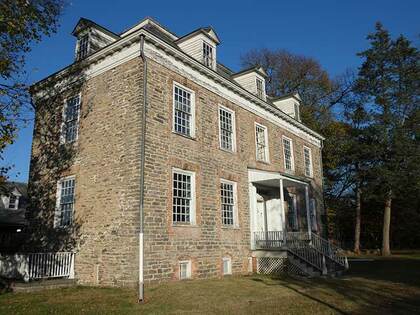
George Washington used Van Cortlandt Mansion as a headquarters during the Revolution (as he had in the Morris-Jumel Mansion in Washington Heights). It’s maintained by the National Society of Colonial Dames as a museum appointed with period Colonial and Federal collections. The Van Cortlandt family granted the house and grounds to New York City in 1889. The estate became Van Cortlandt Park, which at over 1100 acres is one of NYC’s largest parks.
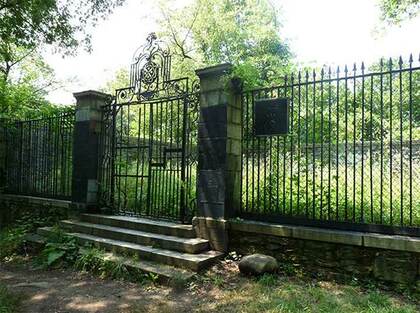
Roaming in Van Cortlandt Park east of the Parade Grounds and athletic fields (including NYC's premier cross country running course) that line the park's western flank at Broadway and just south of the Henry Hudson Parkway you can find the original burial plot of the Van Cortlandt family, Vault Hill. NYC municipal records were hidden from the Brits here in 1776 by NYC clerk Augustus Van Cortlandt (Frederick’s son), and in 1781 George Washington lit campfires here to deceive the British while he marched to Yorktown to face Cornwallis in a decisive battle of the Revolution. By 1917, the region in view of the cemetery was used as a training ground for World War I troops. Doughboys dug trenches and hiked the surrounding hills. Most of the Van Cortlandt family remains are now in Woodlawn Cemetery.
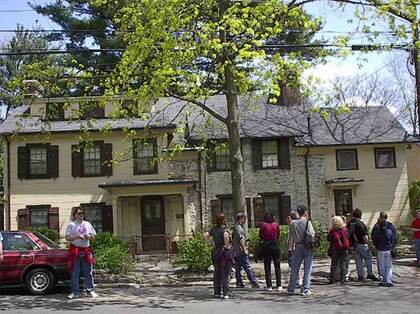
Brothers George and William Hadley built the center section of this two-story colonial on Albany Post Rd. just north of W. 251st St. in the mid-1700s, making it just younger than the Van Cortlandt Mansion. In 1777, the Hadleys used the house as a garrison for a corps of volunteers serving the patriots’ cause. In 1829 it became the property of Major Delafield, along with much of the rest of Riverdale and Fieldston.
In 1915, Dwight James Baum, who had a hand in Riverdale’s architecture, remodeled the Hadley house, adding wings to the north and south. Baum was careful to maintain the house’s original features. The house has now survived over two centuries, and escaped demolition in 1999, and was sold that same year to private owners who are maintaining the property.
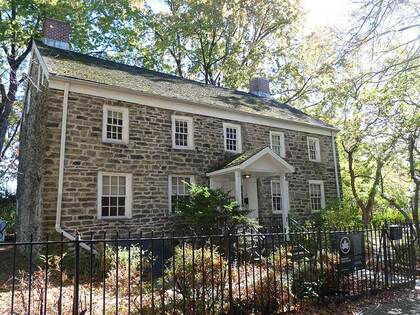
Though Brooklyn has the lion’s share of pre-Revolutionary War houses, there’s one in Norwood that qualifies, just barely. In 1758 blacksmith Isaac Valentine purchased property from the Dutch Reformed Church at today’s Bainbridge Ave. and Van Cortlandt Ave. East, and, depending on what account you read, built this fieldstone cottage either in the 1750s or as a successor to a previous home in 1775.
Like the Old Stone House in Brooklyn’s Park Slope, the Valentine cottage was the scene of a Revolutionary war battle: by 1777 the home was occupied by British and Hessians but was recaptured by General William Heath after a brief but fierce battle which left the house surprisingly intact.
By 1791 the house and land was sold to Isaac Varian, whose grandson, Isaac L. Varian, became NYC mayor between 1839 and 1841. After changing hands several times the house became home to the Bronx County Historical Society in 1965 and was moved across the street. Unlike the Old Stone House in Brooklyn, this building never fell into disrepair and required reassembly. Interestingly, Van Cortlandt Ave. East, near where the cottage stands, was the original post road to Boston, which ran from Spuyten Duyvil east and northeast.
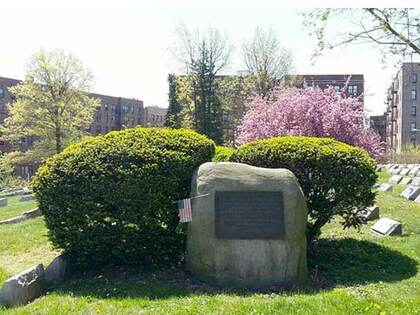
In January 1777, skirmishes occurred between the patriots and the British at Fort Independence, located then where Giles Pl. and Sedgwick Ave. in Kingsbridge Heights would be, and then at John Williams’ bridge at Gun Hill Rd. and the Bronx River. The patriots took refuge at a redoubt (a small temporary fort made of earthworks, stone or brick) on January 25th, 1777, that was located just north of E. 211th St. and west of Webster Ave. in what is now Woodlawn Cemetery.
A monument to this redoubt can be seen inside the southern Woodlawn Cemetery fence north of the intersection of E. 211th and Decatur Ave. The patriots, commanded by Major General William Heath, fired cannon at the British here, which sent the King’s forces retreating. The spot became known as “the gun hill.” The monument cannot be seen from the street, and is on Heliotrope Avenue inside Woodlawn Cemetery.
By 1875, Gun Hill Rd. had received its name west of White Plains Rd., but the Bronx east of that was mostly farmland and meadows at the time. As the Bronx became built out and newly populated, a grid system of streets was laid out and Gun Hill Rd. was extended east, arriving at its present length in 1938.
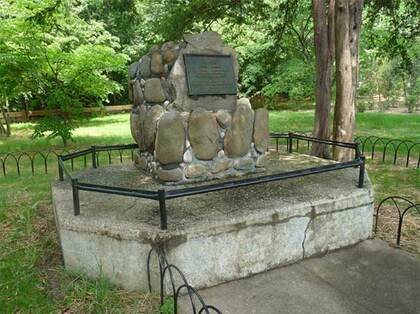
On August 31, 1778, 17 Mohican Indians, led by Daniel Nimham and fighting on the side of the patriots, were massacred after their defeat by Colonel Simcoe and his Queens Rangers, fighting for the Crown. The Indians are commemorated at Indian Field in Van Cortlandt Park on E. 233rd St. east of Jerome Ave. The Mohicans, all from Stockbridge, Massachusetts, had tracked the British through the Bronx but were finally met by an overwhelming force of British and Hessian troops. This battle, on land owned by the Devoe family, was the only one in the Revolutionary War that occurred completely within what would become Van Cortlandt Park.
The Mohicans were buried in Indian Field by the Devoes and their gravesite’s marked by a plaque and a cairn, a stone mound used in Scottish burials, at Van Cortlandt Park East and E. 238th St. Chief Nimham was also commemorated by tiny Nindham Pl. in Kingsbridge Heights, but that street has since been de-mapped.
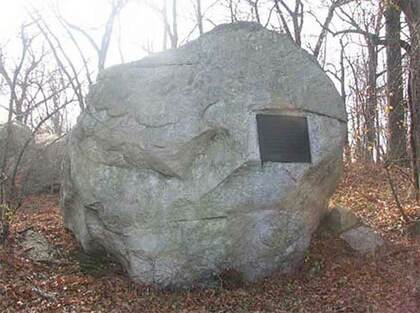
Something you discover when researching these historical markers is that sometimes they were placed far out on the city outskirts, where you wouldn’t see them unless you happened to be driving past. That’s the case with Glover’s Rock, which is located up on the south side of Orchard Beach Rd. near Park Dr. in vast Pelham Bay Park.
As much as can be determined, it was used as an Indian lookout; the area had an Indian trail long before Shore Rd. appeared. The rock’s main claim, though, was that on this spot during the Revolutionary War in October 1776, Colonel John Glover (1732-1797) and his 14th Continental Regiment, largely made up of militia from Marblehead, MA engaged the British during the Battle of Pell’s Point and took heavy casualties, allowing a retreating General Washington to escape. The Redcoats had planned to cut off the patriots at Rodman’s Neck, a nearby peninsula jutting into Eastchester Bay. Glover’s men, who numbered just 550, had to deal with as many as 4000 British and Hessians. Glover placed his regiments behind stone walls lining the Pelham Road; Glover’s brigades held their positions as long as they could until the enemy advanced, and then retreated to join the next regiment’s position. The enemy was forced to engage more and more patriots as the battle unfolded. Washington’s forces were able to move north to White Plains due to Glover’s delaying strategy. Glover’s regiment took 12 casualties while claiming nearly 1000 from the Crown. His Marbleheaders later assisted Washington in his famed Delaware crossing.
Glover’s Rock is marked by a tablet erected in 1960 by the Bronx Historical Society, replacing an earlier one placed in 1901 by the Daughters of the American Revolution.
—Kevin Walsh is the webmaster of the award-winning website Forgotten NY, and the author of the books Forgotten New York (HarperCollins, 2006) and also, with the Greater Astoria Historical Society, Forgotten Queens (Arcadia, 2013)