
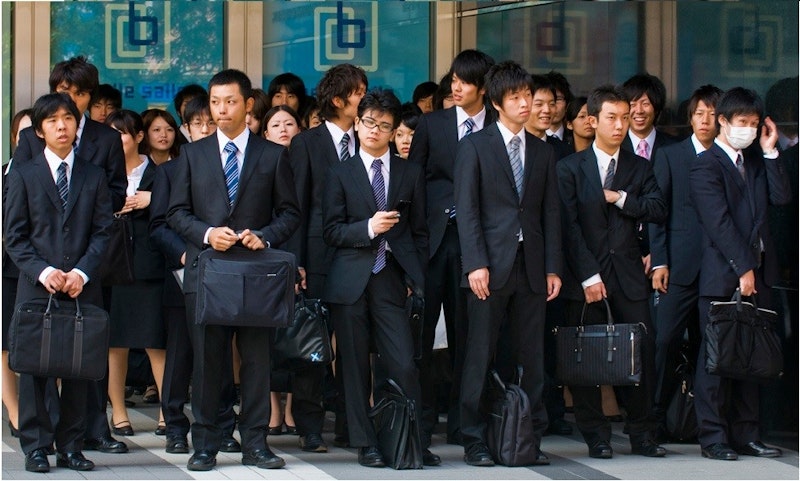
I lived in Tokyo for several years. My first job there was teaching English at Berlitz. All that was required was a college degree. This put me in contact with a number of people I enjoyed spending time with, and became friends with outside of the job, but the harsh, everyday reality was me sitting across the table from the dreaded (by all the teachers) “salaryman” with no visible personality who bored me to death.
Time slowed down on these occasions. The school’s management told me that the main complaints I used to get from such students was my yawning, but I considered it an accomplishment just to stay awake for the entire 45-minute session.
I shouldn't be too hard on these dedicated worker bees. Often, their companies force them to attend English lessons even though they have no interest in learning English. Plus, their free time was precious to them because they got so little of it.
All those excruciating hours in a small room at the school added up to a real—and depressing—experience. What I learned was that Tokyo was a city of crushed souls, a story that's less visible than it deserves to be because of the stoicism ingrained into the Japanese male that masks the despair. The gaman spirit—restraining impulses, suppressing complaints, and enduring hardship quietly and with dignity—is a valued trait in Japanese society. I’d routinely ask these suited corporate warriors what they did on the weekends, knowing that I'd hear the dreaded answer, “Sleep,” which isn't much of a conversation starter.
I’d heard that the Japanese pursued their hobbies with vigor, and they really dressed for the part. This interested me, and I thought I was in a position to learn more about it. People told me that amateur bicyclists in Japan are indistinguishable from Tour de France trainees, that weekend photographers look like they’re on National Geographic assignments, and that regular hikers appear to be devoting themselves to an Everest base camp training day.
It was disappointing to hear almost nothing about any passions for my students’ hobbies. Rather, they seemed drained of all energy for life—stuck on a treadmill that wore them out, but took them nowhere but retirement at the end of the long road. I'd never heard about people talking about sleeping with so much reverence.
I was also surprised to hear so much about their famirī sābisu (family service), which refers to going on weekend outings with the family that the wife—never the husband—has chosen. The husbands are so tired from work that they'd rather sleep, but they go on family outings out of obligation in a life that's dictated by obligations rather than choices. Just think how off-putting it’d be to hear an American man, when asked what he did on Saturday say, “family service,” rather than just saying what he did with his family, like it was just another job.
These men chose a life that makes them semi-voluntary, overworked cogs in the labor pool, but the social pressures to do so are enormous. In Japan, it’s all about putting the group first, maintaining harmony, and controlling personal impulses. Parents, teachers, and girlfriends’ parents all ask the same question of male college grads: “Which company did you join?”
The right answer—an established, prestigious firm—makes one marriage material, but getting the girl comes at a high price. There's no viable plan B for regular guys in Japan, and once they're in, they're in for life. No second acts in a Japanese man's career. After 10 years of the corporate grind, they have specialized skills that only have value inside Japanese corporate culture.
The typical salaryman’s day starts at 5:30-6:00 a.m. Their wives don't drop them off at the station, so many have a 15-minute bike ride to get there, and it may be raining. Some are lucky enough to get a seat on the train, meaning they can drowse, but most have to strap-hang with multiple bodies pressed against them.
When the salaryman gets to the office after a long commute, he's already experienced an ordeal. The day starts with a group huddle followed by more meetings, many of which are ceremonial or for consensus-building purposes, some of which are meetings to prepare for meetings. After a quick lunch, there are more meetings, document stampings, and client visits.
After the official quitting time there's sabisu zangyō (unpaid overtime), common but illegal, followed by nomikai (after-work drinking) two to four times a week on average. But it's not the optional, after-work drinking American workers do. Not participating is a career killer.
Tokyo’s the only city I've been in where it's common to see men in suits puking in the streets late at night, often with colleagues rubbing their backs. Group harmony, probably the defining characteristic of Japanese culture, can be rough on the body and mind. Starting a long work day with a hangover is a regular reminder of that in Japan. Being a teetotaler isn't an option.
Some of the guys I taught told me how much they hated nomikai. Others said that their kids were asleep when they left in the morning and when they got home. They’d complain that the drinking money was coming out of their own pocket—sometimes the company covers the cost and sometimes it doesn't—and about hearing the same stories from the 60-year-old executive about his golf score on the weekend.
A Japanese woman who worked in a major Japanese corporation once told me that one of her co-workers got so drunk at a nomikai that he returned to the office instead of going home when it was finished. Perhaps he’d missed the last train. When workers arrived the next morning, they found him lying by his desk with his pants down. HR would get him into rehab in this country, but there were no repercussions. That's what allows the nomikai tradition to continue.
The pressure to conform at work in Japan can lead to the loss of one's identity to the point where some salarymen don't know which version of themselves is real—the one at the office or the one at home. These men become invisible.
The salaryman life doesn’t kill dreams cleanly. Instead, it slowly strangles them in the polite, Japanese way by stacking 16-hour days on top of each other for decades without giving workers any sense of building something or making their mark in a tangible way. Such is the danger of living in a society that values all kinds of duties except for the duty to oneself.