
When Jeff Bezos launched Amazon in 1995, he declared war on independent bookstores. Los Angeles institutions like Midnight Special, Samuel French, Dutton’s, Dawson’s, the Bodhi Tree, Caravan Books, Metropolis, A Different Light and Williams Bookstore all fell prey to the internet and digital book sales. One bookstore defied expectations.
The Last Bookstore sits at the corner of Spring and 5th Street in downtown Los Angeles. The area was once the center of LA’s financial district. Today, the neighborhood teems with crime, poverty and homelessness. This isn’t where you’d expect to find a thriving bookstore with close to half a million books.
To understand the Last Bookstore, you need to know the origin story of its owner. Josh Spencer was always passionate about books. As a teenager, he loved fantasy, science fiction and graphic novels. His family moved back and forth between North Carolina and Hawaii. Spencer embraced outdoor sports like hiking, surfing and beach volleyball. He enrolled at the University of North Carolina in 1994 to study religion and communications. His long-term plan was to become a teacher in Japan.
Then tragedy struck. In 1996, Spencer was riding a moped with friends. He failed to stop at a stop sign and was struck by a speeding car. His injuries were severe: collapsed lung, broken pelvis, two exploded vertebrae. He endured several spinal surgeries but became paralyzed from the waist down.
As he lingered in his hospital bed, a Bible verse from the Book of Job cycled through his mind. Shall I accept good from the Lord, but not trouble? Spencer told New Mobility Magazine, “I felt, then, that what was happening to me was fine and maybe was even supposed to happen. It was what my lot was, coming to me from God.”
After the accident, Spencer returned to Hawaii. He played cards with friends on the beach and immersed himself in video games. He was aimless and filled with self-pity. He told filmmaker Chad Howitt in the documentary Welcome to the Last Bookstore, “There were years of struggle and crying and questions like how can I still be a man when I’m half paralyzed? How can I succeed in this world and have a family?”
Spencer’s parents offered emotional support and his grandmother paid for his apartment. He fell into an abyss worsened when his longtime girlfriend Jenna broke up with him and left Hawaii. Spencer tried unsuccessfully to find work. He started a magazine about books and movies. This went nowhere. He sought help in therapy but after his parents’ divorce, he bottomed out. Needing a change of scenery, he moved to Los Angeles. He found a tiny loft on Main Street in a dingy part of downtown. He lived on welfare and food stamps.
Feeling like a loser, Spencer began selling books on eBay. He found titles at thrift stores, garage sales and library bookstores. He was at a disadvantage due to his wheelchair. He told the Los Angeles Times, “I would find ‘back doors’ where I didn’t have to compete with people physically but could use my relationships to gain an advantage. What if I volunteered at this library sale? Will they let me buy books when nobody is around?”
He soon made enough money to pay his rent and begin saving. Books piled up in his apartment. A friend encouraged him to open a brick and mortar store. He was hesitant. To start a new bookstore when bookstores were dying seemed foolhardy. But then a 1000-square foot loft became available across the street from his apartment. In 2009, this became the first iteration of The Last Bookstore.
On opening day, locals waited in lines eager to support any effort to help the downtown renaissance. The store was an immediate success. Two years later, Spencer needed a larger space. He scoured the area until he found an old bank building from the 1920s. The space had two stories, 22,000 square feet and six 25-foot high pillars. Spencer felt this new location was perfect for the bookstore.
As Spencer sat in the massive empty venue, he let the room speak to him. He told the Times, “the vibe I got was Indiana Jones, an early ’20s-’30s university kind of thing. And maybe a Hellboy steampunk feel, too. Stylish and fantastical.”
He wanted to create a place where locals would hang out all the time. He visualized a “huge living room with comfortable chairs and couches and a swirling maze of bookshelves, cabinets and curiosities.” He felt it should be a home away from home, a cultural gathering spot for downtown denizens.
Spencer’s father was a contractor. He traveled to LA to help his son bring the store to life. They acquired bookshelves from bankrupt bookstores including Borders in Glendale. They called upon local artists who lived in the building to design creative artworks with a literary theme.
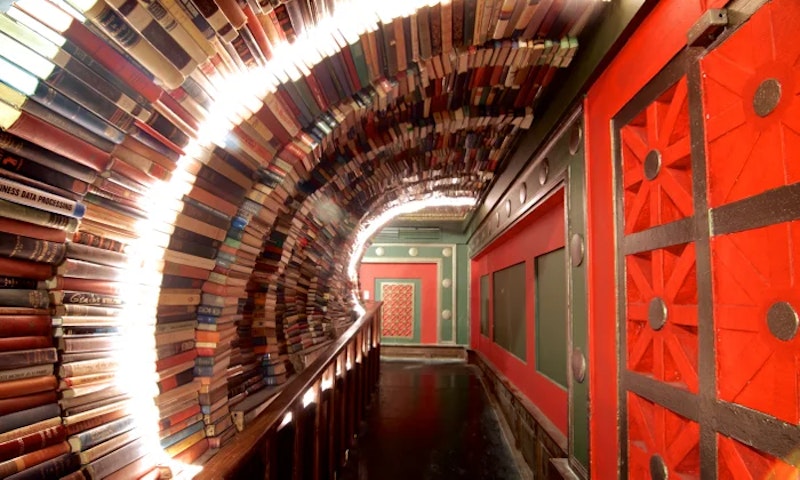
The upstairs section became part-bookstore, part-art installation with conceptual pieces made of flying books and floating typewriters. Spencer called this area the Labyrinth. A walk-in bank safe became the Science Fiction room. The walls were pasted with comic book wallpaper. There were windows made of books, a tunnel made of old books, a book section arranged by the color of book jackets. Spencer included a dollar room where books cost $1 each. To make book searching exciting, he hid valuable first-edition books in the dollar stacks.
“In the beginning I thought I’d make an art project bookstore that was destined to fail. But after my injury my perspective changed like looking at everything as a challenge and not being afraid of failure.”
In the documentary Welcome to the Last Bookstore, Spencer told filmmaker Chad Howitt, “Selling books is not a way to get rich. You have to really love it. Why wouldn’t you want to work with something you love? If I didn’t make any money at all I’d still want to do this. It’s a hobby that turned into a business that became an obsession. It doesn’t feel like work to me.”
Spencer views Los Angeles as a literary haven and the store as a support group for LA writers and readers. It’s also a landing spot for employees from bookstores that went out of business. Last Bookstore employees come from stores like Book Soup, Borders and Chatterton’s.
The Last Bookstore is a remedy for corporate stores like Barnes & Noble. They host author readings, book signings, poetry slams and musical performances. Twice a year they have a large flea market in the outdoor parking lot. They donate books to schools, hospitals and inner city libraries.
Spencer appreciates how the bookstore unites disparate aspects of the city. He told the Times, “I like that there’s an intersection of downtown’s past, downtown’s future and present. There’s a slight element of danger. People at all different places in life, people who are criminals, people who are in city government, people who are artists, all together. I think that’s vibrant and essential.”
Inventory is maintained through large estate purchases, personal donations and in-store buybacks. “It’s a treasure hunt,” Spencer told Chad Howitt. “Not just the books themselves but what’s inside.” Spencer has found money in books, old love letters, pressed marijuana leaves, personal photos, unpaid parking tickets. His one grievance is when donated books include toilet paper once used as bookmarks.
The Last Bookstore also sells vinyl records, old postcards, maps, pamphlets, magazines and LA-centric ephemera. They have a section dedicated to local history, another highlighting Los Angeles authors. They have a Rare Book Vault. (They sold a first edition copy of On the Road for $2300.) The store also features a restaurant called the Yuko Cafe.
On my recent visit to the Last Bookstore, I purchased a Black Sparrow Press copy of John Fante’s Ask the Dust, a hardcopy edition of Raymond Chandler’s The Big Sleep, a signed copy of Mike Davis’ City of Quartz and an original vinyl record of Nick Drake’s Pink Moon.
In 2009, Spencer reunited with his old Hawaiian girlfriend Jenna. They were married in 2013 and now have four children. Jenna helped Spencer survive the pandemic. She came up with ideas like selling curated book bundles, converting an upstairs office into a recording/podcast studio and renting out the store for weddings and film shoots. (The store was featured in the movie Gone Girl.) Jenna also inspired Spencer to open a second Last Bookstore location in Studio City. Spencer hopes one day to move into book publishing.
The Last Bookstore’s name was intended to be ironic but each year it feels more true. Spencer believes the digital age helped print books become more popular. He told the Times, “Everyone came out of the woodwork who really wanted to see books survive. This created loyalty among people who love books.”
Spencer’s life has given him a unique perspective on surviving difficult times. “I’ve lost things in my life much more dramatic than a business. There’s not much that can compete with that. If I can deal with that I can certainly deal with a business failing, it’s no big deal. No fear.”