
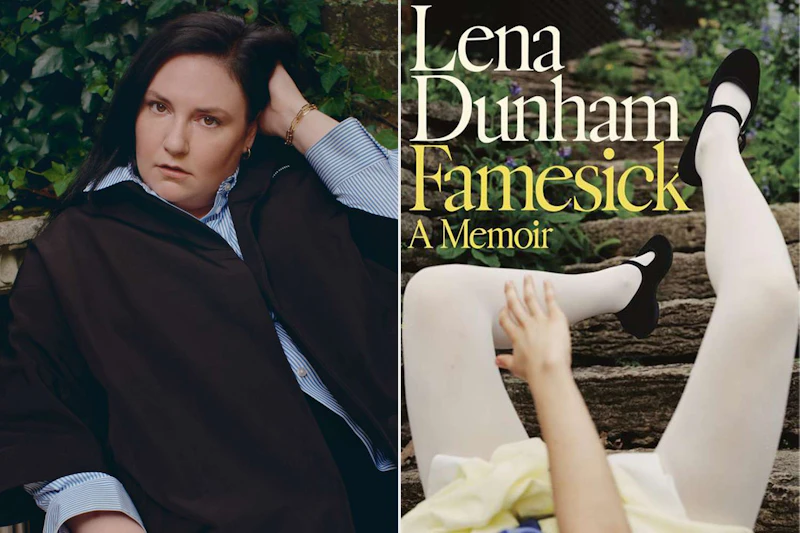
In the 14 years since its premiere, Girls and its creator Lena Dunham have endured and found new, younger fans. Once Zoomers started calling the show “HBO Girls,” Millennials commenced a mass rewatch of the show, and, for the most part, gave it the praise it always deserved. Dunham, however, remains a touchy subject for nearly everyone: the right thinks she’s a child molester, misogynist men think she’s too loud and fat, hipsters think she’s a loser, leftists think she’s a capitalist pig, and liberals think she’s uncouth. Unlike any other “voice of a generation,” Dunham’s fans have been her most vocal critics from the start; these were people who wrote for Gawker, Jezebel, and other New York media outlets, who saw themselves in Girls and in Dunham (on and off the show), and didn’t like it. Famesick, Dunham’s second memoir, has given the public an opportunity to finally appreciate Dunham in the way she should’ve been from the jump.
American pop culture doesn’t allow a celebrity to “have everything.” The public and the press are enraged by people like Quentin Tarantino, Demi Moore, and Dunham because there are supposed to be “trade-offs” for being famous and successful. Tarantino promises to stop directing after his 10th movie, and what do his critics do? Get mad. “The message behind that is, ‘You don’t get to stop until we tell you to stop.’” Besides an expectation that celebrities will remain humble and modest and oh-so aww-shucks about their good fortune, the public takes it for granted that they’re the ones who made celebrities, and they’re the ones who can unmake them. Tarantino, Moore, and Billy Corgan caught an enormous amount of shit for winning and being happy, but they ultimately didn’t care if everyone in the world liked them or not. Dunham, like all Millennials, wanted to be a “good person,” a born people-pleaser who learned the hard way that with fame comes vampires, sucking the life out of anyone with any kind of energy.
Jenni Konner, Dunham’s creative partner on Girls and Camping, is the book’s major bloodsucker: when they meet, Dunham’s 24 and Konner’s 40, and, already married with two kids, she sees Dunham as her ticket to fame (“Let’s get that private jet money!”). Shooting season one, she pressured Dunham to gain weight and, losing patience, would yell things like “Just fucking eat something.” Like so many in Dunham’s life, Konner assumes her health struggles are exaggerated or “all in Lena’s head,” and by the end of the show’s run, they’re barely friends anymore. Anyone who’s lived with a chronic illness or someone who has knows that people have very little patience for perpetual suffering, and after Dunham’s first few health “snow days,” just about everyone around her keeps their distance, annoyed and over their “drama queen” boss. The fact that she’s lost friends—because of her meteoric rise, her health, and her many overblown controversies—isn’t surprising, and I’m not sure what she could’ve “done” to cause this, considering she spent most of the 2010s essentially incapacitated.
Ashley Fetters Maloy offered a particularly nasty review in The Washington Post, writing that the book’s “blithe, sometimes spiteful oversharing is a feature, not a bug, of Dunham’s long career in the public eye. It does little, though, for her case for martyrdom.” Martyrdom? She lived through multiple medical nightmares, lost her fertility, and severe chronic pain going all the way back to the third season of Girls. Maloy suggests that, “Surely there was a better way to make it up to those friends lost along the way than by re-airing all their dirty laundry.” But Dunham tells a familiar tale of fame throughout the book: overnight success begets endless requests for “favors,” people you thought you knew show their true colors, even family members bristle at all the second-hand attention with their own egos inevitably singed by the glare. Maloy’s piece is built around the idea that Dunham was and is a people-pleaser, but a close reading (or simply a reading) makes it clear that this is one of many destructive patterns and behaviors Dunham’s since addressed. I doubt she’s taking scripts from strangers anymore.
“I wanted to have my cake and eat it, too,” Dunham writes, “to have this big, impossible life and be loved by everyone I met in the process.” This is the Millennial condition, a bad one, a childish way of looking at the world that Dunham regrets. More than success, it’s being perceived as “a good person,” whatever that means at the moment; early in her relationship with Jack Antonoff, Dunham notes that he “placed a premium on being a good person,” which, as always, was simply a social front with nothing behind it. Would a “good person” yell at their girlfriend, writhing in agony on the bathroom floor, telling her to get up so they can go on a glass bottom boat tour? Would a “good person” ask if surgery “could wait” until his tour bus gets out of the Holland Tunnel? If Antonoff isn’t a villain, he’s, at the very least, stupid. Too immature to understand Dunham’s pain, and put off by her and her family’s tastes and habits, he gives up and starts looking around (Lorde, not mentioned by name, comes first; she refers to Dunham as “Aunt Lena”).
“Jack had always placed a heavy premium on the idea of being a good guy. He held on to his high school friends. He made a big deal out of birthdays and anniversaries. He did charity and responded to messages from fans. These were things good guys did.” Besides one bizarre example—since when is “holding on to your high school friends” the mark of a “good person”?—these are all really basic things. I’m surprised taking out the garbage and brushing your teeth weren’t in there. The absurdly reductive “good/bad” paradigm has shifted into an even more pernicious “good/evil” mindset that’s convinced certain people it’s okay to wish death on those who are politically undesirable, a suicidal mindset adopted by nihilistic Millennials who got the politically-correct world they wanted and realized it fucking sucks for everyone.
Dunham was never politically correct (she notes that the first Facebook group she started in college was called “Political Correctness is Totally Gay”), and her lack of inhibition drove a lot of people crazy. She said things you weren’t supposed to say, like “I wish I could have an abortion just to know what it feels like” and “not all rape allegations are true.” The tragedy of her rise is that she lacked the self-esteem to take her critics in stride, posting through it all rather than going radio silent like stars do today. She fed the beast simply by being herself, in her life and in her work, and her primarily Millennial female audience couldn’t stand that she had “gotten away with it,” whatever that means.
Amanda Hess had a much more sympathetic piece in The New York Times, ending with, “It’s rare now, and necessary, to have a public figure who, despite the costs, opens all of herself to us—this time, to promote a book about how that almost killed her.” Although Dunham’s shooting-star story is familiar in most respects, she was crucially not undone by the media or studio bosses, but her audience. As soon as she arrived on HBO at 24, the driving force behind most criticism of Dunham and Girls has been driven by jealousy; even Hess admits that she read the book with, “my heart pulsing with envy at the creative life she claimed.” Dunham’s rise lasted about two seconds before her critics, who were also universally her fans (until the right claimed her as a punching bag, too), ripped into her for nothing: not having any black characters, being too fat, being too naked, or being too “self-absorbed,” which is often just code for “confidence.”
Famesick is equally engaging and enraging, a blow-by-blow of our culture’s preference for outrage over admiration; it’s terribly sad that Dunham lacked the self-love to defend herself and call her critics for what they were, and are: envious charlatans who believe in nothing but, as Dunham puts it, “being successful before even knowing what to be successful at.”
—Follow Nicky Otis Smith on Twitter: @NARCFILM