
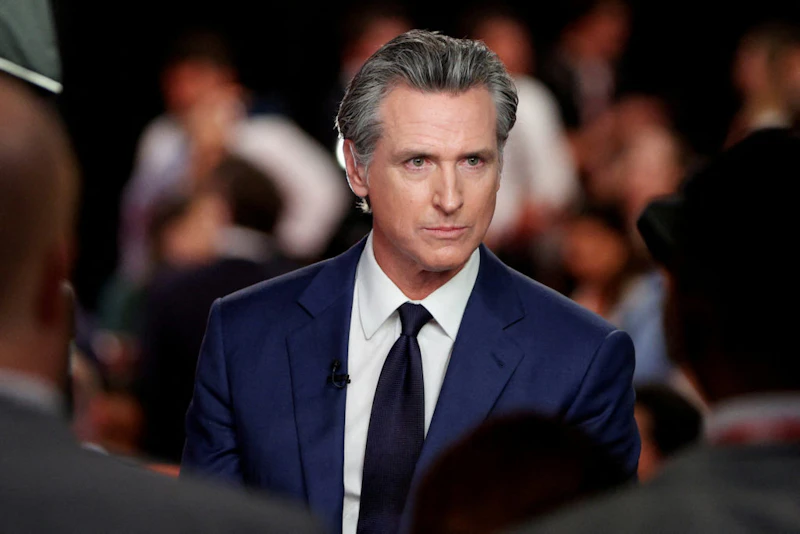
Gavin Newsom recently announced a new initiative addressing California's crisis of male disconnection and despair. Young men in California are dying by suicide at rising rates, and the ones still alive are increasingly checked out—out of work, out of school, out of options.
Newsom wants you to know he's on it. What he'd prefer you forget is who's been governing California for the past seven years. Newsom took office in 2019, at the precise moment the cultural war on masculinity was at its most confident and cruel. "Toxic masculinity" had completed its journey from gender studies seminar to institutional doctrine. Schools, HR departments, corporate training programs, and public health offices had absorbed it. California absorbed it fastest. Boys who fidgeted got flagged. Boys who competed got corrected. Boys who wanted to work with their hands got nudged toward a four-year degree they didn't want and couldn't afford. The message was unambiguous: maleness required management. Newsom wasn't observing this culture from a distance. His wife, Jennifer Siebel Newsom, made a documentary on toxic masculinity; he promoted it repeatedly. The man now convening summits on male purposelessness was, not long ago, helping market the idea that male nature was the problem.
California's education bureaucracy spent years redesigning schools around a philosophy that treated traditional male energy—competitive, physical, hierarchical, risk-seeking—as something to correct rather than channel. The results are now statistical. Boys fell behind in reading, and then graduation rates and college enrollment.
Meanwhile, the state's regulatory appetite strangled the trades. Licensing requirements, environmental restrictions, and construction costs made it progressively harder to build the kind of blue-collar economy where men without college degrees could find dignity and decent wages. Newsom's California celebrated the knowledge economy while making the working economy nearly impossible to navigate. California has 39 million residents and a construction sector so starved of skilled labor that contractor wait times stretch months and project costs routinely double. The state faces shortages of tens of thousands of electricians, plumbers, and carpenters—trades that have historically absorbed exactly the young men now showing up in his suicide statistics. His boast of 667,000 apprenticeships over seven years works out to roughly 95,000 a year in a state workforce of 18 million. It’s modest remediation, not transformation.
The housing crisis Newsom spent years failing to solve had a specific human shape: the young man priced out of the city where he grew up, relocated to somewhere cheaper and lonelier, cut off from the social ties that might’ve held him together. Rootlessness isn’t an abstraction. It’s a young man eating alone, working a job he got off an app, in a town where he knows nobody. California manufactured that condition at industrial scale.
Fentanyl found those men with devastating precision. Newsom's administration never resolved its own ambivalence—was open drug use a public health crisis requiring forceful intervention, or a symptom of poverty requiring tolerance and services? The equivocation cost lives, and disproportionately male ones. Men overdose at three times the rate of women, partly because men in freefall are less likely to ask for help and more likely to use alone, in the dark, where nobody finds them in time.
To be fair, Newsom didn't invent the cultural disdain for young men. He inherited a Democratic Party that had decided, somewhere around 2012, that men were the obstacle rather than the audience. The politics made a kind of short-term sense: women were a more reliable coalition, and catering to male grievance felt uncomfortably close to validating it. So the party that once organized around working-class men suddenly stopped speaking their language, stopped building programs around their needs, and occasionally implied that their struggles were the natural consequence of centuries of patriarchy settling its debts.
Newsom swam in that current. He governed at the height of it. Now the polling has moved. Young men broke hard for Republicans in 2024. The gender gap in party affiliation among under-30 voters became a canyon. Newsom, who has national ambitions, noticed. The executive order followed. The Sacramento convening followed. The press releases about suicide rates, lonely men, and purposeless youth followed.
The new initiative includes a Men's Service Challenge, expanded workforce training, and outreach on behavioral health. These aren’t bad. The cynicism isn't about the programs themselves. Rather, it’s about the governor who spent years funding the ideology that told boys their instincts were dangerous, their ambitions suspect, and their struggles self-inflicted—now presenting himself as the man with solutions.
Many of the lost, disillusioned young men Newsom now wants to save were educated in his schools, priced out of his cities, and swallowed by his drug crisis. He can hold all the summits he likes. But somewhere in California, a family is grieving a young man who needed help seven years ago and is no longer here to receive it.