
Steven Soderbergh has never been a conventional filmmaker, but the last decade has seen the once-prominent auteur doing some curious cinematic soul-searching. Soderbergh had a 15-year stretch after winning Best Director at the Academy Awards for Traffic where he could get any mid-budget film made, thanks to how many A-listers were willing to take pay cuts to work with him. Unfortunately, the middle fell out of Hollywood around the time that the streaming boom began, which forced Soderbergh to quickly drop into television. Despite a brief stint in 2013 in which he claimed to have retired from directing films, Soderbergh had worked at an alarming rate, with 11 films in less than 10 years.
This era of Soderbergh has seen the filmmaker utilize new technology, perspectives, and formats to tear down the pillars of cinema that every film student learned. The result’s a series of timely films about the narrowing world, each of which was augmented by some type of gimmick; for example, High Flying Bird explored the democratization of streaming whilst it debuted on Netflix, The Laundromat looked at globalization through the attention-span of a modern media consumer, Kimi used the Covid pandemic to make a story about surveillance, and Presence used voyeuristic, intimate cinematography to subvert a ghost story. They’re most interesting as formal exercises that stand out amidst the banal output of Soderbergh’s workmanlike peers.
Soderbergh’s the polar opposite of Quentin Tarantino, who’s said that he won’t make his 10th and final film until he can guarantee to end his career on a strong note. Although some have taken this as a sign of Tarantino’s unflappable ego, it’s distinguished him from the many “once great” directors whose credits have become dominated by mediocrity, such as Ridley Scott, Tim Burton, and Robert Zemeckis. Soderbergh hasn’t made any disasters on the level of Scott’s Exodus: Gods and Kings or Burton’s Dumbo, but it seemed unlikely that he’d ever make a masterpiece on the level of Out of Sight or Ocean’s Eleven again. The Christophers is not only the best film Soderbergh has made since 2017’s Logan Lucky, and a conversation about the sustainability of art. The technical wizardry in The Christophers is subdued, which is an act of defiance on Soderbergh’s part; if it’s often spectacle that has driven audiences to theaters, Soderbergh gambled that two interesting actors having intelligent conversations would be engaging on its own.
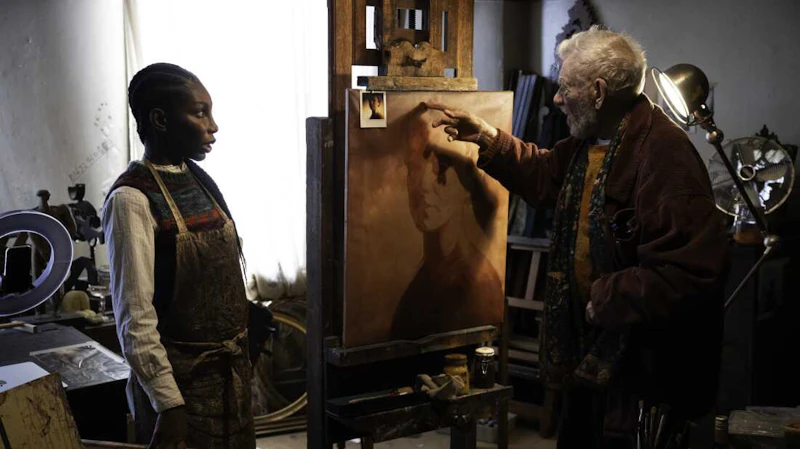
The Christophers is the story of Lori Butler (Mikaela Cole), a painter-turned-forger hired by the siblings Barnaby (James Corden) and Sallie Sklar (Jessica Gunning) to gain the confidence of their father, Julian (Ian McKellen), an artist who’s dying. Julian’s remaining paintings would have value if he bothered to finish them, and his children are aware that they’d be sitting on a fortune if his collection was to pass into their hands. Barnaby’s argument is that Lori isn't technically forging Julian’s work because she’s merely hired to complete his vision; it’s not a coincidence that this is the type of argument that is commonly used to justify the use of AI in creative fields. That Soderbergh has come out in favor of AI would seem counterintuitive to the message of The Christophers, but then again, he didn’t write the film; the sharp screenplay was penned by Ed Solomon, whose words are well-suited to the film’s stars.
Soderbergh’s primary fascination is with process, but The Christophers is only occasionally interested in art theory. The overarching idea is that the value of any creative endeavor can’t be quantified because its quality is intrinsically subjective; the Skylar siblings understand that their father’s name means something, regardless if he’s responsible for what it is used to endorse. At the same time, Lori has grown to idolize Julian, and has put far more thought into his more obscure work that he did at the time he created it. The most autobiographical aspect of the film is when Lori, serving as a spokeswoman for Soderbergh, is asked to consider the point in which refining becomes an original act of creation. Lori’s become so involved in restoring Julian’s work that it has transformed into something new, with its own identity; Soderbergh is renowned for remixing and reediting classical films, and most of his best work is some sort of homage.
There are some non-traditional angels used to capture the multi-faceted process of sketching and painting, but the magic trick in The Christophers is that Soderbergh’s engaged with his actors as performers, and not just chess pieces to move on his digital board. McKellen is among the great living actors who’s easy to take for granted, which is why he was perfectly suited to play an aging artist who has proven to be only slightly past his prime. McKellen’s character is such an open book that a steely presence was necessary to oppose him, and Cole’s performance is muted without being cold. Their characters are representative of the divergent strains of artistic philosophy; Julian came from a generation that was encouraged to be expressive, whereas Lori has been taught that there’s more value in being unreadable.
The Christophers is more interesting as an old-fashioned two-hander than a dark comedy of twists and turns, because most scenes that involve the Skylar siblings feel like a direct means for Soderbergh and Solomon to call out the various inept financiers they’ve been forced to take money from over the years. It may not take much for Corden to act like an out-of-touch, oafish buffoon, but being centered on a dogmatic character means the film has to simplify its intelligence to accommodate his characters. Nonetheless, The Christophers has more on its mind than the average “post-retirement” Soderbergh film. Should Soderbergh be able to slow down and make films like The Christophers, his legacy would be that of an artist who’s consistent, not just prolific.