
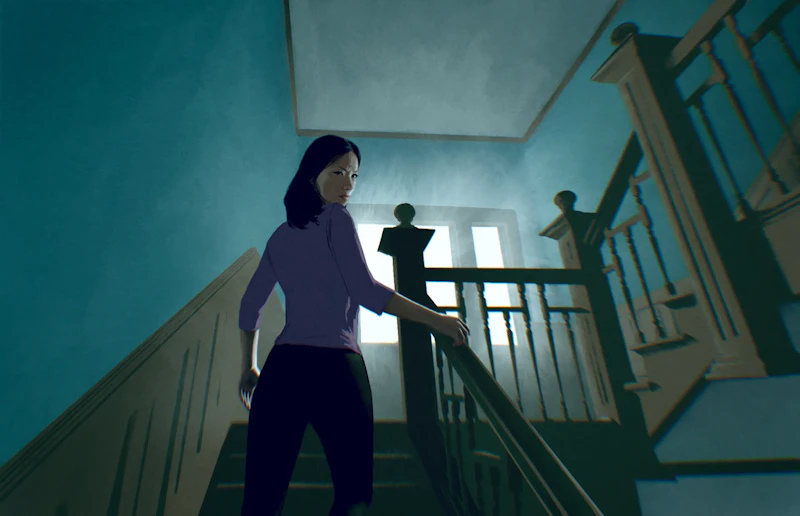
Some 35 years into his career, Steven Soderbergh directed his first horror movie. I like Soderbergh and like the horror genre, so I wish I could say that Presence (2024) was a highlight for both. Unfortunately, it’s a mostly pedestrian effort—Soderbergh’s usual skill can’t make up for the script’s very un-horror-like sentimentality, nor the derivative ideas.
The most derivative of those is the haunted house itself. The Payne family moves into a big, old residence where suddenly things start to move on their own. Daughter Chloe (Callina Liang) believes she’s haunted by the ghost of her friend Nadia, who asphyxiated from an overdose. Her father Chris (Chris Sullivan) is supportive; her high-powered snappish executive mom Rebekah (Lucy Liu) and her swim team dude-bro brother Tyler (Eddy Maday) are less so. It soon becomes clear that the spirit’s protecting Chloe from her creepy, control-freak, dealer boyfriend Ryan (West Mulholland) who keeps dosing people’s drinks.
The movie doesn’t use the found footage conceit, but it follows films like Paranormal Activity in evoking a feeling of constraint, claustrophobia, and paranoid intimacy through handheld camera work and a restricted setting—you never leave the house till the final shot. The viewpoint’s all from first-person perspective, and as Soderbergh (who doubled as the cinematographer) has said, “the camera’s the ghost.” Many of the shots are extended cuts, as the presence slides down halls, up stairs, into rooms, and settles in closets.
The ghost is living outside of time—but the movie’s presented in chronological order, as if Soderbergh couldn’t be bothered to follow through on his own high concepts. We also learn that the poltergeist is on the side of the angels, and while the film has its share of tragedy, the identification of director, camera, and ghost means the project is static and predetermined—like Soderbergh’s keeping you safe.
This is at odds with the usual horror genre, where the point is danger; Presence ends up as more a problem movie-of-the-week than a suspense thriller. It doesn’t help that the final twist is partly enabled by the previous underdevelopment of a key character, which lowers the emotional stakes. And the climax is irritatingly rushed.
Presence feels like Soderbergh wasn’t all that present—it’s dashed-off and half-assed, without much to say about horror, ghosts, grief, family dynamics, date rape, or any of the other themes or subjects it’s ostensibly engaging.
Which may be the point; Soderbergh said that he enjoyed the low-budget exercise because “The beauty of projects at this scale is I can just do them without having to talk to anybody.” For him, the movie was a chance to walk around a house with a camera and call it a movie.
That cheerful lack of ambition is key, I think, to both Soderbergh’s virtues and vices as a filmmaker. Unlike many of his peers—David Lynch, Tarantino, the Coen Brothers, De Palma—Soderbergh’s a director without much in the way of obsessions. He has some preferred genres (crime, arguably sexploitation), some preferred themes (sex, lies), some widely-shared influences (Hitchcock, Coppola, Orson Welles), and an interest in technical problems and solutions. But he holds all of those interests loosely; they’re what he plays with, rather than what consumes him, as Hitchcock consumes De Palma, or as the fundamental absurdity of existence consumes the Coen Brothers, or as special effects have consumed James Cameron.
This has allowed Soderbergh to pursue a stunningly varied career—from the intimate relationship drama of Sex, Lies and Videotape to a sprawling message picture like Traffic, from the determinedly optimistic Erin Brockovich to the bleak dead-end vision of The Good German. At its best, his shrug-and-a-camera approach to filmmaking can lead him to the glorious fuck-it nonsense of Schizopolis or the hyper-competent pulp of Kimi or Black Bag. At its worst, he unreflectingly picks up the ugliest aspects of the genres he inhabits, as in the viciously misogynist noir of Side Effects. Or else, as in Presence, he just forgets to bother to have anything worth saying.
When you show up to a Soderbergh film, you never know what you’re going to get. That can make his work an exercise in frustration. It can also make it a delight. It’s to his credit that, at the end of this Soderbergh series, I can still say that—despite clunkers like Presence—the delight predominates.