
If you want to see a movie in Baltimore City now, you have four options: The Charles, The Senator, Harbor East Cinemas, and Warehouse Cinemas Rotunda. Currently playing at all of them: Michael, The Devil Wears Prada 2, Project Hail Mary. All of them are on multiple screens, showing throughout the day; The Super Mario Galaxy Movie just ended its own reign. Great news for exhibitors, but for audiences, there’s hardly anything to see. The Charles is also currently playing Erupcja, Mother Mary, and The Christophers, and by the time of publication, Blue Film, Blue Heron, and Obsession will be enjoying their opening weekend there; but, as former Amazon Studios head Roy Price recently pointed out, “Domestic box office is up 12% YTD vs 2025 but down 25% vs 2019 (peak year). Movie releases are down 20% vs 2019. People see good movies in theaters when they are released, and releasing in theaters enhances a film’s streaming value. We need many more movies in theaters.”
More movies in theaters would produce movies that are more interesting; in 2002, 467 movies were released in American theaters, among them blockbusters (Spider-Man, Star Wars, The Lord of the Rings, Harry Potter), sleeper hits (My Big Fat Greek Wedding, Bowling for Columbine, 8 Mile), science fiction (Minority Report, Solaris), adult dramas (Road to Perdition, Catch Me If You Can new films by Martin Scorsese, Paul Thomas Anderson, Brian De Palma, Spike Lee, M. Night Shyamalan, Todd Haynes, Alexander Payne, and the kinds of comedies that have since gone extinct (Austin Powers in Goldmember, Orange County, The Sweetest Thing). Not to mention the movies that occupied the Oscars the following year, like The Hours, The Pianist, Chicago, and Adaptation, the best case for a saturated theatrical marketplace.
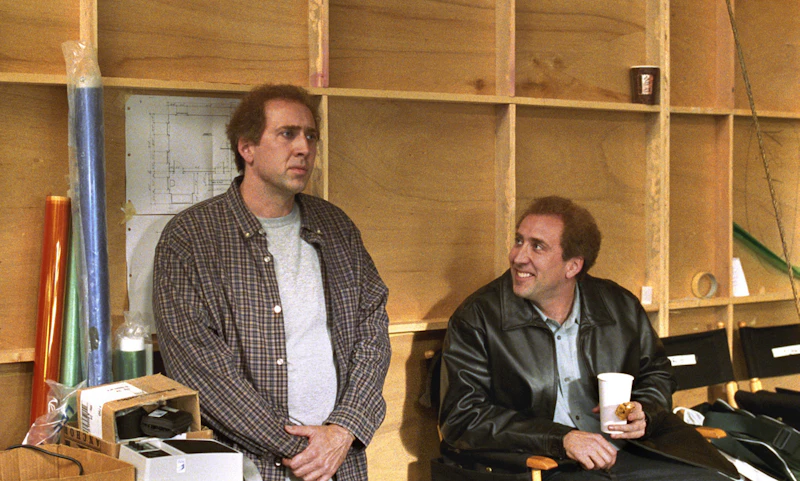
Adaptation, written by Charlie Kaufman and Donald Kaufman, follows Charlie (Nicolas Cage) as he struggles to adapt Susan Orlean’s The Orchid Thief into a coherent and meaningful screenplay. His brother Donald is free of the neuroses that strain Charlie constantly, something that’s established at the very beginning with an extraordinary monologue by Kaufman read by Cage as Kaufman played over black as the opening credits roll:
“Do I have an original thought in my head, my bald head? Maybe if I were happier, my hair wouldn’t be falling out. Life is short; I need to make the most of it. Today is the first day of the rest of my life. I’m a walking cliché. I really need to go to the doctor and have my leg checked. There's something wrong. Oh well. The dentist called again, I'm way overdue. If I stopped putting things off, I would be happier. All I do is sit on my fat ass, if my ass wasn’t fat, I would be happier. I wouldn’t have to wear these shirts with the tails out all the time; like that’s fooling anyone. Fat ass. I should start jogging again. Five miles a day; really do it this time. Maybe rock climbing; I need to turn my life around. What do I need to do? I need to fall in love. I need to have a girlfriend. I need to read more; improve myself. Maybe I should learn Russian or something. Or take up an instrument. I could speak Chinese. I could be the screenwriter who speaks Chinese and plays the oboe. That would be cool. I should get my hair cut short; stop trying to fool myself and everyone else into thinking I have a full head of hair. How pathetic is that? Just be real. Confident. Isn't that what women are attracted to? Men don’t have to be attractive. But that's not true, ''specially these days. There's almost as much pressure on men as there is on women these days. Why should I be made to feel like I should apologize for my existence? Maybe it's my brain chemistry. Maybe that’s what's wrong with me. Bad chemistry... all my problems and anxiety can be reduced to a chemical imbalance or some kind of misfiring synapses. I need to get help from them; but I'll still be ugly though. Nothing is going to change that.”
At his best, Kaufman manages to convey everything that Synecdoche, New York’s Caden Cotard can’t; that film, released in 2008, remains one of the most powerful I’ve ever seen, and its overwhelming and magnificent effect is only briefly visible in the films Kaufman wrote for Spike Jonze and Michel Gondry (never mind his 2020 novel Antkind, a 700-page rip-off of Philip Roth’s Sabbath’s Theater). The two films he’s written and directed since have been disappointing, not only compared to Synecdoche but lesser scripts like Confessions of a Dangerous Mind and Human Nature; his new film, Later the War, was shut down early last year due to lack of financing, although it’s recently started back up in Poland, and I look forward to it. Kaufman gets a lifetime pass for Being John Malkovich, Eternal Sunshine of the Spotless Mind, Synecdoche, and, to a lesser extent, Adaptation, a movie that can’t live up to its remarkable premise. Cage plays both Kaufman brothers, which an under-discussed meta-aspect of the film, considering it came out less than a decade into “split screen” comedies by Michael Keaton and Eddie Murphy; he visits the set of Being John Malkovich, released just there years earlier, and we get glimpses of John Cusack and Catherine Keener in character, along with cinematographer Lance Acord and Spike Jonze.
This effect—not a mirror or an echo, but something closer to holographic projection—is what sustains Adaptation through its otherwise amusing but relatively rote comedy of failure in Hollywood. Brian Cox, for example, is excellent as screenwriting guru Robert McKee (the real McKee picked Cox to play him). He’s the one who gets Kaufman out of his rut, and after months of writer’s block, he—and the movie—settle for a generic thriller ending.
While Kaufman tries and fails at everything in life, Susan Orlean (Meryl Streep) writes and recalls the times that inspired her book The Orchid Thief featuring John Larouche (Chris Cooper). She goes down to see him in Florida, but Kaufman can’t bring them together and make a romance like everyone tells him to. He decides to go to Florida to talk to Larouche, and after startling Larouche and Orlean in bed together, they go after Kaufman, nervous that news of their affair will leak. Kaufman, out of his depth, tries to get away, but Orlean ends up next to him with a gun. The close-up of the gun is hilarious, but the joke has nowhere left to go; unfortunately, the movie keeps going for another 20 minutes, exhausting a lot of goodwill and ultimately coming off as snotty and dumb. The flower montage at the end is quite nice, but you’re still so burned by the obvious joke run into the ground—this is how Hollywood insults your intelligence! Kaufman doesn’t come off as smug until the end, when all his neuroses lose whatever endearing qualities they might have had from the jump in that opening monologue.
Adaptation falls at the end of its high wire, but all’s forgiven now that practically zero American films are released with this much wit, invention, and intelligence. As much as Kaufman looks down on Hollywood thrillers and spectacles, he respects the audience’s intelligence and uses their complicity in pop culture to bring Adaptation to its greatest heights, however brief. Writing an “adaptation” of The Orchid Thief that’s actually a comic tragedy about the real screenwriter’s insecurities is signature Kaufman, but unlike his recent work, it depends on a certain level of audience engagement with several things other than the movie itself: Being John Malkovich, Susan Orlean, The New Yorker, the business of Hollywood, recognizably cliché endings and third acts. What passes for meta-fiction in contemporary Hollywood films is limited to the Marvel Cinematic Universe and other adolescent franchises.
When there’s not much to see, there’s not much to talk about, and the idea of the movies, kept alive by Americans for 120 years, is losing its focus and power. While it’s encouraging that people, from Roy Price to the man or woman on the street to you, dear reader, recognize that there’s a drought and something’s wrong, Hollywood only has so much time to correct course. The movies aren’t in danger of being supplanted by new media, as the surprising plateau of video games and (and the predictable failure of virtual reality) have proven, but as Generation Alpha grows closer to adulthood, and certainly Generation Beta (think they’re gonna keep that name?), collective memory and recognition of what the movies mean will fade past the point of saving.
A surplus cinema, like the boom year 2002, provides fertile ground for many kinds of films, but even more importantly, it sustains the parallel reality that makes people fascinated with movies in the first place. Budgets are still bloated with enormous salaries for actors, a vestige of a bygone era when a last name and a poster could guarantee millions and millions of dollars. Budgets need to be reconsidered, reconsolidated, and reduced; it’s time for a New Wave to announce itself and stir up and inspire the flat-footed and tenured. Will the next Charlie Kaufman please stand up?
—Follow Nicky Otis Smith on Twitter: @NARCFILM